Bladder Cancer Outcomes Favor Enfortumab–Pembrolizumab
Perioperative enfortumab vedotin plus pembrolizumab improved survival and pathologic complete response versus cisplatin–gemcitabine in cisplatin-eligible adults undergoing cystectomy.
 Written and medically reviewed byRayan SalihContributing writer · PharmD, RPh
August 19, 2026 · 7 min read
Survival gains strengthen the pathologic response result
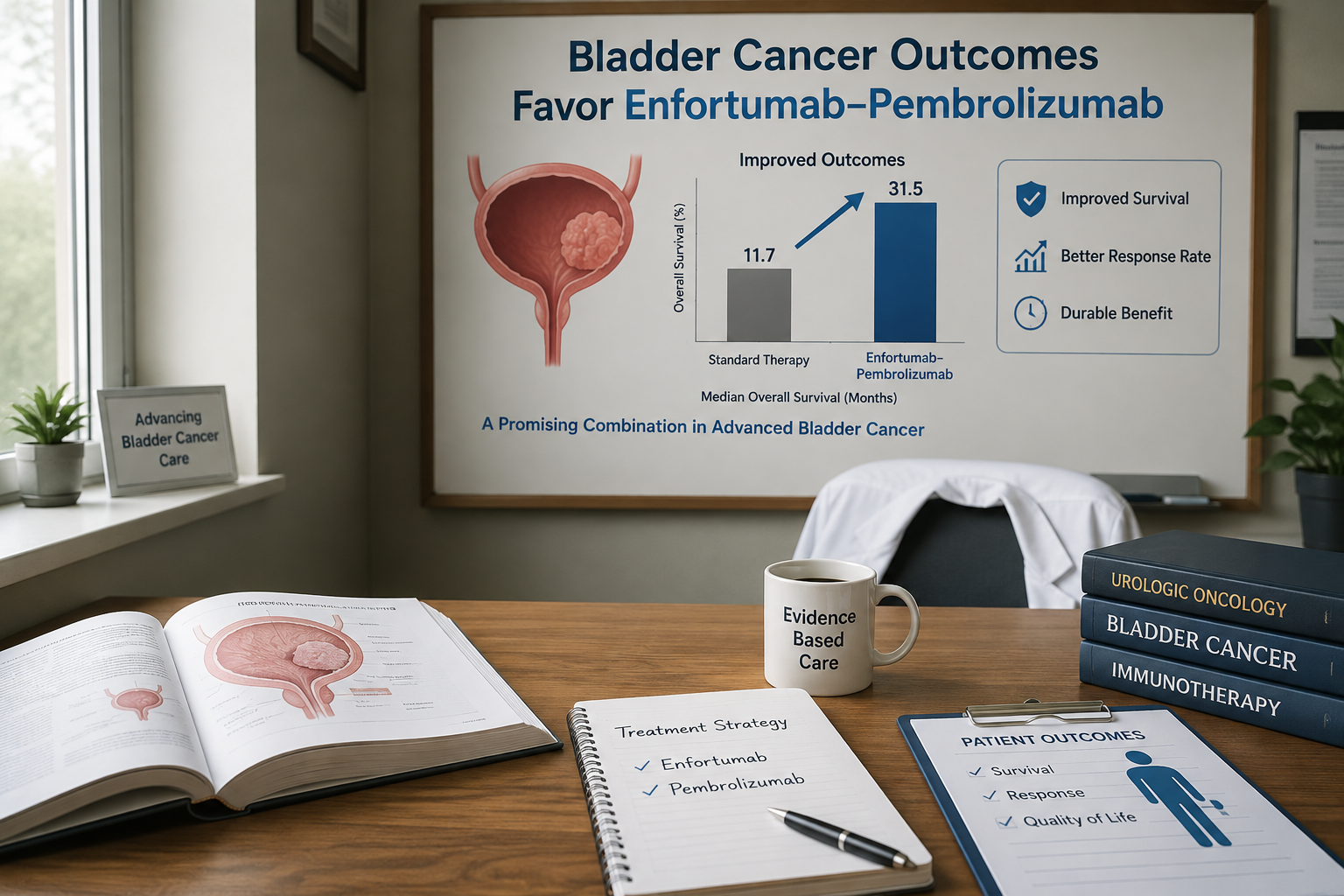
On a page in my notebook, three figures sit together: 0.40, 0.50 and 57.1%. They capture why this randomized phase 3 trial is likely to change conversations about treatment before and after bladder removal.
Perioperative enfortumab vedotin plus pembrolizumab produced better outcomes than neoadjuvant cisplatin–gemcitabine followed by radical cystectomy. The comparison goes beyond what surgeons found in the removed bladder. It includes evidence that patients lived longer without a major disease event and had a lower risk of death, which gives clinicians something more substantial than an encouraging response rate to discuss.
At a median follow-up of 25.6 months, event-free survival favored enfortumab vedotin plus pembrolizumab. The hazard ratio was 0.40, with a 95% confidence interval of 0.28 to 0.57 and P<0.00001. Overall survival also favored the experimental regimen, with a hazard ratio of 0.50, a 95% confidence interval of 0.33 to 0.74 and P=0.0002.
Neither group had reached median event-free or overall survival. At this point, the hazard ratios and the survival curves still taking shape tell us more than a median estimate would.
Pathologic complete response was 57.1% with enfortumab vedotin plus pembrolizumab and 34.6% with cisplatin–gemcitabine. The difference was 22.5 percentage points, with a 95% confidence interval of 15.4 to 29.6 and P<0.00001. In this trial, complete response meant no residual invasive or noninvasive tumor in the bladder or regional lymph nodes examined at surgery.
| Outcome | Enfortumab vedotin plus pembrolizumab | Cisplatin–gemcitabine | Comparative result |
|---|---|---|---|
| Event-free survival | Median not reached | Median not reached | HR 0.40; 95% CI 0.28–0.57 |
| Overall survival | Median not reached | Median not reached | HR 0.50; 95% CI 0.33–0.74 |
| Pathologic complete response | 57.1% | 34.6% | Difference 22.5 percentage points; 95% CI 15.4–29.6 |
That final percentage matters, but the first two numbers in the notebook carry more weight. Pathologic complete response is measured at one point, after the bladder and lymph nodes are removed, while event-free and overall survival follow what happens to patients afterward. The agreement among the endpoints makes it harder to dismiss the response result as an early finding that may not last.
A direct comparison in cisplatin-eligible disease
The study enrolled 784 adults with muscle-invasive urothelial bladder cancer who were eligible for cisplatin and radical cystectomy. Participants were randomly assigned to perioperative enfortumab vedotin plus pembrolizumab or standard neoadjuvant gemcitabine plus cisplatin, followed by surgery.
The distinction is important. These were not patients considered too frail for cisplatin, and the experimental combination was not tested against observation or a deliberately lighter treatment. It was tested against an established curative-intent option in people considered able to receive that option, which makes the result more directly relevant to the choice clinicians already face.
Treatment with enfortumab vedotin plus pembrolizumab extended across the operative period. The control strategy placed cisplatin-based chemotherapy before cystectomy. Surgery remained central in both groups.
Event-free survival counted consequential developments around and after surgery, including progression that prevented cystectomy, recurrence after surgery or death. Overall survival and pathologic complete response were key secondary outcomes. Nothing in the trial establishes that systemic therapy can replace cystectomy for a patient who appears to have responded before surgery.
The notebook page has no column marked “easier,” and it should not. Enfortumab vedotin can cause peripheral neuropathy, skin reactions and hyperglycemia. Pembrolizumab can produce immune-mediated adverse events involving multiple organs. Cisplatin–gemcitabine brings another set of risks, including myelosuppression, kidney injury, nausea, hearing damage and neuropathy.
A comparison of severe adverse-event rates alone would miss how differently those problems may matter to an individual patient.
How the evidence may change perioperative selection
For years, cisplatin eligibility has functioned as a major treatment fork. Patients who could receive it were generally offered neoadjuvant cisplatin-based combination chemotherapy before cystectomy, while trials and alternative strategies drew particular attention for those who could not.
This study unsettles that arrangement. Being eligible for cisplatin no longer means cisplatin–gemcitabine necessarily has the strongest comparative phase 3 evidence for that person.
The results support consideration of perioperative enfortumab vedotin plus pembrolizumab for adults who resemble the trial population, depending on FDA status, guideline incorporation, access and individual contraindications. The overall survival finding is especially persuasive because a lower risk of death cannot be reduced to better downstaging in the cystectomy specimen.
Selection will not be automatic. Baseline neuropathy, poorly controlled diabetes, a history of serious skin reactions, active autoimmune disease, organ transplantation or another concern about checkpoint inhibition may weigh against the combination. Adequate kidney function for cisplatin does not settle the choice in the other direction, either, and patients may place different value on competing toxicities or on the commitment of continuing treatment after surgery.
There is a practical side that survival curves do not show. An antibody–drug conjugate paired with a checkpoint inhibitor requires infusion capacity, toxicity monitoring and coordination among medical oncology, urology and the perioperative team, while its acquisition cost will differ substantially from generic chemotherapy. Payers and health systems will have to consider the survival benefit beside total treatment duration, management of adverse events and uneven access.
The figures in my notebook do not support delaying cystectomy while waiting to see whether imaging looks better. They do not support omitting surgery after an apparent complete response. Pathologic complete response was determined from cystectomy specimens, and bladder-preserving use would need its own prospective evidence, surveillance plan and pathway to salvage surgery.
Important uncertainties and limitations
A median follow-up of 25.6 months is still short for a curative-intent bladder cancer trial. The overall survival difference is statistically significant, yet longer observation is needed to understand whether the benefit holds, how late recurrences appear and what happens with persistent neuropathy, delayed immune toxicity and quality of life.
The trial was open label. That design can affect treatment discontinuation, supportive care and some decisions made by clinicians, although it is less likely to account for an overall survival difference.
Generalizability also has boundaries. The participants had been selected for cisplatin eligibility and cystectomy, so the results cannot be assumed to apply in the same way to frailer adults, people with major organ dysfunction, patients with clinically node-positive or metastatic disease, or those pursuing bladder preservation.
The control arm does not resolve every current sequencing question. In particular, investigators did not directly compare enfortumab vedotin plus pembrolizumab with cisplatin-based neoadjuvant chemotherapy followed by response-adapted or risk-adapted adjuvant immunotherapy. The study establishes superiority over the cisplatin–gemcitabine pathway that was tested, not over every multimodality sequence now used in practice.
The study was sponsored by industry, and financial relationships were reported. Independent follow-up, mature patient-reported outcomes and evidence from routine care will be needed to show how tolerability, completion rates, equity and value look beyond specialized trial centers. I put a question mark beside “25.6 months” in the notebook and left it there.
Questions clinicians ask
Should cisplatin-eligible patients still routinely receive cisplatin–gemcitabine?
The results weaken cisplatin eligibility as the lone reason to default to cisplatin–gemcitabine. Enfortumab vedotin plus pembrolizumab improved event-free survival, overall survival and pathologic complete response in the phase 3 comparison. Regulatory status, guidelines, neuropathy, metabolic risk, immune contraindications, access and patient preference still shape the decision.
Can cystectomy be omitted after a strong clinical response?
No. Patients in both groups proceeded toward radical cystectomy, and pathologic complete response was determined from surgical tissue. This trial informs the choice of systemic therapy around cystectomy. It did not test replacement of surgery with imaging, cystoscopy or a clinical response assessment.
Does the overall survival result make pathologic complete response irrelevant?
No. Pathologic complete response remains useful as a measure of treatment activity and may inform postoperative risk discussions. Survival carries greater clinical weight here because it shows that the advantage extended beyond whether tumor remained in the bladder and regional lymph nodes at surgery.
What should be discussed before choosing the regimen?
The conversation should include the survival evidence, expected treatment duration, timing of surgery and the regimens’ different toxicity profiles. Baseline neuropathy, diabetes, skin disease, autoimmune conditions, kidney function, hearing, marrow reserve and the ability to complete postoperative treatment may affect the balance between enfortumab vedotin–pembrolizumab and cisplatin-based chemotherapy. At the bottom of the notebook page, beneath 57.1% and 34.6%, there is still an empty line.
Questions people ask
Did enfortumab vedotin plus pembrolizumab improve survival before bladder cancer surgery?
Yes. In this trial, the combination reduced the risks of a major disease event and death compared with cisplatin–gemcitabine, while also producing more pathologic complete responses. I read the agreement across these outcomes as stronger evidence than the response result alone.
Can cystectomy be skipped after a complete response to enfortumab vedotin plus pembrolizumab?
No such conclusion was tested. Patients proceeded toward radical cystectomy, and complete response was established by examining tissue removed during surgery. The study evaluated systemic treatment around cystectomy, not replacement of surgery.
What are the main limitations and risks of enfortumab vedotin plus pembrolizumab?
Follow-up was still relatively short, the trial was open label and its findings may not extend to frailer patients or those pursuing bladder preservation. Enfortumab vedotin can cause neuropathy, skin reactions and hyperglycemia, while pembrolizumab can cause immune-mediated problems. The story also notes cost, access and treatment coordination concerns.
References
1. Perioperative Enfortumab Vedotin plus Pembrolizumab in Muscle-Invasive Bladder Cancer — The New England Journal of Medicine, 2026 2. Perioperative Enfortumab Vedotin Plus Pembrolizumab Versus Neoadjuvant Gemcitabine and Cisplatin in Muscle-Invasive Bladder Cancer — ClinicalTrials.gov, 2021 3. Bladder Cancer Treatment (PDQ)–Health Professional Version — National Cancer Institute, 2026
One story a day
The story of the day, in your inbox
One health journey each morning — no advice, no alarm, just company for the road.