Efgartigimod Builds a Pediatric Track Record in Myasthenia Gravis
ADAPT Jr data show 80% of adolescent gMG patients achieved minimal symptom expression by cycle two with efgartigimod at AAN 2026.
 Written and medically reviewed byRayan SalihContributing writer · PharmD, RPh
April 28, 2026 · 7 min read

AAN 2026 ADAPT Jr results show efgartigimod produces consistent, deepening responses in adolescents with gMG, with 80% reaching minimal symptom expression by cycle two.
Results from the ADAPT Jr study, presented at the 2026 AAN Annual Meeting by argenx, showed that efgartigimod alfa (Vyvgart) produced consistent and repeatable improvements in patients with generalized myasthenia gravis (gMG) between the ages of 12 and 17, with response rates that tracked closely with those seen in the adult gMG trials.
Why It Matters
In ADAPT Jr, 72.7% of adolescent participants achieved minimal symptom expression (MSE) in cycle one of treatment. That figure increased to 80% in cycle two, a pattern of deepening response with repeated cycles that mirrors what has been observed in the adult ADAPT studies. Improvements in MG-ADL scores were described as consistent and repeatable across cycles, supporting the durability of the treatment effect in this age group. Argenx also announced that enrollment of a younger pediatric cohort below age 12 is ongoing, extending the program further down the age spectrum.
What the Research Says
Based on the results shared at the 2026 American Academy of Neurology (AAN) Annual Meeting, the ADAPT Jr study focuses on the use of Vyvgart (efgartigimod) in pediatric patients with generalized myasthenia gravis (gMG).
The key findings and status of the ADAPT Jr study include:
- Efficacy in Adolescents: Adolescent participants (ages 12–17) showed consistent and repeatable improvements in Myasthenia Gravis Activities of Daily Living (MG-ADL) scores across multiple treatment cycles.
- Minimal Symptom Expression (MSE): A high percentage of adolescent patients achieved minimal symptom expression, a state in which the disease has little to no impact on daily life.
- Cycle 1: 72.7% of participants reached MSE.
- Cycle 2: 80% of participants reached MSE.
- Broadening Patient Reach: Data from ADAPT Jr, along with the ADAPT SERON and OCULUS trials, are being used to support VYVGART’s potential as a biologic therapy effective across diverse MG subtypes and age groups.
- Ongoing Research: While results for the adolescent cohort have been presented, the study is ongoing with the enrollment of a younger pediatric cohort.
- Safety Profile: No new safety signals were identified in the pediatric population, and the drug was generally well tolerated, consistent with the profile observed in adult gMG patients.
Who It Affects
Patients
Myasthenia gravis in adolescents is rare but not vanishingly so, and the absence of approved targeted biologics for this age group has historically meant reliance on immunosuppressants with significant long-term toxicity profiles. For planning, adolescent data arrive in the context of a condition in which early diagnosis is often delayed, and the impact on school, physical activity, and quality of life is substantial. An FDA approval in the adolescent population would create a new specialty pharmacy category for pediatric rare neuroimmune disease, for which most plans have not yet built a formulary and utilization-management infrastructure to accommodate it.
Understanding Myasthenia Gravis (MG) in Children
Myasthenia Gravis (MG) is a chronic autoimmune disorder that disrupts the communication between nerves and muscles, leading to muscle weakness. In children, this condition manifests in three primary forms: Transient Neonatal MG, Juvenile MG, and Congenital Myasthenic Syndromes.
Types and Symptoms
- Transient Neonatal MG: Occurs in infants born to mothers with MG. Symptoms such as poor sucking and weak crying typically resolve within weeks as maternal antibodies fade.
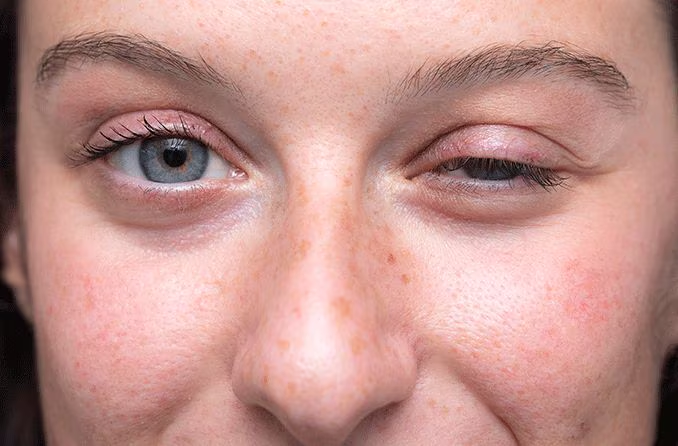
- Juvenile MG: The most common autoimmune form in children. It often begins with drooping eyelids (ptosis) or double vision. Over time, it can progress to generalized weakness in the arms, legs, and muscles used for swallowing or breathing.
- Congenital Myasthenic Syndromes: Rare, genetic (non-autoimmune) forms present at birth that require lifelong management.
A hallmark of MG is that weakness often fluctuates. Symptoms may be mild in the morning but worsen after activity or later in the day. Many children eventually develop generalized weakness affecting limb and bulbar muscles, leading to difficulties with swallowing (dysphagia), speaking (dysphonia), and, in severe myasthenic crises, breathing.
Diagnosis and Treatment
Diagnosis typically involves blood tests for specific antibodies, nerve conduction studies, or a Tensilon test to observe immediate muscle improvement. While there is no cure, various treatments help manage the condition:
- Medications: Anticholinesterase inhibitors (such as pyridostigmine) to improve neuromuscular signaling and immunosuppressants to reduce antibody production.
- Thymectomy: Surgical removal of the thymus gland, which can lead to long-term remission in some juvenile cases.
- Emergency Care: In severe “myasthenic crises,” respiratory support via a ventilator may be necessary.
With early diagnosis and a personalized care plan, most children with MG can lead active, fulfilling lives.
Therapy management
Adequate therapy management requires a multidisciplinary team to address the child’s developmental and medical needs.
- First-line Therapy: Acetylcholinesterase inhibitors (e.g., Pyridostigmine) provide symptomatic relief by improving nerve-muscle communication.
- Immunosuppression: Corticosteroids are effective but carry risks for children, including growth failure and increased susceptibility to infections. Steroid-sparing agents like Azathioprine or Mycophenolate Mofetil (MMF) are often added to reduce long-term steroid use.
- Thymectomy: Surgical removal of the thymus gland is recommended for many postpubertal, seropositive children to increase remission rates, though its use in prepubertal children remains more cautious.
- Emergency Care: Plasma exchange and IVIG are typically reserved for preparing for surgery or managing a myasthenic crisis.
Key Differences in Children
While JMG shares features with adult MG, it presents unique challenges and characteristics in pediatric patients:
- Prepubertal Onset: Children who develop MG before puberty often have a higher prevalence of ocular symptoms (isolated to the eyes) and a lower frequency of detectable acetylcholine receptor (AChR) antibodies.
- Remission Rates: Prepubertal children have a significantly higher probability of achieving spontaneous remission compared to adolescents and adults.
- Epidemiology: JMG is more common in Asian populations than in Caucasian populations, with up to 50% of Chinese MG cases presenting in childhood.
Managed Care and Payers
Managed care organizations that cover adolescent members with rare autoimmune neuromuscular conditions have new data to process. The long-term prognosis for children with JMG is generally good. With better diagnostic tools and a wider range of effective therapies, most pediatric patients can achieve significant improvement or remission.
What Changes
Plans managing pediatric specialty drug spend should expect clinical criteria challenges to center on diagnostic confirmation, specialist supervision requirements, and age-appropriate severity thresholds, as the instruments validated in adults may require adaptation for adolescent use.
Impact of Innovation
The ADAPT Jr results signify a paradigm shift in the treatment landscape for pediatric generalized myasthenia gravis (gMG). Historically, pediatric patients relied on broad-spectrum immunosuppressants with significant long-term toxicity, including growth failure and increased susceptibility to infections. The new data introduces several critical changes:
- Shift to Targeted Biologics: The study demonstrates that efgartigimod (Vyvgart) is highly effective in adolescents (ages 12–17), with 80% reaching minimal symptom expression by the second treatment cycle. This offers a targeted alternative to traditional, high-risk steroids.
- Consistency Across Ages: The data confirm that adolescent response rates track closely with those in adult trials, indicating that the treatment effect is consistent and repeatable across age groups.
- Infrastructure Requirements: Potential FDA approval necessitates that managed care organizations build new specialty pharmacy categories and utilization-management infrastructures specifically for pediatric rare neuroimmune diseases.
- Expanding Research Focus: The successful adolescent data has prompted a further descent along the age spectrum, with ongoing enrollment of a younger pediatric cohort under age 12.
- Improved Quality of Life: By providing a durable treatment that mirrors adult outcomes, the management of gMG can shift from merely surviving myasthenic crises to achieving a state in which the disease has little to no impact on school, physical activity, and overall development.
This evolution moves pediatric MG care away from managing side effects and toward proactive, biologic-driven remission.
Additional Ongoing Research
The ADAPT Jr SC study is an ongoing clinical research trial (Phase 2-3) evaluating the safety and efficacy of efgartigimod PH20 SC, a subcutaneous injection, in children and adolescents living with generalized myasthenia gravis (gMG).
The following key details are provided by the study overview:
Study Objective & Status
- Purpose: The study is designed to assess how the investigational drug works (efficacy) and its safety profile in pediatric patients.
- Status: To date (April 2026), the study is recruiting participants.
- Investigational Drug: The drug is administered as an injection under the skin (subcutaneous). It is not yet approved by regulatory agencies for pediatric use.
Participant Eligibility
- Age Range: Generally between 2 and 18 years old (specifically 12 to 18 years old for participants in the U.S.).
- Diagnosis: Participants must have a confirmed diagnosis of generalized myasthenia gravis (gMG).
Study Timeline & Process
The study is divided into three distinct phases:
- Screening (Up to 2 weeks): The study team evaluates whether the child meets all necessary eligibility criteria.
- Treatment (4 weeks): The investigational drug is administered once weekly for a total of 4 doses. During this time, the child continues their standard gMG therapy.
- Follow-up (Approximately 8 weeks): After the final dose, the study team monitors the child’s safety through physical check-ups, blood work, urine tests, and health questionnaires.
Additional Opportunities
Extension Study: Participants who complete the ADAPT Jr SC study may have the option to enroll in an open-label extension safety study to continue receiving the investigational drug while being monitored.
References
- argenx SE. argenx brings neuromuscular leadership to AAN 2026 with new data supporting broader Vyvgart use across MG and CIDP. GlobeNewswire. April 18, 2026. https://www.globenewswire.com/news-release/2026/04/18/3276554/0/en/argenx-Brings-Neuromuscular-Leadership-to-AAN-2026-with-New-Data-Supporting-Broader-VYVGART-Use-Across-MG-and-CIDP.html
- https://clinicaltrials.gov/study/NCT06392386
- https://www.stanfordchildrens.org/en/topic/default?id=myasthenia-gravis-mg-in-children-90-P02612
- Finnis MF, Jayawant S. Juvenile myasthenia gravis: a paediatric perspective. Autoimmune Dis. 2011;2011:404101. doi:10.4061/2011/404101
- https://clinicaltrials.argenx.com/adaptjrsc#aboutgMG
One story a day
The story of the day, in your inbox
One health journey each morning — no advice, no alarm, just company for the road.