FDA Expands Anktiva Plus BCG Approval to Papillary-Only Bladder Cancer
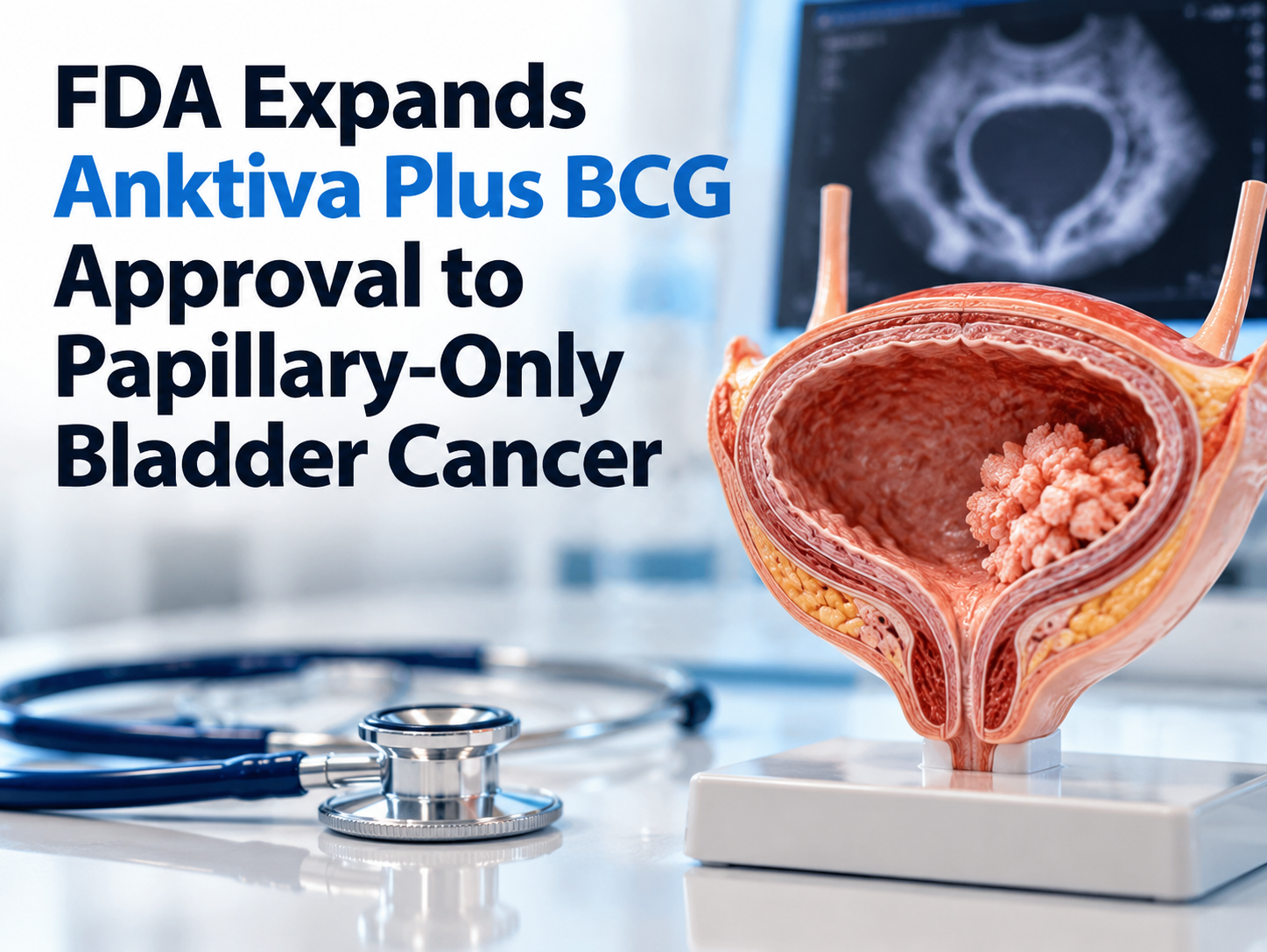
The FDA expanded Anktiva plus BCG to adults with BCG-unresponsive, high-grade papillary-only non–muscle-invasive bladder cancer, adding a bladder-preserving option for this underserved group.
 Written and medically reviewed byDr. Abu BakarContributing writer · PharmD, PhD (Pharmacology)
October 22, 2026 · 7 min read
The indication closes a regulatory gap
The October 14, 2026, decision extends the US indication for intravesical nogapendekin alfa inbakicept-pmln used with Bacillus Calmette-Guérin, or BCG. Its earlier approval covered BCG-unresponsive non–muscle-invasive bladder cancer with carcinoma in situ, with or without papillary tumors. The expansion reaches patients whose disease consists of high-grade papillary tumors without concomitant carcinoma in situ.
That distinction matters. Clinical trials and regulatory pathways have often centered on carcinoma in situ because a complete response can be measured through cystoscopy, cytology and biopsy. Papillary-only disease instead requires complete endoscopic resection before treatment, followed by measurement of whether high-grade disease returns. Until this decision, no FDA-approved therapy was specifically indicated for the BCG-unresponsive papillary-only population.
Eligible adults have high-grade Ta or T1 non–muscle-invasive urothelial carcinoma that meets the regulatory definition of BCG-unresponsive disease and has no accompanying carcinoma in situ. They must not have muscle-invasive, locally advanced or metastatic disease. Accurate staging is therefore foundational: visible papillary tumors should be resected, muscularis propria should be assessed when clinically appropriate, and T1 disease may require repeat transurethral resection to exclude understaging.
BCG-unresponsive is not interchangeable with any recurrence after BCG. For high-grade papillary disease, it generally describes persistent or recurrent high-grade Ta or T1 cancer within the specified interval after adequate BCG exposure. Clinicians should document the induction and maintenance or repeat-induction courses, pathology, resection dates and recurrence timing against the current FDA labeling rather than relying on the broader term “BCG failure.”
Evidence came from a nonrandomized bladder-preservation study
The supporting QUILT-3.032 study was an open-label, multicenter, single-arm trial of nogapendekin alfa inbakicept-pmln plus BCG in adults with BCG-unresponsive non–muscle-invasive bladder cancer. Participants entered separate cohorts according to whether carcinoma in situ was present. The papillary-only cohort included patients with completely resected high-grade Ta or T1 disease and no carcinoma in situ.
Because the study had no randomized control arm, it compared observed outcomes with a prespecified efficacy threshold rather than with BCG alone, cystectomy or another drug. The primary clinically relevant outcome for papillary-only disease was disease-free survival: remaining free of recurrent high-grade non–muscle-invasive disease, progression or other protocol-defined failure.
In the published primary report, 71 patients were included in the papillary-only efficacy analysis. Median disease-free survival was 23.6 months, with a 95% confidence interval extending from 7.8 months to not reached at the analysis cutoff. Estimated disease-free survival remained close to one-half at two years.
| Outcome in the papillary-only cohort | Estimate | 95% confidence interval |
|---|---|---|
| Disease-free survival at 12 months | 55.4% | 42.0% to 66.8% |
| Disease-free survival at 18 months | 53.0% | 39.1% to 65.0% |
| Disease-free survival at 24 months | 48.6% | 34.5% to 61.3% |
| Median disease-free survival | 23.6 months | 7.8 months to not reached |
Most patients in the published analysis avoided cystectomy during the reported follow-up. That is clinically meaningful but should not be interpreted as proof that the regimen improves survival or is equivalent to surgery. Cystectomy avoidance is influenced by patient preference, surgical fitness, clinician recommendations and follow-up duration as well as treatment activity.
Nogapendekin alfa inbakicept-pmln is an interleukin-15 receptor agonist designed to stimulate natural killer cells and T cells. It is given intravesically with BCG, not as stand-alone systemic immunotherapy. Treatment scheduling, maintenance and management of interruptions should follow the current prescribing information because the expanded indication does not justify extrapolating a regimen from another intravesical product.
What changes in treatment planning
The decision creates a labeled nonsurgical pathway for a group previously managed through repeat endoscopic procedures, additional intravesical therapy without a specific FDA indication, clinical trials or radical cystectomy. It also makes precise pathology more consequential. A patient with papillary-only high-grade disease now falls within a distinct indication, whereas detection of carcinoma in situ places the patient within the existing carcinoma-in-situ indication.
This option does not displace timely radical cystectomy for every patient. BCG-unresponsive T1 disease, lymphovascular invasion, variant histology, prostatic urethral involvement and other very-high-risk features can signal a greater likelihood of progression or occult muscle invasion. For surgically fit patients with such findings, discussion of cystectomy remains essential. Delaying potentially curative surgery while repeatedly treating biologically aggressive disease can carry harm.
For patients who seek bladder preservation, are poor surgical candidates or decline cystectomy after informed counseling, the approval allows clinicians to discuss an FDA-reviewed regimen supported by prospective data. Planning should include a clear surveillance schedule and predefined triggers for re-biopsy, upper-tract evaluation, treatment discontinuation or renewed surgical referral. A bladder-preserving choice is not a lower-intensity surveillance choice.
The expansion may also affect coverage and pathway development. Payers and health systems can now distinguish labeled use in papillary-only disease from off-label intravesical treatment. Documentation will remain important because a history of BCG exposure alone does not establish eligibility; the adequacy, timing and high-grade nature of the recurrence all matter.
Important uncertainties remain
The principal limitation is the single-arm design. Without randomization, the study cannot establish that nogapendekin alfa inbakicept-pmln plus BCG is superior to another bladder-preserving regimen or produces outcomes comparable with radical cystectomy. Cross-trial comparisons are especially unreliable because studies use different definitions of adequate BCG, disease-free survival, treatment failure and censoring.
The papillary-only cohort was modest in size, producing wide confidence intervals at later time points. Patients treated in a clinical trial may also have more standardized resection, pathology review and surveillance than patients in routine practice. Longer follow-up is needed to define durability, progression to muscle-invasive disease, metastasis, cancer-specific survival and the consequences of cystectomy performed after treatment failure.
The study was sponsored by the product’s manufacturer, and investigators reported relevant financial relationships. Regulatory review provides an independent assessment of the submitted evidence, but postmarketing experience and additional comparative research will be important for placing this regimen among other bladder-preserving strategies.
Questions clinicians ask
Does any high-grade recurrence after BCG qualify?
No. Eligibility depends on high-grade Ta or T1 papillary disease recurring or persisting within the label-defined interval after adequate BCG. Clinicians should verify prior dose delivery, treatment dates, pathology and the absence of carcinoma in situ rather than using “BCG failure” as a substitute for the regulatory definition.
Must visible papillary disease be removed first?
The evidence applies to patients whose visible papillary tumors were completely resected before intravesical treatment. Residual tumor, incomplete staging or absent muscle in a high-risk specimen should prompt further evaluation because the regimen was not studied as a replacement for adequate transurethral resection.
Is the regimen an alternative to cystectomy for T1 disease?
It is an FDA-approved bladder-preserving option, but the single-arm evidence does not show equivalence to radical cystectomy. Patients with T1 disease require careful restaging and risk assessment, with explicit discussion of progression risk and the potential consequences of postponing surgery.
How should response be assessed without carcinoma in situ?
Papillary-only disease is followed for recurrence rather than a carcinoma-in-situ complete response. Surveillance relies on cystoscopy, cytology, indicated biopsy and assessment for upper-tract or progressive disease, using the current label and established high-risk non–muscle-invasive bladder cancer follow-up practices.
References
1. FDA Approves First Treatment for Certain People With BCG-Unresponsive Bladder Cancer — US Food and Drug Administration, 2026 2. IL-15 Superagonist NAI in BCG-Unresponsive Non–Muscle-Invasive Bladder Cancer — NEJM Evidence, 2023 3. QUILT-3.032: Intravesical BCG in Combination With N-803 in Patients With Non–Muscle-Invasive Bladder Cancer — ClinicalTrials.gov, 2026
One story a day
The story of the day, in your inbox
One health journey each morning — no advice, no alarm, just company for the road.