Monoclonal Antibodies for Hyperlipidemia: How PCSK9 Inhibitors Lower LDL Cholesterol
Monoclonal antibodies that target the PCSK-9 protein are now part of routine discussions about managing high cholesterol (hyperlipidemia).
 Written and medically reviewed byDr. Abu BakarContributing writer · PharmD, PhD (Pharmacology)
August 2, 2026 · 8 min read
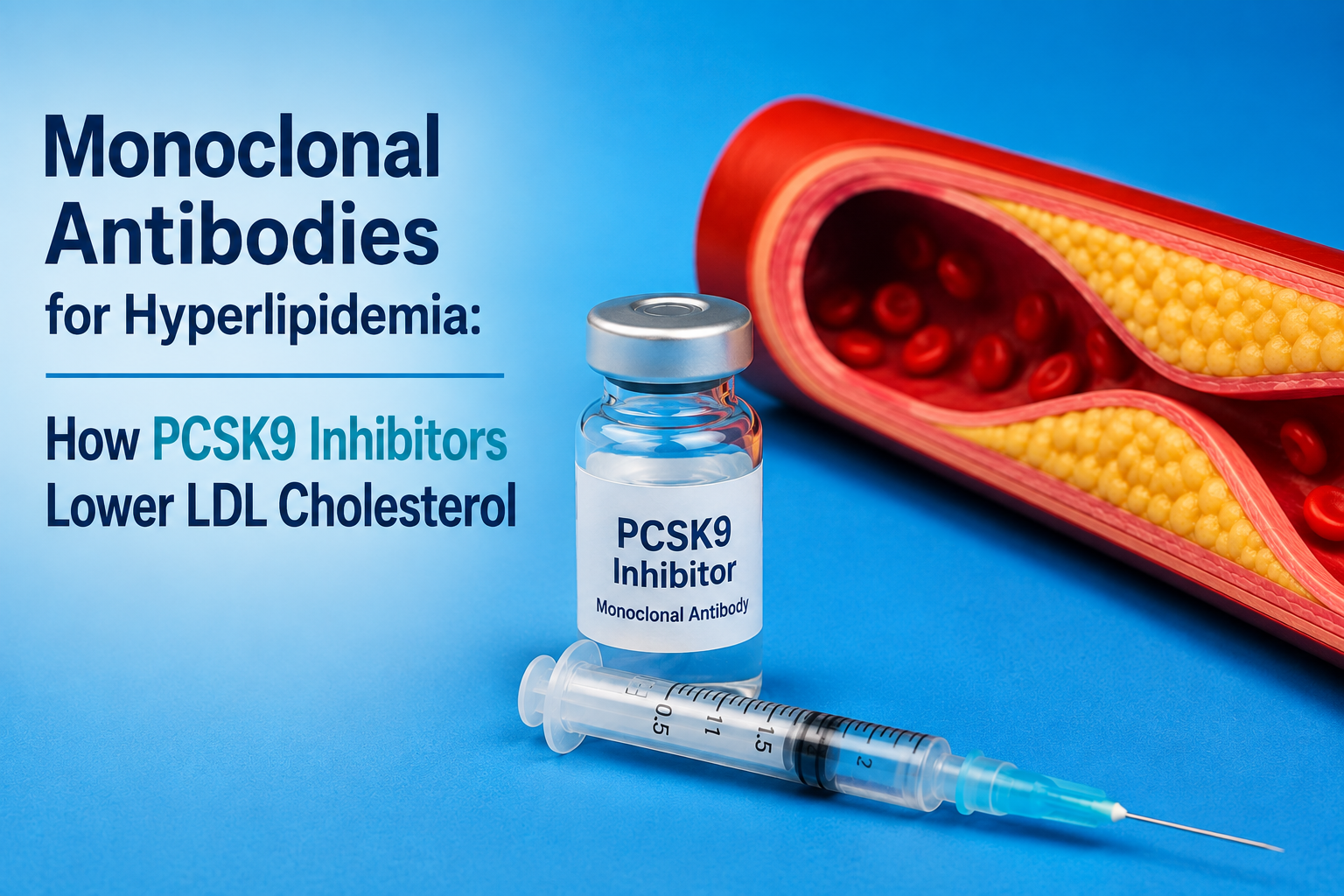
Monoclonal antibodies that target the PCSK-9 protein are now part of routine discussions about managing high cholesterol (hyperlipidemia). These new biologic drugs work differently from statins to lower LDL (“bad” cholesterol). By blocking PCSK-9, they preserve the liver’s LDL receptors, allowing more LDL to be cleared from the blood. This means more patients can reach cholesterol targets that statins alone couldn’t achieve. In practice, PCSK-9 inhibitors give doctors and patients another powerful tool to reduce long-term risk of heart disease and stroke. They are so effective that current heart health guidelines now include them for certain very-high-risk patients.
Why It Matters
Statins have been the cornerstone of cholesterol care for decades because they prompt liver cells to pull more LDL out of the bloodstream. But statins aren’t perfect for everyone. Some people on the strongest statin doses still fall short of their LDL goals, and others stop statins because of side effects like muscle aches or liver enzyme changes. There’s also a group of patients (such as those with familial hypercholesterolemia) who start life with very high LDL levels and need more help than statins can provide.
Enter the PCSK-9 inhibitors: these monoclonal antibodies neutralize the PCSK-9 protein, which normally marks LDL receptors for destruction. With PCSK-9 out of the way, LDL receptors stick around on the liver cell surface longer and clear more LDL from circulation. The result is often a very large LDL drop, frequently around 50% or more on top of what statins achieve. These big LDL reductions matter because LDL cholesterol is a central, modifiable driver of heart attacks and strokes. In fact, large clinical trials have found that adding a PCSK-9 antibody to statin therapy leads to further reductions in heart attacks and strokes for high-risk patients. So these drugs aren’t just improving lab numbers; they translate into real prevention of future cardiovascular events.
However, bringing these new drugs into practice has exposed real trade-offs. Unlike a pill, PCSK-9 drugs come as injectable biologics (given by subcutaneous injection every few weeks). They also cost thousands of dollars a year, far more than generic statins. This creates extra steps in care: clinics need workflows for patient education on injections, pharmacies and insurers need to handle complex prior authorizations, and doctors must plan regular follow-up. And since PCSK-9 inhibitors are relatively new (approved in the last decade), their long-term use in practice isn’t as well-established as decades of statin experience. Clinicians and patients therefore must weigh the immediate benefit of lower LDL against uncertainties about sticking with shots, tracking long-term safety, and the economics of long-term therapy. These are practical issues in everyday care, not just theoretical concerns.
Who It Affects
Several groups of patients stand to benefit most from PCSK-9–targeted monoclonals. First are people who have already had a cardiovascular event (like a heart attack or stroke) and still have high LDL despite being on statins. Guidelines for these patients are very aggressive about lowering LDL, and adding a PCSK-9 antibody can be lifesaving by preventing another event. Second are patients with familial hypercholesterolemia – an inherited condition that causes very high LDL from a young age. These people often need treatments beyond statins to reduce their lifelong heart risk, and PCSK-9 inhibitors are a key option. Third are patients who truly cannot tolerate statins due to side effects; for them, PCSK-9 antibodies offer an effective non-statin alternative to lower LDL.
Beyond individual patients, the broader healthcare system is affected too. Cardiologists and primary care doctors must learn new criteria for who should get these drugs, how to handle injections, and how to monitor cholesterol response. Nurses and pharmacists need training in teaching patients to self-inject and to manage storage and handling of these medications. Health systems have to develop protocols for keeping these biologics in stock and handling insurance approvals. On the payer side, insurance companies and pharmacy benefit managers must decide who qualifies for coverage and how to manage authorizations without delaying treatment. All of these decisions ultimately shape who ends up getting these therapies in real life.
What Changes
- Stronger LDL lowering: Patients who couldn’t hit cholesterol targets with statins alone now have a new option. Using a PCSK-9 antibody along with a statin can produce far greater LDL reductions than any pill alone. In practical terms, many high-risk patients will reach guideline LDL goals who previously could not. Clinicians are increasingly considering combination therapy (statin plus PCSK-9 inhibitor) rather than just pushing a single drug to its side-effect limit.
- Adapting workflows and training: Introducing injectable biologics requires changes in clinical workflow. Expect more resources spent on prior authorization paperwork and patient education. Clinics may set up special teaching sessions or nurse-led programs so patients can learn to give themselves injections at home. Early follow-up visits or calls will check that patients can use the injection pens correctly and that their LDL levels are dropping as expected. New care pathways will be needed that tie together cardiology, pharmacy, nursing, and sometimes addiction or other support services (if the patient has complex needs).
- Budget and access pressures: Because these drugs are expensive, health systems and insurers face tough budgeting decisions. They have to weigh the large upfront drug cost against the potential downstream savings from prevented heart attacks, strokes, or additional surgeries. This cost-benefit balance often means starting therapy in the highest-risk patients first. Access can become an equity issue, uninsured or underinsured patients may struggle to afford these drugs unless assistance programs are in place. Payers are likely to use restrictive criteria (like requiring very high LDL levels or history of heart events) to control costs.
- Future options and competition: The landscape will continue to evolve. Newer ways to interfere with PCSK-9 are coming. For example, in 2026 an oral PCSK-9 inhibitor (Lipfendra) was approved, meaning a daily pill can now block PCSK-9. Inclisiran, a twice-a-year injection that turns off PCSK-9 production in the liver, is already on the market. Other long-lasting antibodies and novel therapies (including gene therapies) are in development. These advances could improve convenience and adherence. As more options emerge, competition may drive costs down or lead insurers to reassess how broadly to cover PCSK-9 treatment.
Clinical decision-making around these therapies remains very patient-centered. Doctors don’t put every patient on a PCSK-9 antibody. Instead, they focus on people with the highest residual risk – such as those with existing heart disease who still have high LDL, those with genetic high cholesterol, or patients who truly can’t tolerate statins. This ensures the biggest benefits where they matter most.
At the bedside, using these drugs is fairly straightforward. Patients get an auto-injector shot every two or four weeks (depending on the specific drug). During the clinic visit, nurses teach patients how to store and self-inject the medication. Doctors arrange a follow-up cholesterol test after a month or two of treatment to confirm that LDL is dropping. If the response isn’t enough, doses can be adjusted or the medication switched. Patients are also told about common side effects (usually mild things like redness at the injection site, flu-like symptoms, or cold symptoms). The key to success is adherence: if a patient stops injections early because of confusion or cost, the promised benefits won’t materialize.
Equity is a real concern. Since these therapies are highly effective but expensive, there’s a risk that access will depend on a patient’s insurance status or socioeconomic situation. Without care, this could worsen heart health disparities. Some health systems are responding by creating special pathways: for example, fast-track approval for the sickest patients, or connecting patients with manufacturer assistance programs. But those are partial fixes. To avoid widening gaps, policymakers and healthcare leaders need to make sure PCSK-9 inhibitors are available to all eligible patients, not just those who can easily navigate insurance forms or pay high co-pays.
Cost-effectiveness also factors in. For a patient at very high risk of another heart attack, paying for these drugs may be justified if they prevent an expensive hospitalization or surgery later. But for lower-risk people, the high drug cost becomes harder to justify. This economic calculus is why guidelines and insurers often target PCSK-9 use to the subset of patients most likely to see big benefits (for example, those with recurrent events or extremely high LDL).
Looking ahead, more innovations are on the way. As mentioned, there is now an oral PCSK-9 pill in addition to injections. Longer-acting antibodies may mean fewer doses. Small interfering RNA drugs (like inclisiran) only require two shots a year. Even vaccines that train the immune system to block PCSK-9 are being explored. Each new approach could improve how easy the therapy is to use and might change pricing dynamics. Clinicians will need to keep up with these options, weighing not just the science but also which choice fits the patient’s lifestyle and insurance situation.
For health system leaders and policymakers, the challenge is how to fit these high-cost therapies into care in a fair and sustainable way. This means setting clear rules for who gets treated, simplifying approval processes, and making support available for patients to adhere to treatment. It also means being realistic in discussions with patients: explaining that while PCSK-9 inhibitors can significantly lower LDL and reduce risk, they are not a cure-all and they involve a long-term commitment (injections and follow-up).
The bottom line: Monoclonal antibodies against PCSK-9 have expanded the toolbox for treating high cholesterol. They can produce very powerful LDL reductions and real drops in cardiovascular events for patients at high risk. They are not meant to replace statins for everyone, but they are a crucial option for the right patients. To make them work in everyday practice, doctors and health systems must carefully balance each patient’s risk, preferences, costs, and practical barriers. When used wisely and made accessible, these therapies can meaningfully reduce heart attacks and strokes in the population – but they require an intentional, patient-focused implementation to succeed.
References
- Jia X, Al Rifai M, Saeed A, Ballantyne CM, Virani SS. PCSK9 inhibitors in the management of cardiovascular risk: a practical guidance. Vascular Health and Risk Management. 2022. Direct URL: View article
- Grundy SM, Stone NJ, Bailey AL, et al. 2018 AHA/ACC/AACVPR/AAPA/ABC/ACPM/ADA/AGS/APhA/ASPC/NLA/PCNA guideline on the management of blood cholesterol. Circulation. 2019. Direct URL: View article
- U.S. Food and Drug Administration. REPATHA (evolocumab) injection, for subcutaneous use: prescribing information. FDA. 2025. Direct URL: View prescribing information
- U.S. Food and Drug Administration. FDA approves first oral therapy that inhibits proprotein convertase subtilisin/kexin type 9 (PCSK9) to lower bad cholesterol in adults with high cholesterol. FDA. 2026. Direct URL: View FDA announcement
One story a day
The story of the day, in your inbox
One health journey each morning — no advice, no alarm, just company for the road.