Nyra Enrolls 1st Patient In Early Mitral Valve Feasibility Study
Nyra Medical has enrolled the first patient in the ENHANCE early feasibility study of its investigational CARLEN transcatheter
 Written and medically reviewed byDr. Abu BakarContributing writer · PharmD, PhD (Pharmacology)
July 27, 2026 · 9 min read
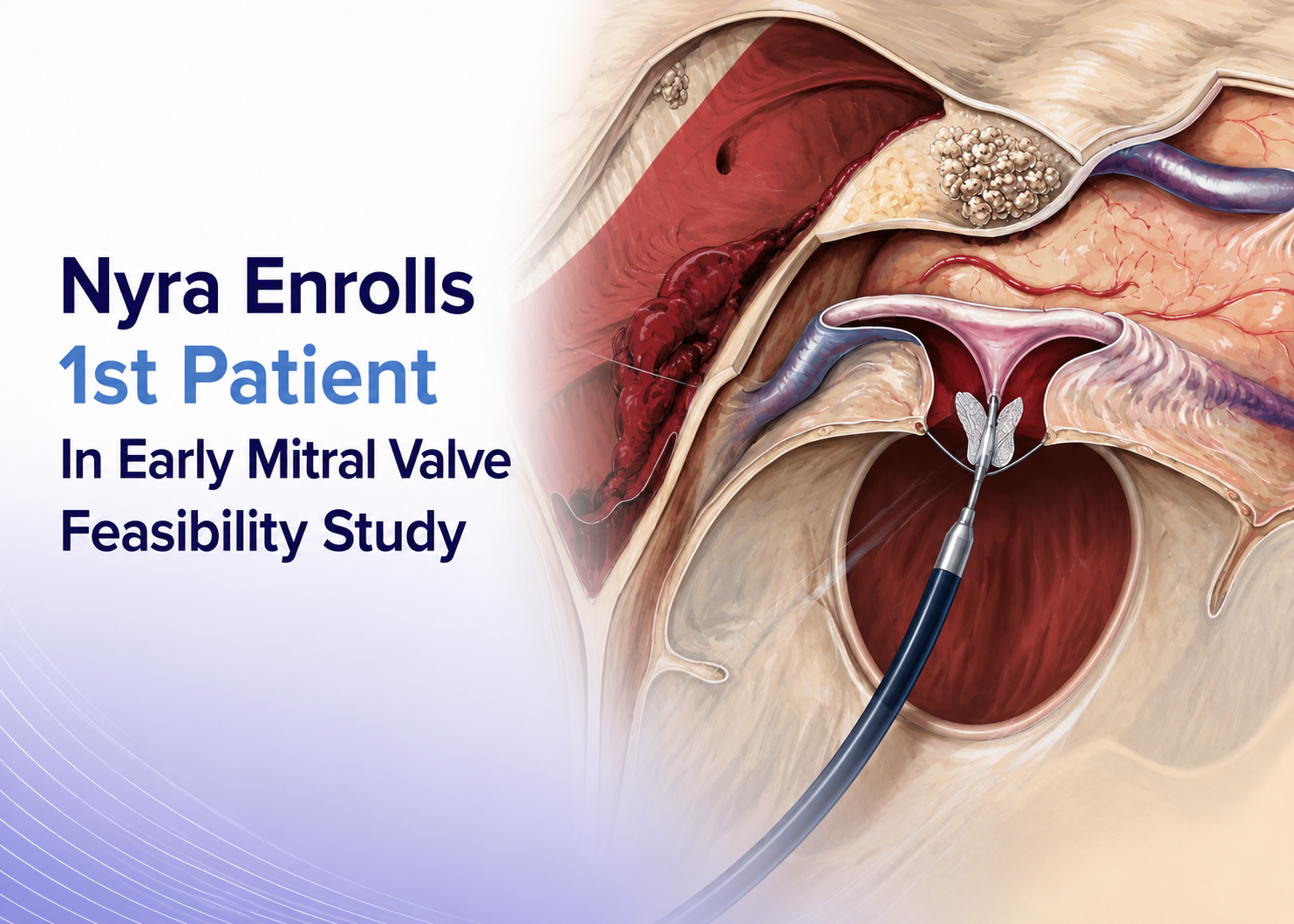
Nyra Medical has enrolled the first patient in the ENHANCE early feasibility study of its investigational CARLEN transcatheter leaflet implant for functional mitral regurgitation. The study marks an early human test of a different repair idea: improving leaflet coaptation by augmenting one native mitral leaflet instead of replacing the valve or joining both leaflets together. CARLEN is designed to help the mitral valve close more effectively while preserving natural valve movement and blood flow. For patients with symptomatic functional mitral regurgitation, especially those who may not be good candidates for open-heart surgery, this early clinical step could become an important signal in the future of less invasive mitral valve repair.
Why It Matters
Functional mitral regurgitation is a common and serious complication of heart disease. It happens when the mitral valve does not close tightly, often because the left ventricle or left atrium has changed shape or size. The valve leaflets may be structurally normal, but they fail to meet properly. As a result, blood leaks backward into the left atrium when the heart pumps. Over time, this backward flow can worsen heart failure, increase pressure in the lungs, and make daily activities harder for patients.
Patients with mitral regurgitation often live with breathlessness, fatigue, reduced exercise tolerance, swelling, repeated hospital visits, and a lower quality of life. Many patients are older or have other medical problems such as heart failure, kidney disease, lung disease, diabetes, or frailty. These factors can make open-heart surgery too risky. That reality has pushed researchers, physicians, and device companies to develop transcatheter mitral valve repair options that can be performed without opening the chest.
Most current transcatheter therapies focus on either pulling the two valve leaflets together or replacing the valve. Those approaches have helped many patients, but they do not fit every anatomy. Functional mitral regurgitation is not one single pattern of disease. Some patients have a dilated ventricle that pulls the leaflets downward. Others have atrial enlargement, commissural leakage, restricted leaflet motion, or valve geometry that makes standard repair difficult. A device that works with the patient’s own leaflet tissue could add another useful tool to the structural heart toolbox.
CARLEN takes a different tack. It is designed as a single-leaflet implant that augments native tissue to restore the seal between leaflets. The aim is to improve coaptation while preserving the mitral valve’s natural motion and orifice area. In simple terms, the device is meant to help the leaflet close the gap without forcing the valve into a heavily altered shape. If this concept works safely and consistently in real patients, it may expand the number of people who can be considered for transcatheter mitral repair.
That design matters because any mitral valve repair must balance two goals. It must reduce leakage, but it must not create a new blockage. If the valve opening becomes too narrow, patients may develop mitral stenosis, which can also cause breathlessness and poor outcomes. Preserving valve movement and blood flow is therefore an important part of device design. CARLEN’s promise rests on whether it can reduce regurgitation without compromising normal filling of the heart.
The clinical and health system implications are significant. A device that reliably restores leaflet coaptation with a practical procedural workflow could help reduce heart-failure symptoms, lower repeat hospital admissions, and offer another option for people who cannot undergo surgery. For hospitals, fewer readmissions and better symptom control could mean improved long-term care value. For patients, the biggest benefit would be simple: breathing easier, walking farther, and spending less time in the hospital.
Who It Affects
Patients with symptomatic functional mitral regurgitation are the main group affected by this development. These patients often have valve leakage because the heart chamber has changed shape, not because the leaflet itself is torn or infected. In many cases, they already have heart failure. They may be taking multiple medications, using devices such as defibrillators or resynchronization therapy, and visiting cardiology clinics often. For them, another less invasive repair option could be meaningful if it proves safe and effective.
Many of these patients are not ideal candidates for open-heart surgery. Age, frailty, weak heart function, lung disease, kidney problems, previous cardiac surgery, or other serious conditions can make surgery risky. Some patients are never referred for surgery because the risk appears too high from the beginning. Others are evaluated but turned down after a heart-team review. These are the patients who could benefit most from a wider range of transcatheter repair options.
For patients and families, however, the message should remain balanced. CARLEN is investigational. Early enrollment does not mean the device is approved for routine use or proven to improve survival. Patients in early studies usually receive close monitoring and structured follow-up. They should understand the purpose of the trial, the possible risks, the unknowns, and the other treatment options available to them. Clear consent and realistic expectations are essential.
Cardiologists and structural heart teams will also feel the impact. The process of implanting a leaflet augmentation device needs precise imaging, proper planning, and good coordination during the procedure. Interventional cardiologists, echocardiographers, anesthesiologists, nurses, and imaging experts are all involved. The team needs to find the site of leakage, maneuver the device, make sure that the leaflets engage, and make real-time assessment of the valve’s performance.
Echocardiographers will be especially important. Functional mitral insufficiency may vary according to blood pressure, volume status, anesthetic effects, and rhythm. The imaging professionals have to decide whether the valve has been helped by the device in its coaptation, whether there is residual insufficiency, and whether the valve is still competent. They have to detect the presence of complications like leaflet trauma, displacement of the device, or increased transmitral gradient. Good imaging is not negotiable during this kind of procedure.
Hospitals with established transcatheter mitral programs are likely to be the first adopters if the device continues through development. These centers already have the imaging platforms, hybrid catheterization labs, trained staff, and multidisciplinary heart teams needed for complex valve procedures. Smaller hospitals and rural centers may not have the same resources. That could create uneven access, especially in the early years.
Payers and hospital administrators are also stakeholders. New structural heart devices often carry high upfront costs. Hospitals must consider device price, procedure time, staffing, imaging needs, training, and follow-up demands. Payers will want evidence that the device improves outcomes that matter, such as symptoms, functional status, heart-failure admissions, repeat procedures, and long-term survival. Without strong clinical evidence, reimbursement may be slow or limited.
Regulators and guideline committees will need durable data before broader recommendations are possible. Early feasibility results can support progress, but they are only the beginning. Regulators will look for safety signals, procedural success, adverse events, and follow-up outcomes. Guideline experts will eventually need comparative data against existing therapies, including guideline-directed medical therapy, transcatheter edge-to-edge repair, and other emerging mitral technologies.
What Changes
- New procedural option. Clinicians may gain an alternative transcatheter technique that augments a native mitral leaflet to re-establish coaptation while preserving valve motion and orifice area. This could be useful for patients whose anatomy is not well suited to existing approaches. - Training and imaging demands increase. Accurate implantation will rely on high-quality echocardiography and experienced structural heart teams. Early use may concentrate in specialized centers with strong mitral valve programs and established procedural workflows. - Patient selection may broaden. CARLEN’s ability to implant on either the anterior or posterior leaflet could make it adaptable to a wider range of valve anatomies. That flexibility may help physicians match the repair strategy to the patient rather than forcing the patient to fit one device profile. - Evidence and reimbursement will lag. First-patient enrollment is only the start. Long-term durability, safety, symptom improvement, quality-of-life benefit, and performance compared with existing therapies will guide coverage and adoption. - What clinicians should watch for in the coming months is how the device performs across different valve shapes and sizes. Functional mitral regurgitation is highly variable. Some patients have relatively preserved leaflets with tethering from a dilated ventricle. Others have atrial functional MR, commissural leakage, restricted motion, or complex geometry. A device that can be placed on either leaflet may offer practical flexibility, but real-world anatomy will test that promise. - Another key issue is the durability of repair. A device may reduce leakage immediately after the procedure, but the mitral valve sits in a moving, high-stress environment. The implant must remain stable through millions of heartbeats. Physicians will need to know whether the repair holds at six months, one year, and beyond. They will also need to understand whether the device changes leaflet tissue, affects blood flow patterns, or increases the chance of later complications. - Future treatment compatibility will also matter. Many patients with functional mitral regurgitation have progressive heart disease. Even after a successful repair, some may need another mitral procedure later. A well-designed transcatheter implant should ideally avoid closing the door to future options. If a device makes later transcatheter repair, valve replacement, or surgery more difficult, that could limit its long-term appeal. - The heart team model remains the safest way to make these decisions. No single specialist can judge all aspects of functional mitral regurgitation alone. The best decisions combine imaging findings, heart-failure status, anatomy, frailty, patient goals, surgical risk, and available device options. This is especially true as new devices enter the field. More choices can improve care, but they also make decision-making more complex. - Access will be another practical challenge. Advanced structural heart care is not evenly distributed. Patients in large cities may reach experienced mitral centers more easily than those in rural or underserved regions. Early adoption of CARLEN, if the study progresses well, may follow the same pattern seen with other complex cardiac devices. Training networks, referral pathways, tele-mentoring, and shared imaging review could help spread expertise over time. - The research path for CARLEN will likely be gradual. Early feasibility enrollment helps the company and investigators learn about device delivery, sizing, positioning, safety, imaging protocols, and short-term performance. Those lessons can shape larger pivotal trials. If early results show reproducible benefits with manageable risks, the device may move toward broader clinical testing. If challenges appear, the technology or technique may need refinement. - For now, enrollment of the first patient is both a technical and symbolic step. It means CARLEN has moved beyond design and bench testing into structured human evaluation. That does not guarantee success, but it does mark progress in a field where many patients still need better options. Functional mitral regurgitation remains difficult to treat, and no single device will solve every case. A broader toolbox could help clinicians offer more personalized care. - Clinicians should watch for published safety and performance data, follow-up duration, patient-selection details, and reports on residual MR after implantation. They should also look for information on complications, valve gradients, leaflet interaction, need for repeat procedures, and quality-of-life changes. These details will matter more than early enthusiasm. A device becomes practice-changing only when it proves that it can help patients safely, consistently, and durably. - For patients living with functional mitral regurgitation, this milestone offers cautious hope. It shows that innovation in mitral valve repair is still moving forward. The goal is not only to create new technology, but to give the right patient the right repair at the right time. If CARLEN can support that goal, it may become an important addition to the future of minimally invasive heart valve care. References: - 1. Nyra Medical, Inc. Nyra Medical Announces First Patient Enrollment in ENHANCE Early Feasibility Study, Advancing Next Generation Mitral Valve Repair Platform. PR Newswire. 2026. Available from: https://www.prnewswire.com/news-releases/nyra-medical-announces-first-patient-enrollment-in-enhance-early-feasibility-study-advancing-next-generation-mitral-valve-repair-platform-302819575.html 2. American Heart Association. Problem: Mitral Valve Regurgitation. American Heart Association. 2024. Available from: https://www.heart.org/en/health-topics/heart-valve-problems-and-disease/heart-valve-problems-and-causes/problem-mitral-valve-regurgitation 3. Faletra FF, La Franca E, Mulè M, Carvelli A, Parisi F, Di Stefano G, et al. Functional Mitral Valve Regurgitation, Pathophysiology, Leaflet Remodeling, and the Role of Imaging. Echocardiography. PubMed Central (PMC). 2025. Available from: https://pmc.ncbi.nlm.nih.gov/articles/PMC11854047/ 4. Pascual I, Carrasco-Chinchilla F, Benito-Gonzalez T, Li CH, Avanzas P, Nombela-Franco L, et al. Transcatheter Mitral Repair for Functional Mitral Regurgitation According to Left Ventricular Function: A Real-Life Propensity-Score Matched Study. Journal of Clinical Medicine. PubMed Central (PMC). 2020;9(6):1792. Available from: https://pmc.ncbi.nlm.nih.gov/articles/PMC7356666/
One story a day
The story of the day, in your inbox
One health journey each morning — no advice, no alarm, just company for the road.