Sodium Chloride Recall Raises Potassium Exposure Risk
One recalled lot labeled as 0.9% sodium chloride injection may expose patients to concentrated potassium chloride. Hospitals, pharmacies and infusion services should rapidly isolate affected inventory and trace possible use.
 Written and medically reviewed byRayan SalihContributing writer · PharmD, RPh
October 7, 2026 · 6 min read
Why the labeling hazard is clinically urgent
The FDA announced a voluntary nationwide recall on September 21, 2026, involving one lot labeled as 0.9% sodium chloride injection because of potential exposure to highly concentrated potassium chloride. The distinction is critical: sodium chloride injection is routinely used as an intravenous fluid, diluent or line flush, while concentrated potassium chloride requires strict controls because an unintended intravenous load can produce severe hyperkalemia.
The resulting toxicity may include conduction abnormalities, malignant arrhythmias, cardiac arrest, muscle weakness or paralysis, and death. Risk can depend on the amount and rate administered, baseline potassium concentration, renal function, concurrent medications and the patient’s ability to redistribute or eliminate potassium. A mislabeled product defeats many ordinary safety checks because clinicians may reasonably act on the sodium chloride labeling.
This is therefore more than a conventional supply recall. It is a wrong-product exposure risk requiring coordinated action across pharmacy, nursing, supply chain, medication safety, risk management and clinical services. The FDA recall notice should remain the controlling source for the exact product description, lot identifier, expiration information, packaging and return instructions; secondary summaries should not be used to decide whether a unit is affected.
What the recall establishes
The evidence is a regulatory safety communication, not a clinical study. It concerns a single recalled lot and identifies the potential for a product labeled as 0.9% sodium chloride injection to expose a patient to concentrated potassium chloride. Because the communication is not a comparative investigation, it provides no study population, comparator, effect estimate, confidence interval or follow-up period.
The notice supports immediate risk containment even without a quantified probability of contamination. A low or unknown event frequency does not make an individual exposure benign: the potential severity is high, and the labeling mismatch could allow administration without the safeguards normally applied to concentrated electrolytes.
Facilities should verify all recall details directly against the FDA notice and the physical package. Matching only the generic name is insufficient. Review should include the manufacturer or distributor, National Drug Code when provided, lot number, expiration date, container size and packaging configuration. Products that do not match every defining element should not automatically be classified as recalled, but any uncertain unit should remain segregated until pharmacy or the manufacturer resolves its status.
Immediate priorities for medication systems
The first operational step is to stop movement and use of matching inventory. Pharmacy and supply-chain leaders should search central stores, clean rooms, automated dispensing cabinets, procedure areas, emergency carts, anesthesia locations, dialysis units, ambulatory sites, transport stock and off-site warehouses. Home infusion and other distributed services need the same review because recalled units may have left the main facility.
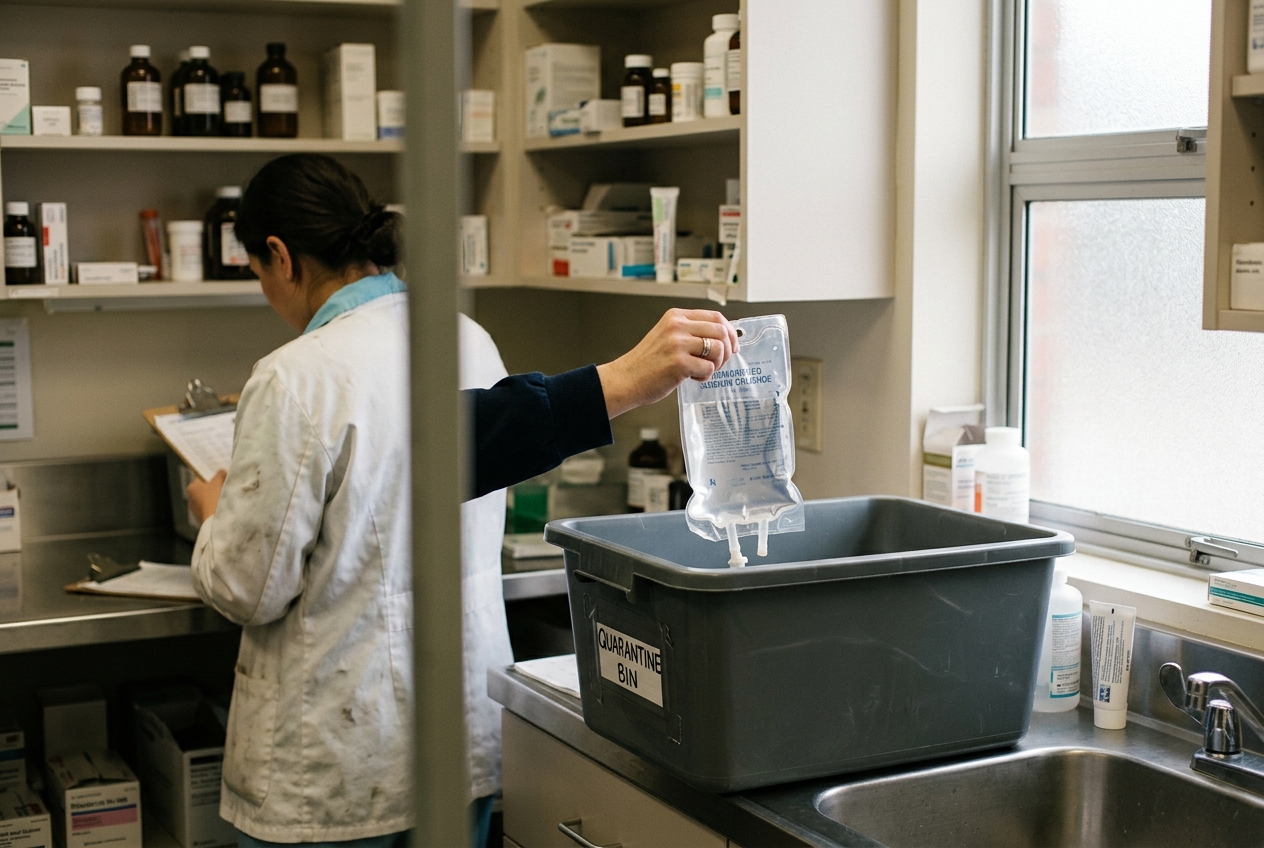
Physically quarantine affected or uncertain stock and restrict access. Electronic controls should reinforce that barrier: block the lot or item in inventory systems where possible, suspend replenishment, flag open purchase orders and communicate the hold to every location that could receive or administer the product. Barcode scanning alone may not resolve a wrong-product hazard when the external label identifies the item as sodium chloride.
A reliable response also requires reconciliation. Organizations should compare quantities received, currently on hand, transferred, returned, wasted and administered. Gaps deserve investigation rather than assumptions. If the product was redistributed, each recipient should receive the recall information and confirm its search and disposition.
The recall should not prompt indiscriminate removal of unaffected sodium chloride injection, which could worsen supply pressure and create substitution risks. Pharmacy should identify verified alternatives, review storage separation and communicate any workflow changes. Facilities should check replacement products through normal procurement and medication-use controls rather than introducing them informally.
Tracing possible patient exposure
Facilities that received the recalled lot should determine whether any units were administered. Useful records can include wholesaler shipment data, receiving logs, lot-level inventory records, compounding documentation, dispensing histories, administration records and home-infusion delivery records. Traceability may be incomplete when systems do not capture lot numbers at administration, so the review may need to combine electronic data with location and date ranges.
Possible exposure warrants prompt clinical review under the organization’s emergency and hyperkalemia pathways. Relevant assessment may include the timing and amount of any infusion, symptoms, vital signs, electrocardiography, serum potassium, kidney function and medications that affect potassium balance. Management should follow established institutional protocols and the clinical situation; the recall notice does not provide a new treatment regimen or justify invented dosing recommendations.
If an infusion is still running and the product may match the recall, activate established emergency procedures immediately. The container, overwrap, tubing and related documentation may be important for product identification and investigation, so their handling should be coordinated with pharmacy, risk management and the recalling firm rather than discarded routinely.
Document and report suspected adverse events and product-quality problems through the channels specified in the recall. The FDA’s MedWatch program accepts reports involving serious reactions, use errors and product-quality concerns. Facilities should also follow manufacturer return instructions and internal requirements for safety-event review, disclosure and regulatory reporting.
Limits of the available evidence
A recall communication is designed to warn and contain risk, not to estimate incidence or systematically characterize outcomes. It cannot establish how many units, if any, contained concentrated potassium chloride; how many patients were exposed; or the absolute probability of harm. Those quantities should not be inferred from a nationwide recall.
The communication also cannot substitute for local traceability. A facility’s actual risk depends on whether it received the specified lot, where the units traveled and whether any were administered. Updates from the FDA or recalling company may refine the scope, return process or adverse-event information, so recall teams should keep the event open until inventory is reconciled and official follow-up is reviewed.
Questions clinicians ask
Should every sodium chloride injection be removed from use?
No. The recall concerns one specified lot, and the FDA notice should be used to match the full product identifiers. Unaffected stock can generally remain available after verification. Removing all sodium chloride injection without regard to lot could create shortages, substitutions and additional medication-safety hazards.
What should happen if administration cannot be ruled out?
The case should receive prompt clinical and medication-safety review based on the possible dose, infusion timing, symptoms and patient risk factors. Electrocardiography and laboratory assessment may be appropriate under local hyperkalemia protocols. The FDA communication identifies the hazard but does not create a separate treatment algorithm.
Is a normal appearance enough to clear a suspected bag?
No. Product disposition should be based on the identifiers and instructions in the official recall, not a bedside visual judgment. A unit with uncertain status should remain quarantined while pharmacy verifies it with the FDA notice or recalling company, particularly because the external labeling is central to this event.
Where should suspected harm or a product problem be reported?
Organizations should use the reporting and return channels specified in the recall and follow their internal safety procedures. Serious adverse events, medication errors and product-quality concerns can also be submitted to FDA MedWatch. Reports should preserve identifying details such as the lot, packaging and administration timeline whenever available.
References
1. Voluntary Recall of Sodium Chloride Injection Because of Potassium-Chloride Contamination Risk — U.S. Food and Drug Administration, 2026 2. Recalls, Market Withdrawals, and Safety Alerts — U.S. Food and Drug Administration, n.d. 3. MedWatch: The FDA Safety Information and Adverse Event Reporting Program — U.S. Food and Drug Administration, n.d.
One story a day
The story of the day, in your inbox
One health journey each morning — no advice, no alarm, just company for the road.