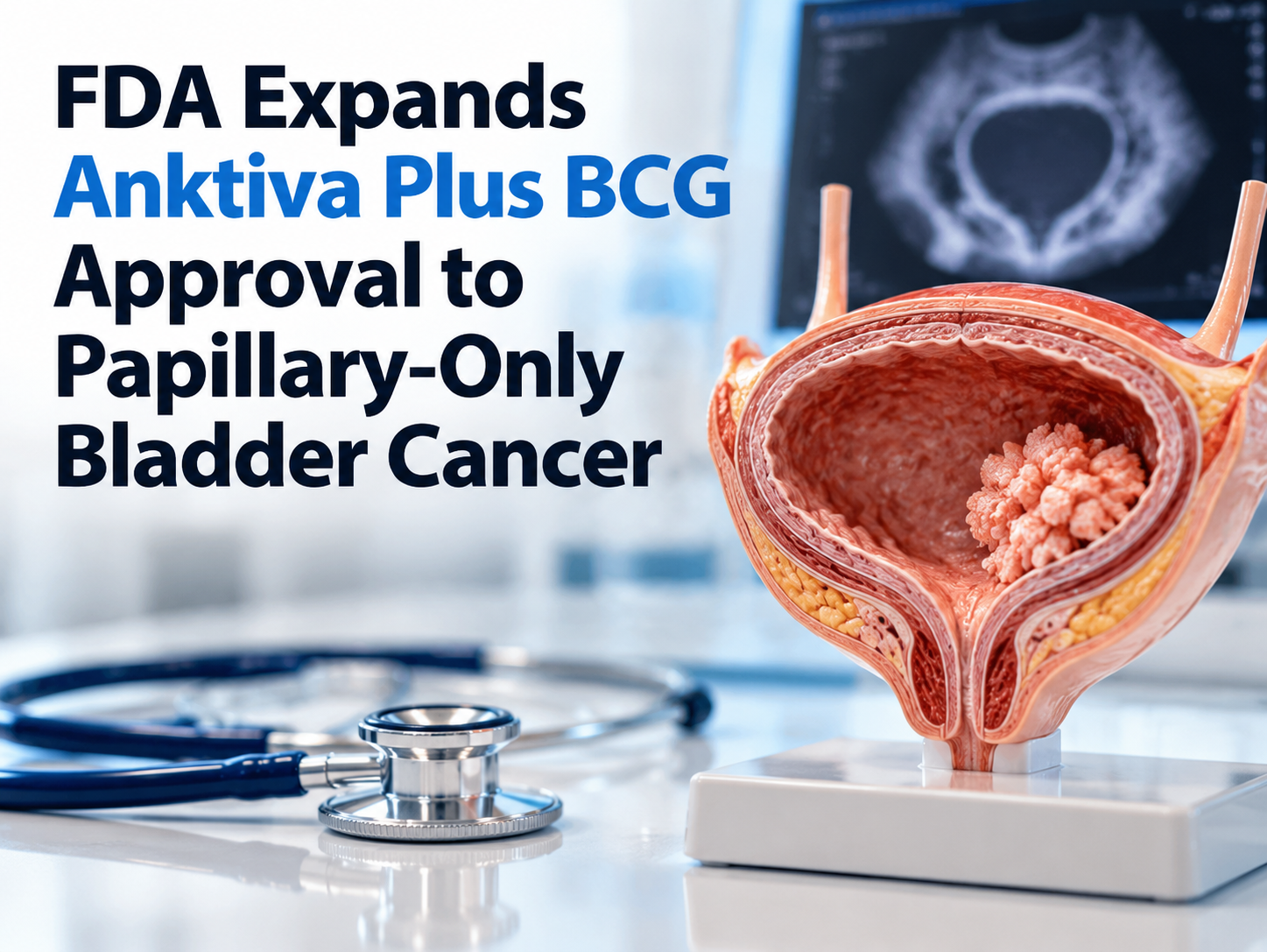
Anktiva Expands for Papillary-Only Bladder Cancer
The FDA expanded Anktiva plus BCG to adults with BCG-unresponsive, high-grade papillary non-muscle-invasive bladder cancer without carcinoma in situ.
 Written and medically reviewed byRayan SalihContributing writer · PharmD, RPh
November 13, 2026 · 6 min read

What the expanded indication changes
The October 2026 FDA action closes a clinically important gap in the indication for nogapendekin alfa inbakicept-pmln (Anktiva). The drug was already approved with bacillus Calmette-Guérin, or BCG, for adults with BCG-unresponsive non-muscle-invasive bladder cancer containing carcinoma in situ, with or without papillary tumors. The expansion adds adults whose qualifying disease consists of high-grade papillary tumors without carcinoma in situ.
In practical terms, the newly covered population has high-grade Ta or T1 papillary disease that remains or recurs after adequate BCG within the regulatory definition of BCG-unresponsive disease. The treatment remains a combination: intravesical nogapendekin alfa inbakicept-pmln is given with BCG, not as monotherapy.
The expansion does not include every patient with a papillary bladder tumor or any recurrence after BCG. Low-grade disease, muscle-invasive disease and metastatic bladder cancer fall outside this indication. Patients with carcinoma in situ were already covered by the earlier approval and are not the new population addressed by this decision.
“BCG-unresponsive” also has a specific meaning. Adequate BCG generally comprises at least five of six induction doses plus at least two of three maintenance doses, or at least two of six doses in a second induction course. For papillary disease, high-grade Ta or T1 recurrence generally must occur within six months after adequate BCG. High-grade T1 disease found at the first assessment after induction is also treated as BCG-unresponsive under the established framework.
Evidence in papillary-only disease
The evidence came from QUILT-3.032, a multicenter, open-label, single-arm phase 2/3 study of intravesical nogapendekin alfa inbakicept-pmln plus BCG in adults with BCG-unresponsive non-muscle-invasive bladder cancer. Separate cohorts enrolled patients with carcinoma in situ and those with papillary-only high-grade disease.
The published papillary cohort enrolled 77 patients, of whom 72 were assessable for the efficacy analysis. Participants had high-grade Ta or T1 disease without carcinoma in situ and received study therapy after endoscopic management. There was no placebo, BCG-alone or cystectomy comparator. The reported analysis included follow-up to 24 months.
Disease-free survival in the papillary cohort was estimated with time-to-event methods. The reported results were:
| Outcome | Estimate | 95% confidence interval | Follow-up |
|---|---|---|---|
| Disease-free survival | 55.4% | 42.0%–67.0% | 12 months |
| Disease-free survival | 48.1% | 34.0%–61.0% | 24 months |
These estimates indicate that approximately half of the analyzed population remained disease-free at two years. They should not be interpreted as showing superiority over cystectomy, additional BCG alone or another bladder-sparing treatment because the study had no randomized comparator. No comparative p-value was applicable.
The broader study’s safety findings were consistent with intravesical treatment and BCG exposure, including urinary symptoms and systemic symptoms such as fatigue, chills and fever. Clinicians should use the current prescribing information for the approved schedule, contraindications, warnings and management of suspected serious BCG-related complications. The indication expansion does not support an independently devised dosing schedule.
Translating the decision into eligibility
The central eligibility question is whether an adult’s current disease is high-grade papillary NMIBC without carcinoma in situ and meets the timing and prior-treatment criteria for BCG-unresponsive disease. Pathology review, documentation of BCG exposure and accurate staging are therefore essential. A chart notation that disease “failed BCG” is not enough on its own to establish that the regulatory definition has been met.
Visible papillary tumors are generally managed with transurethral resection before intravesical therapy. For T1 disease, adequate sampling of muscularis propria and repeat resection when indicated are particularly important because understaging could place a patient with muscle-invasive disease on an inappropriate NMIBC pathway. The expanded indication does not relax staging standards.
The approval creates another bladder-preserving option, but it does not remove radical cystectomy from consideration. Cystectomy remains an established oncologic approach for BCG-unresponsive high-risk NMIBC, particularly when progression risk is substantial. Treatment selection should account for pathologic features, prior recurrence pattern, operative fitness, patient preferences and the consequences of delaying definitive surgery.
Cross-trial comparisons with other bladder-preserving therapies are unreliable. Studies differ in whether they include carcinoma in situ, papillary disease or both; how they define adequate BCG and disease-free survival; and how frequently participants undergo cystoscopy, cytology and biopsy. The FDA expansion establishes that the combination may be used in the defined papillary-only population, not that it is preferable to every alternative.
Important limits and remaining uncertainties
QUILT-3.032 was single-arm and open-label. Without a concurrent control group, it cannot quantify the treatment effect relative to repeat BCG, another intravesical agent or cystectomy. The papillary efficacy cohort was also modest in size, producing confidence intervals that leave uncertainty around the exact durability of benefit.
The study was sponsor-funded, which warrants attention alongside the trial’s prospective design and regulatory review. Participants were selected for a clinical trial and may not reflect patients with major comorbidity, variant histology, uncertain staging or incomplete BCG records. Longer-term evidence is needed for progression to muscle-invasive disease, cystectomy-free survival, bladder cancer-specific survival and overall survival in the expanded population.
The regulatory action is therefore best understood as a population expansion supported by durable disease-free responses in a nonrandomized cohort. It is not evidence that the combination eliminates progression risk or makes surveillance less important. Patients treated with a bladder-preserving approach still require close cystoscopic, cytologic and upper-tract follow-up appropriate for high-risk NMIBC.
Questions clinicians ask
Which patients are newly eligible?
The expansion adds adults with BCG-unresponsive, high-grade Ta or T1 papillary NMIBC without carcinoma in situ. The diagnosis must satisfy the established requirements for adequate prior BCG and the timing of persistent or recurrent high-grade disease; low-grade, muscle-invasive and metastatic disease are not included.
Do patients with papillary tumors plus carcinoma in situ rely on this expansion?
No. Adults with BCG-unresponsive carcinoma in situ, with or without associated papillary tumors, were covered by the earlier FDA indication. The 2026 change specifically reaches the previously excluded papillary-only population, meaning high-grade papillary disease with no concurrent carcinoma in situ.
Does high-grade T1 disease qualify?
High-grade T1 NMIBC can qualify when it meets the BCG-unresponsive definition, but careful restaging is critical because occult muscle invasion changes both prognosis and treatment. Eligibility for the drug combination should not be taken to mean that bladder preservation carries the same expected cancer control as timely cystectomy.
Can the combination be considered a replacement for cystectomy?
The evidence does not establish that conclusion. The supporting study lacked a randomized cystectomy or medical-treatment comparator, although disease-free survival remained 48.1% at 24 months in the assessable papillary cohort. The approval supports another option for shared decision-making, not comparative superiority or equivalent long-term survival.
References
1. FDA Expands Indication for Nogapendekin Alfa Inbakicept-pmln for BCG-Unresponsive Non-Muscle-Invasive Bladder Cancer — US Food and Drug Administration, 2026 2. IL-15 Superagonist NAI in BCG-Unresponsive Non-Muscle-Invasive Bladder Cancer — NEJM Evidence, 2023 3. QUILT-3.032: A Study of N-803 in Combination With BCG in Subjects With Non-Muscle Invasive Bladder Cancer — ClinicalTrials.gov, 2026
One story a day
The story of the day, in your inbox
One health journey each morning — no advice, no alarm, just company for the road.