Catheter Recall Expands Over Particulate Safety Risks
The FDA expanded a Class I recall covering specific lots of reprocessed electrophysiology and ultrasound catheters because particulates may remain on patient-contacting surfaces.
 Written and medically reviewed byDr. Abu BakarContributing writer · PharmD, PhD (Pharmacology)
October 11, 2026 · 6 min read
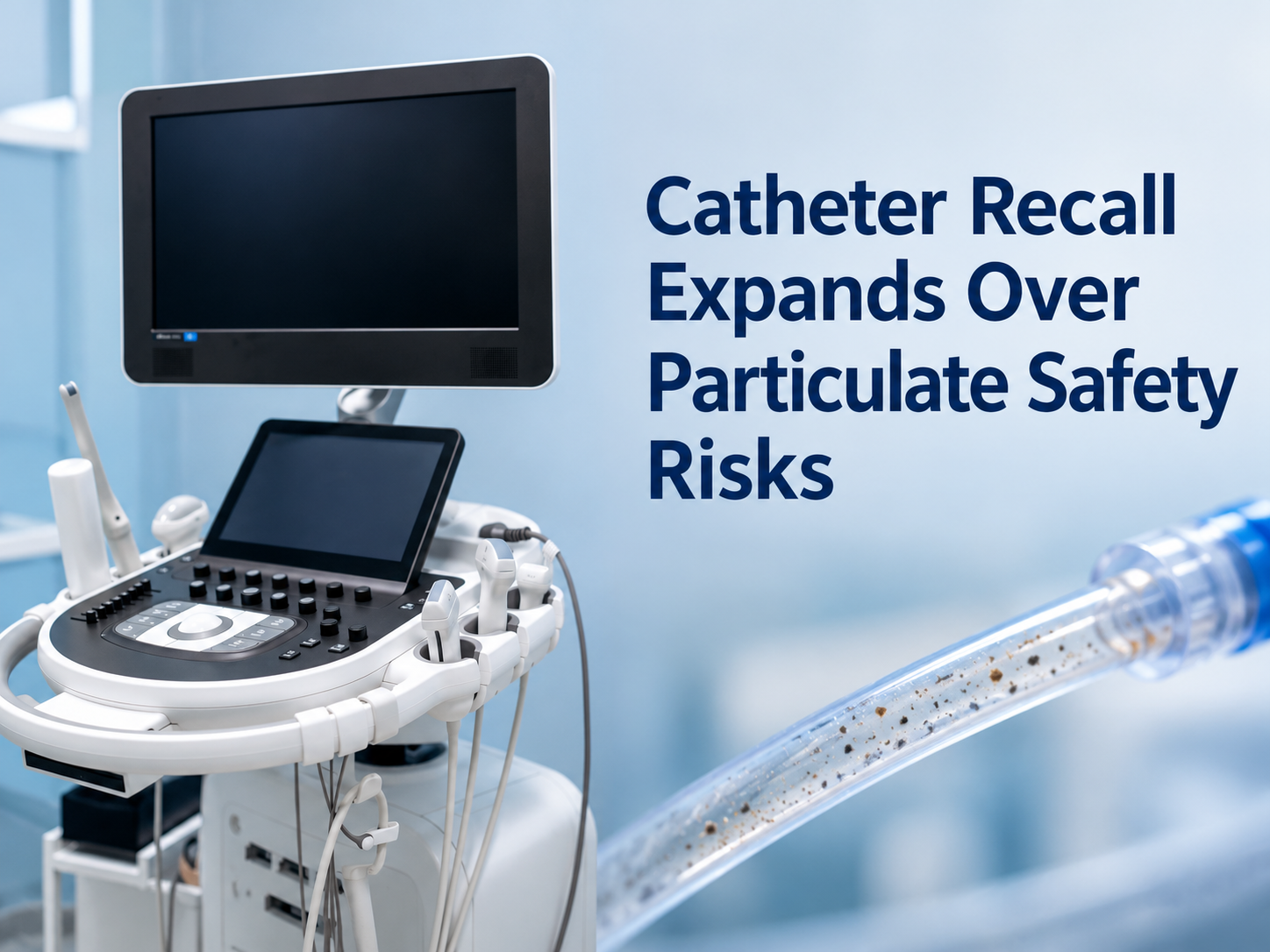
The recall now covers additional catheter lots
The FDA’s September 2, 2026, notice expands a Class I recall involving specific lots of reprocessed electrophysiology and ultrasound catheters distributed by Medline Industries. The concern is that particulates may remain on surfaces that contact the patient, creating potential risks that include infection, thrombosis, and cerebral or pulmonary embolism.
This is a regulatory safety action, not a clinical study. The FDA notice does not provide a trial population, comparator, effect estimate, confidence interval, or defined follow-up period. It therefore cannot quantify the probability of harm after any individual procedure. The Class I designation means there is a reasonable probability that use of the affected products could cause serious adverse health consequences or death; it does not mean every recalled catheter is contaminated or that every exposed patient will experience an adverse event.
The expansion changes the operational question for facilities that previously screened their supply. A completed response to an earlier recall may no longer be sufficient. Inventory, purchasing records, procedure logs, and prior quarantine decisions need to be checked against the expanded product and lot information in the current FDA notice.
Why residual particulate matter matters
A catheter used within the cardiovascular system can place residual material in direct contact with blood, endocardial structures, or vascular tissue. Depending on particle properties and the catheter’s location, material could remain local, contribute to thrombus formation, or enter the circulation. The clinical destination would depend in part on the procedure and vascular pathway: embolized material could reach the pulmonary circulation or, in relevant circumstances, the cerebral or systemic circulation.
Particulate contamination may also represent an inflammatory or infectious hazard. However, the recall notice identifies potential outcomes rather than proving a specific biological mechanism in each case. It should not be interpreted as evidence that a retained particle caused an infection, thrombotic event, stroke, or pulmonary embolism in any particular patient without a clinical assessment and consideration of other causes.
That distinction is important in electrophysiology. Patients undergoing invasive EP procedures may already have baseline risks related to arrhythmia, anticoagulation, vascular access, intracardiac instrumentation, and comorbid disease. A temporal association between a recalled catheter’s use and a subsequent event would warrant review, but timing alone cannot establish causation.
Inventory control is the immediate priority
The FDA recall notice should be the controlling source for affected product names, catalog identifiers, and lot numbers. Facilities should avoid relying on abbreviated email summaries or staff memory, particularly because this is an expansion. Supply-chain teams can download or preserve the current notice and document which version was used for reconciliation.
A robust inventory response includes all locations where the devices could reside: the EP laboratory, cardiac catheterization areas, ultrasound or echocardiography services, operating rooms, central sterile storage, procedural carts, satellite sites, and consignment stock. Electronic inventory blocks are useful, but they do not replace a physical search when products may have been removed from their original bins or recorded under local aliases.
Potentially affected units should be segregated from usable stock, clearly labeled, and protected from inadvertent redistribution while the facility follows the recall instructions. Reconciliation should account for quantities received, currently on hand, transferred, used, returned, or otherwise dispositioned. Relevant identifiers include the product or catalog number, lot number, unique device identifier when available, receipt date, storage location, and procedure date.
The review should involve supply chain, electrophysiology and ultrasound leadership, infection prevention, patient safety, risk management, and the personnel responsible for device-event reporting. If a distributor, reprocessor, or manufacturer provides updated instructions, the facility should preserve that communication with its recall file and confirm that downstream sites receive the same update.
Follow-up begins with reliable exposure reconstruction
For products no longer in inventory, facilities may need to determine whether recalled units were used. Procedure records, barcode scans, implant or supply logs, charge capture, and manual case documentation can be cross-checked against purchasing and lot data. A lack of lot-level documentation is itself important: it may prevent definitive exclusion of exposure and should be recorded rather than converted into an assumption that no exposure occurred.
Patients identified as potentially exposed require clinician-led, risk-based review. Relevant factors include the procedure performed, catheter position and duration of use, vascular territory, timing since the procedure, documented intraprocedural abnormalities, subsequent symptoms, and competing risks for infection or thrombosis. The FDA notice does not establish a universal imaging, laboratory-testing, antimicrobial, or anticoagulation protocol for asymptomatic patients.
Follow-up planning should therefore distinguish possible exposure from suspected injury. Symptoms or findings compatible with infection, venous or arterial thrombosis, pulmonary embolism, or cerebral embolism merit evaluation under established clinical pathways. Examples include otherwise unexplained fever, access-site inflammation, limb swelling, chest pain, dyspnea, hypoxemia, focal neurologic deficits, or acute confusion. These findings are nonspecific and should not be attributed automatically to the recalled device.
Facilities should document how potentially exposed patients were identified, how clinical review was conducted, and whether communication was considered under institutional disclosure and recall policies. Suspected device-associated adverse events can be reported through the FDA’s medical device reporting framework or MedWatch, with the available product and lot identifiers included. Reporting a suspected association supports surveillance and does not by itself establish causality.
Important evidence gaps remain
The principal limitation is the evidence type. A recall alert is designed to identify a hazard and prompt risk control; it is not structured to estimate incidence, compare outcomes, or define an optimal surveillance strategy. Without a denominator of exposed procedures, consistently verified contamination, and adjudicated clinical outcomes, the absolute risk cannot be calculated from the notice alone.
The FDA notice also cannot resolve whether risk varies by catheter model, particle burden, procedural route, or patient characteristics beyond the distinctions explicitly listed in the recall. Local case finding may be incomplete where lot capture was inconsistent. Conversely, broad symptom screening can generate false associations because infection, thrombosis, stroke, and pulmonary embolism have many established causes in patients undergoing cardiovascular procedures.
The evidence supports prompt control of affected inventory, preservation of traceability data, and individualized review after possible exposure. It does not support assuming that all recalled devices carried particulates or routinely treating every potentially exposed patient in the absence of clinical findings.
Questions clinicians ask
How do I determine whether a catheter in my laboratory is affected?
Use the product and lot identifiers in the FDA’s expanded recall notice and compare them with both physical stock and electronic records. Because local descriptions can differ from regulatory identifiers, involve supply chain or recall personnel when catalog numbers, lot numbers, or unique device identifiers cannot be matched confidently.
What should happen if a recalled catheter may already have been used?
Reconstruct exposure from procedure, supply, barcode, and purchasing records, then arrange clinician-led review based on the procedure and the patient’s clinical course. The recall does not define one test or follow-up interval for everyone, so evaluation should reflect symptoms, timing, vascular territory, and alternative explanations.
Should asymptomatic patients receive routine imaging or preventive treatment?
The regulatory action does not establish routine imaging, antibiotics, anticoagulation, or another preventive treatment for every asymptomatic person with possible exposure. Decisions should be individualized because the notice identifies plausible serious hazards but does not quantify patient-level risk or demonstrate benefit from a universal intervention.
When should a possible adverse event be reported?
Report when a device may have caused or contributed to a serious injury or other reportable event, following applicable FDA and institutional requirements. Include the catheter model, lot or unique device identifier, procedure details, timing, clinical findings, and device availability when known; uncertainty about causation should be stated rather than concealed.
References
1. Catheter Recall Expansion: Medline Industries Removes Reprocessed Electrophysiology and Ultrasound Catheters — US Food and Drug Administration, 2026 2. MedWatch: The FDA Safety Information and Adverse Event Reporting Program — US Food and Drug Administration, n.d.
One story a day
The story of the day, in your inbox
One health journey each morning — no advice, no alarm, just company for the road.