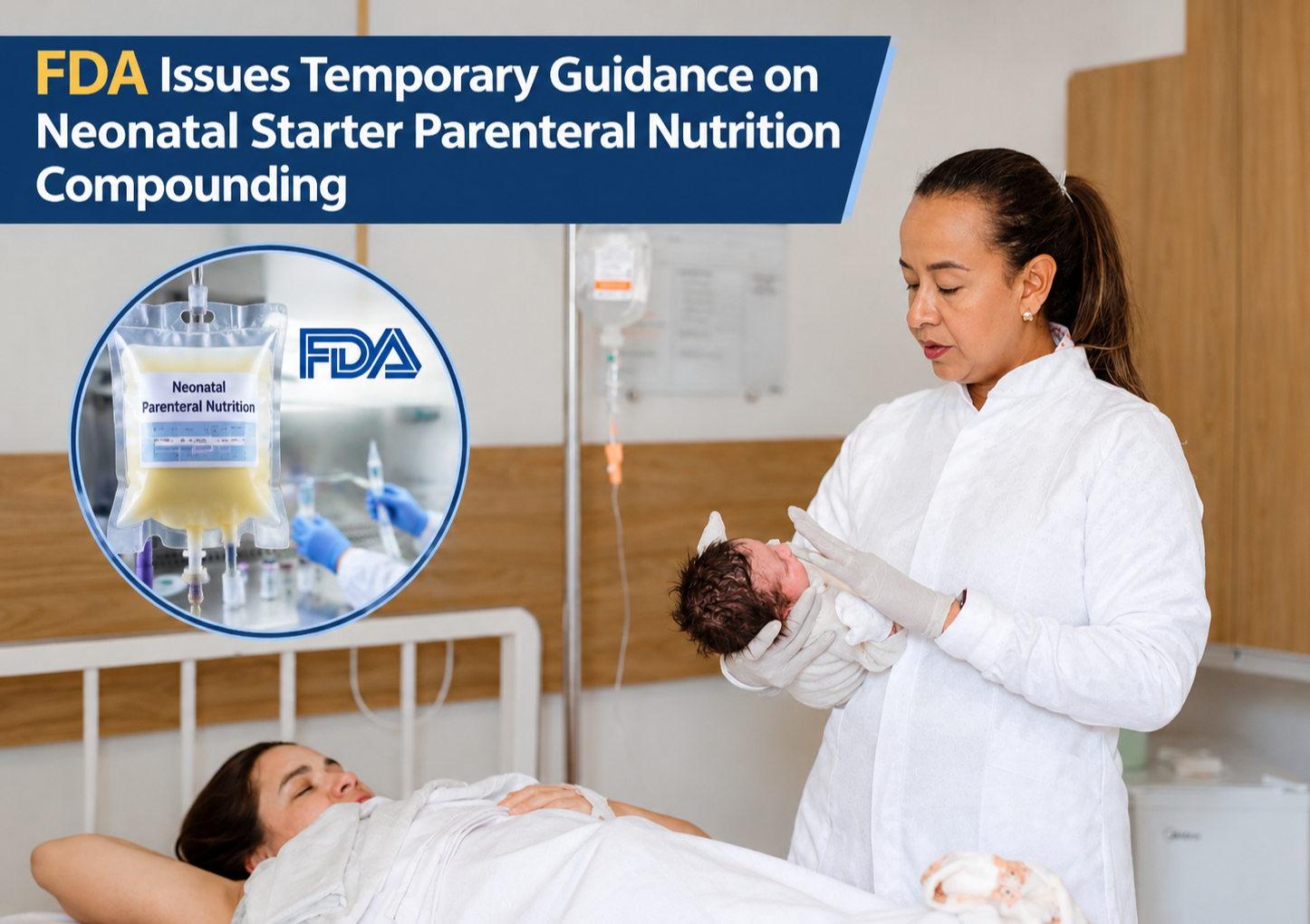
FDA Issues Temporary Guidance on Neonatal Starter Parenteral Nutrition Compounding
Temporary FDA guidance creates a regulatory bridge for neonatal starter parenteral nutrition as the predominant market source prepares to exit. Hospital pharmacies still must meet the policy’s conditions and core quality obligations.
 Written and medically reviewed byDr. Abu BakarContributing writer · PharmD, PhD (Pharmacology)
October 11, 2026 · 7 min read
A temporary pathway, not a substitute product
The FDA’s September 9, 2026, guidance addresses a narrow continuity problem: how neonatal units can retain access to certain starter parenteral nutrition products after the expected departure of the predominant market source. The agency implemented the guidance immediately because waiting for the usual draft-guidance process could leave hospitals without enough time to establish another supply route.
Starter parenteral nutrition is used when a neonate needs prompt intravenous nutritional support and an individualized formulation is not yet available or clinically appropriate. Standardized starter products can reduce the interval between the decision to provide parenteral nutrition and the delivery of amino acids, dextrose and other prescribed components. A supply interruption therefore affects both pharmacy workflow and time-sensitive neonatal care.
The policy is temporary and based on enforcement discretion. That distinction matters. FDA guidance generally describes the agency’s current thinking rather than creating an approval, exemption or legally enforceable right. A compounded product covered by the policy does not become FDA-approved, and FDA has not reviewed it through a new drug application for safety, effectiveness or manufacturing consistency.
The document also is not evidence from a clinical trial. There is no enrolled population, comparator, effect estimate, confidence interval or follow-up period. Its evidence base is regulatory and operational: the anticipated market exit, the clinical need for continued access and the statutory constraints that ordinarily apply to drug compounding.
What immediate implementation changes
FDA guidance is usually issued in draft form for public comment before it is finalized. Immediate implementation allows the agency’s temporary policy to take effect without that advance comment period when prior participation is not feasible or appropriate. Stakeholders may still submit comments, and the FDA can revise or withdraw the policy as circumstances change.
For hospital and health-system pharmacies, this means planning can begin against an active federal policy rather than a proposal. Pharmacy leaders should identify whether their intended activity falls within the guidance’s defined scope, including the covered starter products, eligible compounders, permitted distribution model and every stated condition. The title is not a blanket authorization to compound any neonatal parenteral nutrition product.
The underlying statutory route remains important. Traditional pharmacies generally compound under section 503A of the Federal Food, Drug, and Cosmetic Act, which centers on prescriptions for identified individual patients and is primarily overseen through state pharmacy regulation, with federal conditions governing specified exemptions. Outsourcing facilities operate under section 503B, may compound office stock without patient-specific prescriptions and are subject to current good manufacturing practice requirements, FDA inspection and other federal obligations.
A hospital pharmacy should therefore document which pathway applies before producing inventory. The temporary guidance should be mapped condition by condition to the institution’s proposed model rather than treated as a general waiver of prescription, distribution, labeling, facility or manufacturing requirements. Any flexibility applies only as described by the FDA and only while the policy remains in effect.
What pharmacies and neonatal units need to operationalize
The immediate challenge is not simply reproducing a familiar bag. Moving production into a hospital or health system changes responsibility for formulation control, aseptic processing, release, storage, distribution and recall readiness. Pharmacy, neonatology, infection prevention, quality, procurement and risk-management teams need a shared implementation plan.
The first task is to define the clinical product. The institution should approve the formulation, ingredients, concentration ranges, container and labeling through its established medication-use governance. It should also distinguish the standardized starter product from subsequent patient-specific parenteral nutrition. Orders and electronic records need to make that transition visible so a starter formulation does not continue by default when individualized nutrition is required.
Capacity must be assessed realistically. Relevant questions include whether the sterile compounding area can absorb additional batch volume; whether trained staff, validated processes and appropriate equipment are available; and whether production could displace other high-risk sterile preparations. A paper policy does not solve shortages of cleanroom time, personnel or quality-control resources.
Ingredient sourcing and compatibility also require formal review. Components should come from suitable, traceable sources, and the final formulation must be evaluated for physicochemical stability and compatibility with its container, storage conditions and intended administration. Institutions should not infer a beyond-use date from the discontinued source’s product unless they have a defensible basis for doing so under the applicable standards and regulatory framework.
Quality controls should cover, as applicable, environmental monitoring, personnel qualification, aseptic-process performance, sterility assurance, endotoxin control, visual inspection and final-product release. The exact controls depend on the compounding pathway and production model. The guidance should not be read as relaxing requirements that it does not expressly address.
Labeling and traceability are equally important. The label should clearly identify the product as compounded, specify its contents and storage conditions, and support safe selection in the neonatal unit. Lot or batch records should connect ingredients, production personnel, test results, recipients and locations so the health system can investigate an adverse event or execute a rapid recall.
Hospitals relying on an external compounder should perform due diligence rather than assuming that registration alone establishes product quality. For an outsourcing facility, teams can verify current FDA registration and review inspection, compliance and recall information. Contracts should address formulation specifications, release documentation, delivery conditions, shortage contingencies and communication of deviations.
Bedside implications
For neonatal clinicians, the policy’s practical purpose is continuity. A validated starter formulation may preserve prompt access while a patient-specific nutrition plan is developed. It does not remove the need to confirm that the available product matches the infant’s clinical requirements or to reassess nutrition as laboratory findings, fluid goals and enteral intake change.
Neonatal units should coordinate order sets, administration guidance and inventory controls with pharmacy before a replacement workflow goes live. Concentrations, package presentation or labeling may differ from the outgoing product even when the clinical purpose is similar. Those differences create opportunities for selection, calculation and administration errors unless they are addressed through standardization, electronic safeguards and staff education.
The policy also has implications for regional systems. A health system should not assume that a product compounded at one hospital may automatically be transferred to every affiliated neonatal unit. Distribution arrangements must fit the conditions of the guidance, the applicable federal compounding pathway and state law in each relevant jurisdiction.
Limits and unresolved issues
This guidance responds to an expected access gap; it does not quantify the number of hospitals or neonates affected, compare alternative production models or estimate how much replacement capacity is available. The FDA source does not provide clinical outcome data showing that implementation will prevent delayed nutrition, medication errors, infections or other neonatal outcomes.
Generalizability is also limited. The policy concerns certain starter parenteral nutrition drug products for neonates and should not be extrapolated to all parenteral nutrition, other compounded sterile preparations or adult and pediatric populations outside its scope. Local readiness will vary substantially according to facilities, staffing, state requirements and access to qualified external compounders.
The central operational uncertainty is duration. Because this is a temporary enforcement policy, hospitals need an exit plan as well as a launch plan. Pharmacy leaders should monitor the FDA page for revision or withdrawal, preserve records supporting reliance on the policy and avoid building a permanent service model on the assumption that temporary flexibility will continue unchanged.
Questions clinicians ask
Does the guidance mean any hospital can compound starter parenteral nutrition in advance?
No. The policy is limited to the products, entities, circumstances and conditions described by the FDA. Each pharmacy must determine whether it is operating under section 503A, section 503B or another applicable arrangement, and it must account for state law and requirements the temporary guidance does not waive.
Are products made under this policy FDA-approved?
No. Compounded starter parenteral nutrition made under an enforcement-discretion policy is not converted into an FDA-approved drug. The agency has not reviewed each compounded preparation for safety, effectiveness or manufacturing consistency in the way it reviews a product submitted through the drug-approval process.
What should neonatal units verify before using a replacement product?
Teams should verify the formulation, concentrations, ingredients, labeling, storage conditions, beyond-use date and administration workflow. They should also ensure that electronic orders distinguish starter nutrition from individualized parenteral nutrition and that clinicians know whether the replacement differs from the product previously supplied.
What happens when the temporary policy ends?
The pharmacy’s activities must again fit the regulatory framework without relying on the withdrawn or expired discretion. Hospitals should monitor FDA updates, maintain alternative sourcing and individualized-compounding plans, and establish triggers for revising inventory, ordering and production workflows if the agency changes the policy.
References
1. Temporary Policies for Compounding Certain Starter Parenteral Nutrition Drug Products for Neonates — US Food and Drug Administration, 2026 2. Human Drug Compounding — US Food and Drug Administration, n.d. 3. Compounding and the FDA: Questions and Answers — US Food and Drug Administration, n.d.
One story a day
The story of the day, in your inbox
One health journey each morning — no advice, no alarm, just company for the road.