FDA Alert: Recall of Glutathione, Myers’ Cocktail and Tri-Immune Boost Injections
A nationwide recall covers compounded glutathione, Myers’ cocktail and Tri-Immune Boost injections. Infusion practices should quarantine affected stock and review patient exposure.
 Written and medically reviewed byDr. Abu BakarContributing writer · PharmD, PhD (Pharmacology)
October 11, 2026 · 7 min read
What the recall changes
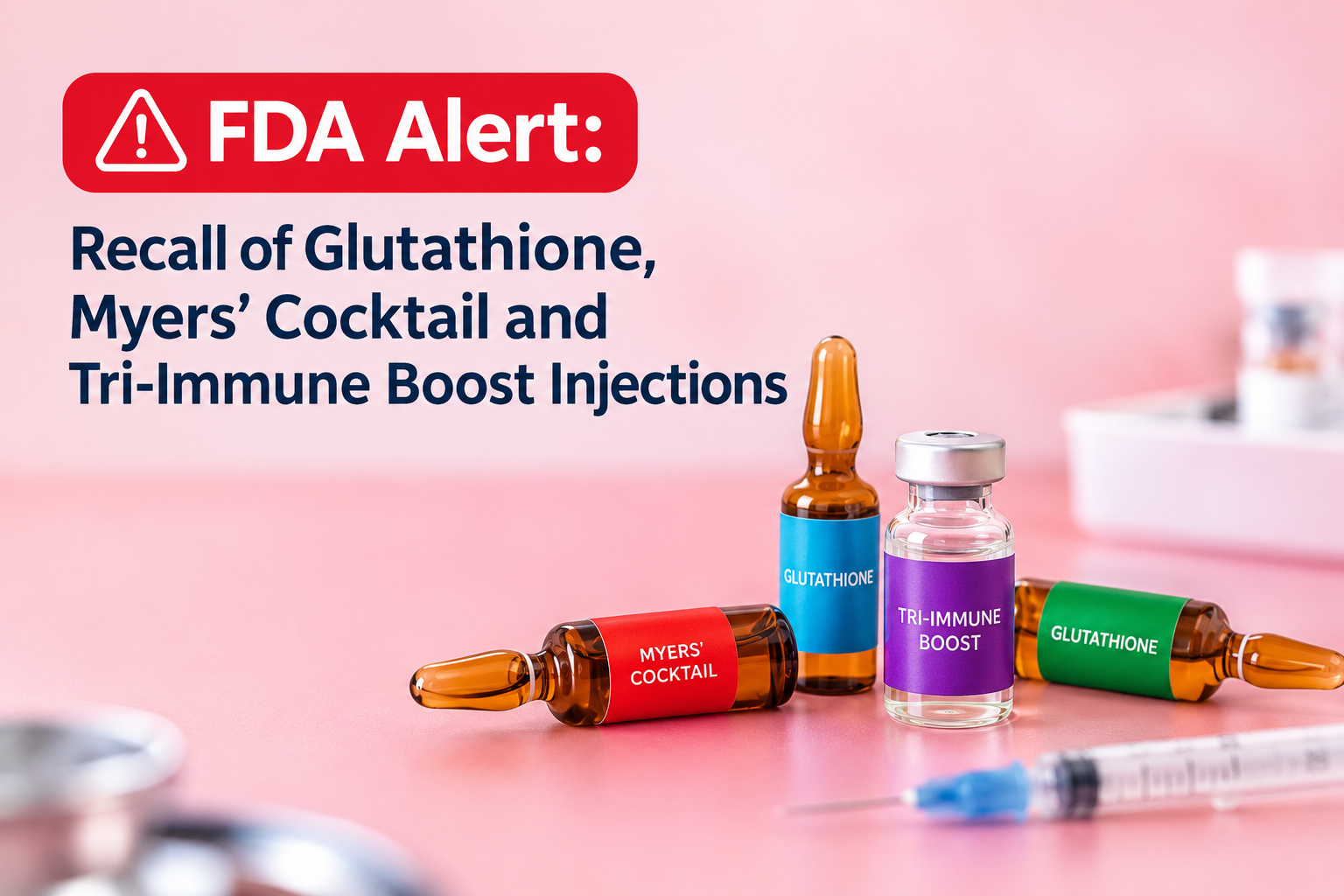
Centric Compounding is recalling affected compounded glutathione, Myers’ cocktail and Tri-Immune Boost injections nationwide, according to an FDA recall notice dated September 13, 2026. The concern is potential endotoxin exposure from injectable products, which can produce fever, hypotension, inflammatory reactions, shock and death.
For practices that stock or administer these injections, the first task is product control rather than clinical interpretation. Staff should compare every vial or syringe against the product names, package details, lot numbers and expiration dates listed in the FDA notice. Matching products should be removed from clinical areas, clearly marked as quarantined and handled under the recall’s return or disposal instructions.
That review should extend beyond the main medication refrigerator. Infusion rooms, procedure areas, satellite offices, mobile services, emergency kits and stock held for scheduled patients may have separate inventories. Practices that transferred products to another location should document where they went and communicate the recall to the receiving site.
The recall does not establish that every distributed unit contains excessive endotoxin or that every recipient will become ill. It identifies a product-quality risk serious enough to remove specified injections from use. Likewise, the absence of visible particles, discoloration or container damage does not establish that an injectable product is free of endotoxin.
Why endotoxin exposure matters
Endotoxins are lipopolysaccharide components of the outer membrane of gram-negative bacteria. Intravenous exposure can activate a brisk innate immune response. The resulting syndrome may resemble an infusion reaction, severe infection or sepsis, with fever and falling blood pressure among the most important warning signs.
FDA guidance treats pyrogen and bacterial endotoxin control as a distinct element of injectable-product quality. Endotoxin may remain after bacteria are no longer viable, so a product can present a pyrogen risk even when viable organisms are not recovered. Visual inspection also cannot detect endotoxin contamination.
Clinical severity depends on factors that include the level of contamination, the administered volume, the route and the recipient’s underlying condition. The recall notice warns of outcomes including inflammatory reactions, hypotension, anaphylactic shock and death. It does not provide a patient-level risk estimate, an exposure threshold or comparative rates for the three formulations.
Compounded drugs are not FDA-approved. As the agency explains in its compounding overview, it does not verify their safety, effectiveness or quality before they are marketed in the same manner as approved drugs. That regulatory distinction does not mean all compounded products are unsafe, but it makes prompt response to a specific quality recall especially important.
Immediate priorities for administering practices
A coordinated response should assign responsibility for inventory control, exposure identification, patient communication and adverse-event reporting. Pharmacy, nursing, medical leadership and quality or risk teams may each hold different portions of the necessary record.
The medication record should preserve the product name, strength or formulation, lot number when available, expiration date, quantity administered, route, administration date and time, and treatment location. Practices should not discard packaging or alter records needed to determine whether a recalled lot was used. If a lot number was not entered into the electronic health record, purchasing records, invoices, photographs, dispensing logs and remaining inventory may help reconstruct exposure.
Patient review should begin with administrations that can be linked directly to a recalled unit. Where traceability is incomplete, the practice may need to define a broader potentially exposed group based on delivery dates, stock rotation and documented use. The FDA notice should remain the controlling source for the recalled product identifiers; similarity of product names alone is not enough to classify an exposure.
Practices should also prevent new administrations. Electronic preference lists, standing orders, online scheduling pathways and preassembled infusion supplies may continue to direct staff toward a recalled product after physical stock has been removed. Scheduled recipients should be informed that the affected injection will not be administered, without substituting another compounded formulation unless it has been independently verified and is clinically appropriate.
Reviewing exposure and escalating symptoms
Exposure review should establish who received an affected product, when it was administered and whether symptoms occurred during or after the injection. Relevant documentation includes infusion-center observations, telephone encounters, portal messages, urgent-care visits, emergency transfers and hospitalizations. A symptom-free record is not equivalent to proof that the patient was contacted or assessed.
Patients identified as potentially exposed should receive clear information about the recall and the symptoms that warrant urgent evaluation. Fever, faintness, marked weakness, low blood pressure, breathing difficulty, confusion, collapse or a rapidly progressive systemic reaction should not be managed solely through routine portal messaging. Severe symptoms require emergency assessment under the practice’s established emergency protocols.
Clinical evaluation should be driven by presentation. Endotoxin-related inflammation can overlap with anaphylaxis, infection and sepsis, and a recalled injection does not rule out those alternatives. Timing relative to administration, vital signs, airway and respiratory findings, skin or mucosal findings, and evidence of organ dysfunction can help guide the differential diagnosis. The recall notice does not supply a unique diagnostic test or a product-specific antidote.
For patients who are currently well, the source does not specify an evidence-based observation period or endorse routine laboratory testing. Practices should avoid inventing a universal testing schedule unsupported by the notice. Follow-up can instead reflect the timing of exposure, symptoms, comorbidities and local clinical judgment, with a low threshold for reassessment if systemic symptoms emerge.
Suspected adverse events and product-quality problems can be reported through FDA MedWatch. Reports are more useful when they include the exact product and lot, administration timing, dose or volume recorded by the practice, symptom onset, clinical course, treatment setting and outcome. Reporting should complement, not delay, emergency care or the recall’s product-return process.
Evidence boundaries
This is a regulatory recall, not a clinical study. There is no study population, comparator, effect estimate, confidence interval or defined follow-up period in the cited notice. The evidence supports removal of the identified products and structured exposure review, but it cannot quantify an individual recipient’s probability of illness.
The notice also does not establish how uniformly endotoxin may be distributed across recalled units, whether risks differ among the three formulations or which patient characteristics predict severe outcomes. Counts of exposed patients, confirmed reactions, hospitalizations and deaths should not be inferred when the regulator has not reported them.
Traceability is another limitation in practice. Compounded preparations may be documented under local order names rather than the manufacturer’s exact formulation, while lot numbers may reside only in paper logs or purchasing systems. These gaps can widen the group considered potentially exposed and make timely reconciliation more difficult.
Questions clinicians ask
Should every glutathione or Myers’ cocktail injection be discarded?
No. The recall applies to products matching the identifiers in the FDA notice, not automatically to every similarly named compounded injection. Practices should compare manufacturer, formulation, lot and expiration details, quarantine matches and follow the recall instructions rather than relying on the product name alone.
What should we do if the lot number was not recorded?
Reconstruct the likely exposure using invoices, receiving records, stock counts, administration logs, delivery dates and any retained packaging. If a specific lot cannot be confirmed, document the uncertainty and define the potentially exposed group using the narrowest defensible inventory window, with input from pharmacy, quality and risk personnel.
Does a negative sterility result exclude endotoxin risk?
No. Sterility testing addresses viable microorganisms, whereas bacterial endotoxin is a pyrogenic cell-wall component that may persist without recoverable live bacteria. A negative culture or normal-looking vial therefore should not be used to release a product covered by the recall or to dismiss compatible systemic symptoms.
When should an exposed patient receive emergency evaluation?
Emergency assessment is warranted for severe or rapidly progressive systemic symptoms such as hypotension, breathing difficulty, confusion, collapse or signs of shock. Fever or an inflammatory reaction after exposure also merits prompt clinical review because endotoxin effects can overlap with anaphylaxis, infection and sepsis.
References
1. Centric Compounding Issues Nationwide Recall of Glutathione, Myers’ Cocktail, and Tri-Immune Boost Due to Endotoxin Risk — U.S. Food and Drug Administration, 2026 2. Pyrogen and Endotoxins Testing: Questions and Answers — U.S. Food and Drug Administration, 2012 3. Compounding and the FDA: Questions and Answers — U.S. Food and Drug Administration, n.d. 4. MedWatch: The FDA Safety Information and Adverse Event Reporting Program — U.S. Food and Drug Administration, n.d.
One story a day
The story of the day, in your inbox
One health journey each morning — no advice, no alarm, just company for the road.