FDA Class I Recall: Aspergillus Contamination in IV-Start and Convenience Kits
An FDA Class I recall covers IV-start and convenience kits containing skin-preparation products contaminated with Aspergillus penicillioides. Health systems need coordinated inventory tracing and exposure review.
 Written and medically reviewed byDr. Abu BakarContributing writer · PharmD, PhD (Pharmacology)
October 11, 2026 · 7 min read
Why the recall requires urgent review
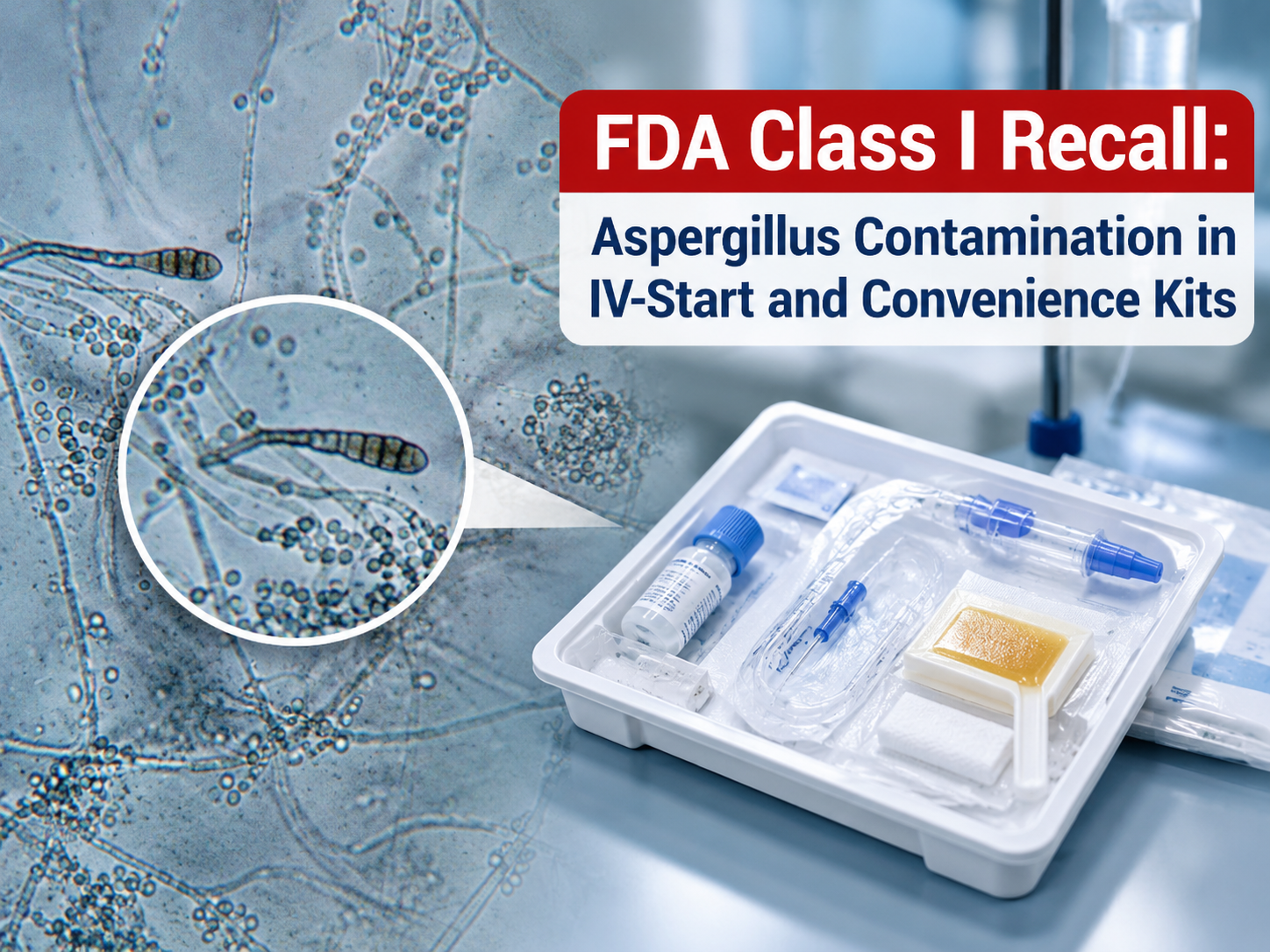
The FDA recall record, dated September 17, 2026, covers IV-start and convenience kits containing skin-preparation products contaminated with Aspergillus penicillioides. The agency warned that use of the affected products could result in systemic infection, sepsis, serious illness or death.
A Class I designation is the FDA’s most serious recall classification. It applies when there is a reasonable probability that use of, or exposure to, a violative product will cause serious adverse health consequences or death. The designation describes the potential severity and probability threshold underlying the regulatory action; it does not show that every exposed person will become infected.
The immediate operational concern extends beyond a central supply room. IV-start and convenience kits may be stocked in emergency departments, intensive care units, operating and procedure rooms, inpatient units, ambulatory clinics, infusion centers and vascular-access carts. Kits may also have been transferred to satellite sites or opened so that individual components could be stored separately.
Teams should therefore search by the identifiers in the FDA record and manufacturer communications rather than relying only on a familiar kit name or visual inspection. The review should cover unopened kits, procedure carts, automated or decentralized storage areas, unit stock and any separated skin-preparation components that remain traceable to an affected kit.
Who should own the response
No single department is likely to have all the necessary records. Supply chain can establish what was purchased and where it was distributed, while clinical units can determine whether kits were opened or used. Infection prevention and patient safety teams are positioned to define potential exposure and assess whether illness reports warrant investigation.
A practical division of responsibility is:
| Team | Primary review | Immediate contribution |
|---|---|---|
| Supply chain and materials management | Purchase, receipt, lot and internal distribution records | Locate and quarantine affected inventory across all sites |
| Nursing, vascular access and procedural services | Unit stock, carts and documented kit use | Identify where and when implicated products may have been used |
| Pharmacy | Kits or components stored or distributed through pharmacy-controlled areas | Reconcile decentralized inventory and preserve traceability |
| Infection prevention and infectious diseases | Potential exposures and compatible clinical events | Develop case-review criteria and escalation pathways |
| Microbiology laboratory | Specimens from patients with suspected infection | Support appropriate testing and organism identification |
| Patient safety, risk management and occupational or public health partners | Reporting and communication obligations | Coordinate documentation, notifications and external reporting |
Quarantined products should remain segregated and clearly labeled so they cannot return to circulation. Disposal, return and reporting should follow the recall instructions and institutional policy. Independently culturing recalled products is not a substitute for following the regulator’s process and may complicate specimen handling or chain-of-custody requirements.
How to approach exposure review
The recall record is a regulatory safety action, not an epidemiologic study. It does not provide a patient population, comparator group, exposure denominator, attack rate, effect estimate, confidence interval or follow-up period. It therefore cannot quantify an individual patient’s probability of infection or prove that a clinical event was caused by the recalled product.
Exposure review should begin with the implicated lot and distribution details, followed by a search of local receiving and use records. If electronic documentation does not capture the exact kit or skin-preparation component, investigators may need to combine purchasing data, unit distribution logs, procedure records and the dates during which affected inventory was available.
Priority should reflect both exposure plausibility and clinical vulnerability. Patients with substantial immune compromise, including prolonged neutropenia, hematologic malignancy or transplantation, are at increased risk for invasive aspergillosis generally. However, the FDA warning is not limited to those groups. A contaminated product used during vascular access may warrant review in other patients because the recall specifically identifies systemic infection and sepsis as potential outcomes.
The presence of a recalled kit in a care area is not equivalent to patient exposure. Likewise, documentation that a kit was used does not establish that contamination reached the patient or caused infection. Response protocols should preserve those distinctions while avoiding an exposure definition so narrow that meaningful cases are missed.
Clinical surveillance and escalation
Facilities should establish a route for clinicians to report patients with compatible illness after potential exposure. Relevant findings may include unexplained fever, worsening systemic illness, sepsis, local inflammation at an access site or another syndrome that raises concern for an invasive fungal infection. These findings are nonspecific and require clinical evaluation rather than automatic attribution to the recalled product.
Suspected cases merit early involvement of infectious diseases, infection prevention and the microbiology laboratory. Testing should be selected for the patient’s syndrome and host factors. The CDC notes that aspergillosis can be difficult to diagnose and may require imaging, culture, microscopy, histopathology or fungal biomarkers; no single result should be interpreted without clinical context.
The available regulatory evidence does not support automatic antifungal treatment, routine fungal testing of every potentially exposed person or screening based solely on the presence of recalled inventory. Such steps could produce false reassurance, false-positive findings or avoidable treatment harms. Institutions should instead define symptom-triggered and risk-informed pathways, with a lower threshold for specialist assessment in severely immunocompromised patients.
Any patient communication should state what is known, what remains uncertain and what symptoms should prompt medical attention. Decisions about individual notification should be coordinated through infection prevention, patient safety, risk management and applicable public health channels because the FDA record alone does not specify a universal notification threshold or follow-up duration.
Important evidence gaps
The recall establishes contamination and a serious potential hazard, but the public record does not quantify how many kits were used, how many patients were exposed or whether confirmed infections have been linked to the products. It also does not provide an incubation window, a validated screening strategy or a standard duration of surveillance.
Those limitations should not delay inventory control. They should shape the subsequent clinical review: track denominators where possible, use consistent case definitions, preserve product and patient traceability, and avoid implying causation before microbiologic and epidemiologic evidence supports it.
Questions clinicians ask
Which patients should be considered potentially exposed?
Potential exposure generally requires documented or plausible use of an affected kit or its implicated skin-preparation component, not merely treatment in a unit where the kits were stocked. When product-level documentation is incomplete, facilities may need to define a conservative cohort using lot availability, distribution dates, procedure records and unit location.
Should asymptomatic patients receive fungal testing or treatment?
The recall record does not establish a routine testing or preventive-treatment strategy for asymptomatic people. Decisions should account for exposure plausibility, immune status and the limitations of available tests, with infectious-diseases consultation for patients at particularly high risk rather than automatic antifungal therapy for everyone in a possible exposure cohort.
What findings should prompt urgent evaluation?
Unexplained fever, sepsis, deterioration without a clear cause, access-site abnormalities or features suggesting invasive fungal disease should prompt assessment when exposure is plausible. These findings are not specific to aspergillosis, so evaluation should include alternative causes while involving infection prevention, infectious diseases and microbiology when suspicion persists.
How long should facilities look back?
The FDA record does not provide a universal patient lookback or surveillance period. Facilities should reconstruct the interval during which affected lots were received, distributed and available for use, then align clinical review with that local timeline and any subsequent manufacturer, FDA or public health instructions.
References
1. Recall of IV-Start and Convenience Kits Contaminated With Aspergillus penicillioides — U.S. Food and Drug Administration, 2026 2. Recalls Background and Definitions — U.S. Food and Drug Administration, n.d. 3. Clinical Overview of Aspergillosis — Centers for Disease Control and Prevention, n.d.
One story a day
The story of the day, in your inbox
One health journey each morning — no advice, no alarm, just company for the road.