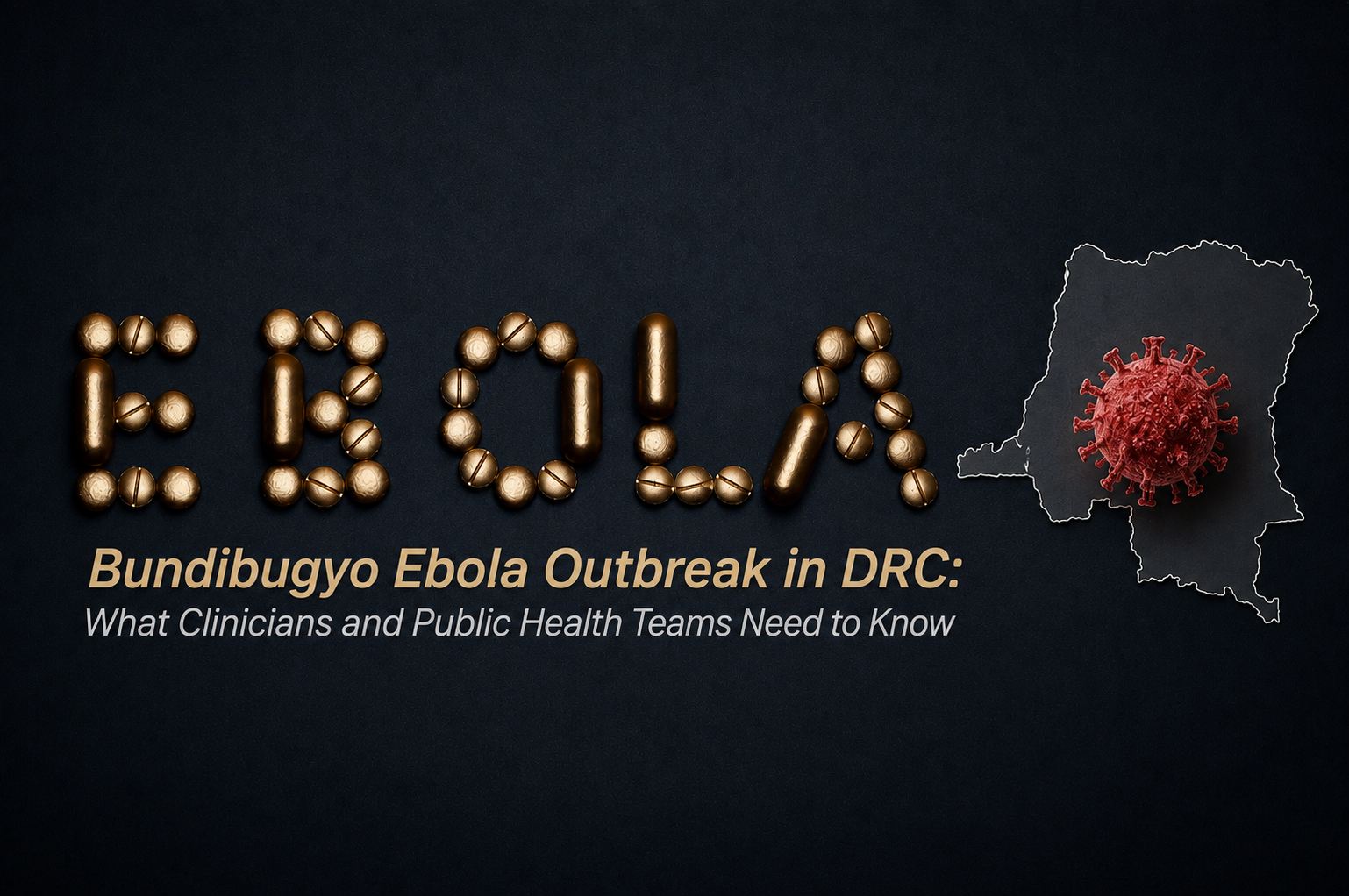
Ebola and Marburg Clinical Care Standards Unified by WHO
WHO has issued a unified framework for clinicians and outbreak teams managing Ebola and Marburg disease, linking supportive care with infection prevention, workforce protection, and coordinated response.
 Written and medically reviewed byRayan SalihContributing writer · PharmD, RPh
September 16, 2026 · 7 min read
One framework for filovirus care
The World Health Organization has consolidated recommendations for Ebola and Marburg disease into comprehensive clinical guidance intended to reduce variation between treatment centers and outbreak responses. The central operational change is integration: case management, infection prevention and control, laboratory coordination, workforce safety, and broader response functions should not be treated as separate workstreams.
That matters because outcomes and transmission risk are shaped by the same early decisions. Rapid recognition and separation of a suspected case can protect staff and other patients while also accelerating diagnostic testing, fluid assessment, treatment of complications, and referral to an appropriate high-level isolation setting.
The recommendations apply across the care pathway, from screening and transport through treatment, discharge, or safe postmortem management. They are relevant to clinicians, infection prevention teams, emergency medical services, laboratories, facility leaders, and public health authorities. Implementation must still be adapted to available staffing, infrastructure, outbreak epidemiology, and the filovirus species involved.
The guidance is normative rather than a newly reported clinical trial. WHO’s announcement does not describe a single study population, comparator, sample size, effect estimate, confidence interval, or follow-up period. Instead, it presents a standardized approach based on the organization’s evidence review and accumulated outbreak experience.
What changes at the bedside
Early supportive care remains the foundation. Patients with Ebola or Marburg disease can develop fever, vomiting, diarrhea, poor oral intake, electrolyte abnormalities, shock, bleeding, organ dysfunction, and secondary infections. Structured reassessment is therefore essential, with attention to hydration, hemodynamic status, oxygenation, glucose, electrolytes, kidney function, pain, nutrition, and signs of complications.
Clinicians should preserve a broad differential diagnosis while filovirus testing is underway. Malaria, bacterial sepsis, enteric infections, and other locally prevalent diseases may resemble or coexist with Ebola or Marburg disease. Isolation should not prevent timely evaluation and empiric management of plausible, treatable conditions, provided procedures can be performed safely.
The same principle applies to diagnostics. Sampling plans should be coordinated with designated laboratories and public health authorities, including requirements for specimen collection, packaging, transport, repeat testing, and result communication. A negative result obtained too early in illness may not always settle the diagnosis; decisions about repeat testing and release from isolation should follow the applicable case definition and public health protocol.
Therapeutics must be matched to the virus. Antibody treatments with evidence for disease caused by Zaire ebolavirus should not be assumed to work against other Ebola virus species or Marburg virus. WHO’s Marburg fact sheet notes that supportive care improves survival prospects but that no approved vaccine or antiviral treatment is currently available specifically for Marburg disease. The unified framework does not make these diseases pharmacologically interchangeable.
| Care domain | Immediate priority | Operational safeguard |
|---|---|---|
| Triage | Identify exposure history and compatible illness early | Separate the patient without delaying urgent stabilization |
| Clinical management | Begin structured supportive care and frequent reassessment | Use protocols that remain feasible inside isolation areas |
| Diagnostics | Coordinate filovirus testing and evaluate alternative diagnoses | Follow designated specimen-handling and transport pathways |
| Therapeutics | Use disease- and species-appropriate evidence | Do not extrapolate Ebola-specific efficacy to Marburg disease |
| Continuity | Plan referral, discharge, follow-up, or postmortem care | Communicate responsibilities across clinical and public health teams |
Infection prevention is part of treatment
Filoviruses are transmitted through direct contact with infected blood or other body fluids, contaminated materials, and the bodies of people who have died from the disease. Safe care therefore depends on controlling exposure at every patient contact rather than relying on personal protective equipment alone.
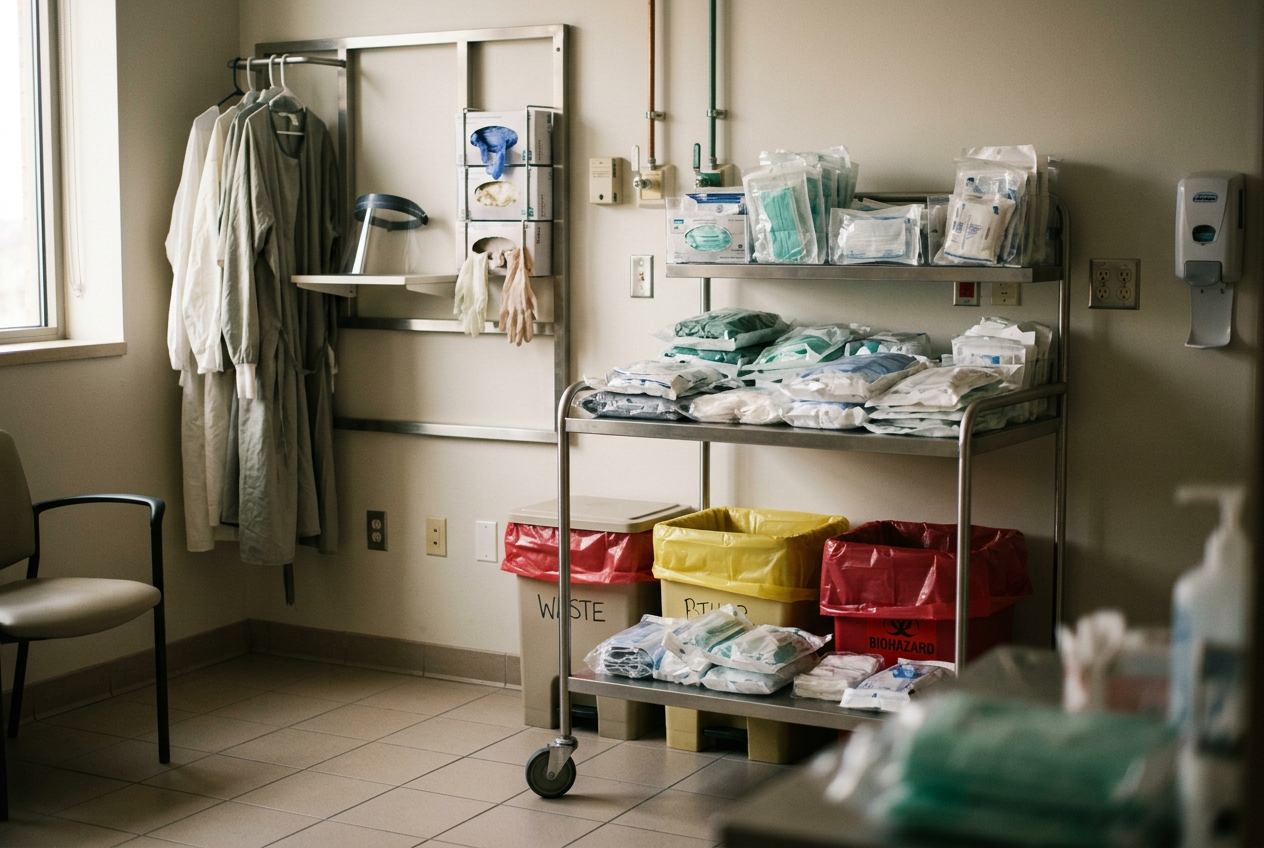
Facilities need a layered program: screening and controlled entry, appropriate patient placement, restricted access, trained staffing, reliable hand hygiene, environmental cleaning, safe injection practices, waste management, and procedures for linen, laboratory specimens, and deceased patients. Confirmed patients may require cohorting where single rooms are unavailable, but suspected and confirmed cases should not be mixed indiscriminately.
Personal protective equipment should be selected according to the task and anticipated exposure. More coverage or complexity is not automatically safer if staff cannot don, work in, and remove the equipment correctly. Training, observed practice, a buddy or trained observer system, and immediate access to replacement supplies are practical defenses against contamination during removal.
Procedures that create splashes, involve sharps, or may generate aerosols require specific risk assessment and controls. Ebola and Marburg disease should not be casually described as airborne infections; nevertheless, airway management and other high-risk procedures can increase opportunities for exposure and demand appropriate respiratory, eye, face, and body protection under the relevant protocol.
Occupational exposure plans should be established before a case arrives. Staff need a clear route for immediate reporting, first aid after sharps or mucous-membrane exposure, confidential assessment, symptom monitoring, work restrictions when indicated, and access to public health follow-up. Fatigue, heat stress, understaffing, and poor communication can undermine technically correct precautions.
From a guideline to an outbreak system
Standardization is most useful when it extends beyond the isolation room. Referral hospitals, ambulance services, laboratories, health ministries, border and community health teams, and burial teams need compatible definitions, communication routes, and escalation criteria. Fragmented protocols can delay transfers, duplicate testing, or expose personnel during handoffs.
For US facilities, the practical implication is preparedness rather than routine filovirus treatment at every hospital. Frontline sites need to recognize and isolate a possible case, protect staff, obtain an exposure and travel history, and promptly involve infection prevention and public health authorities. Ongoing care and testing should then be coordinated with the appropriate jurisdictional and special-pathogen network.
Resource-limited settings face different constraints, including unreliable electricity or water, restricted laboratory access, shortages of trained staff, and long transport distances. A comprehensive standard can define the goal, but implementation plans must specify minimum safe staffing, supply continuity, referral options, and contingencies when ideal isolation infrastructure is unavailable.
Community engagement also remains indispensable. Fear, stigma, or unclear communication may delay presentation and complicate contact tracing or safe burial. Clinical and infection-control programs work better when communities understand why separation, testing, monitoring, and changes to customary caregiving or funeral practices are necessary.
Evidence limits and remaining gaps
The WHO announcement establishes the scope and direction of the guideline but does not provide trial-style numerical estimates for the complete package. The independent contribution of each component—such as staffing models, monitoring frequency, or particular infection-control configurations—cannot be quantified from the announcement. Recommendations may combine direct evidence, indirect evidence, outbreak observations, feasibility considerations, and expert judgment.
Generalizability also varies. Findings from Ebola treatment units in large outbreaks may not transfer fully to an isolated imported case in a highly resourced hospital, while recommendations developed around Ebola cannot automatically establish therapeutic efficacy for Marburg disease. Access to diagnostics, investigational products, blood products, intensive care, and trained personnel remains uneven.
Priority gaps include effective Marburg-specific treatments and vaccines, evidence for less common Ebola virus species, optimized care for children and pregnant patients, and implementation research on safe models in facilities with constrained staffing and infrastructure. Standardization creates a common baseline; it does not eliminate those uncertainties.
Questions clinicians ask
Should supportive care wait for laboratory confirmation?
No. A patient with a credible exposure and compatible illness should be separated promptly, but urgent stabilization and structured supportive care should proceed using appropriate precautions. Evaluation for malaria, bacterial sepsis, and other treatable diagnoses should continue because filovirus disease can resemble or coexist with common infections.
Can an Ebola antibody treatment be used for Marburg disease?
Evidence for an Ebola-specific antibody should not be extrapolated to Marburg virus. Therapeutic decisions must account for the identified species, available evidence, authorization status, and outbreak protocol. For Marburg disease, WHO continues to emphasize early supportive care while candidate vaccines and treatments are evaluated.
Is personal protective equipment enough to prevent transmission?
No. Personal protective equipment is one element of a layered program that includes early recognition, patient separation, hand hygiene, controlled access, environmental cleaning, specimen and waste management, trained observers, and exposure reporting. Protection can fail when equipment is poorly selected, supplies are inconsistent, or removal is rushed.
What should a hospital do before an outbreak occurs?
Hospitals should define screening, isolation, notification, specimen, transfer, occupational exposure, and waste pathways before they are needed. Staff who may encounter a suspected case require role-specific practice, while leaders should establish contacts with public health authorities, laboratories, emergency transport services, and designated special-pathogen treatment centers.
References
- WHO issues comprehensive guidelines on filovirus disease, including Ebola and Marburg disease — World Health Organization, 2026
- Ebola disease — World Health Organization, n.d.
- Marburg virus disease — World Health Organization, n.d.
One story a day
The story of the day, in your inbox
One health journey each morning — no advice, no alarm, just company for the road.