Andes Virus Cluster Prompts Cruise Ship Case Protocols
A cruise ship-linked Andes virus cluster highlights how clinicians and public-health teams should test suspected cases, monitor contacts and coordinate safe disembarkation.
 Written and medically reviewed byRayan SalihContributing writer · PharmD, RPh
September 9, 2026 · 7 min read

Why Andes virus changes the shipboard response
The World Health Organization’s July 2026 outbreak notice describes a hantavirus cluster associated with cruise travel and sets out procedures for cases and contacts. Andes virus changes the usual hantavirus calculation. Rodent exposure still matters, but person-to-person transmission has been documented, especially after close or direct contact with an infected person.
The notebook matters early. A clinician can put the illness history on one page and the exposure timeline on the next, which helps separate a passenger who shared a cabin with a case from someone who crossed the same dining area once. Fever and muscle aches cannot make that distinction.
Early illness may look unremarkable: fever, myalgia, headache and gastrointestinal symptoms. It can become severe if pulmonary capillary leak develops, with low oxygen levels, hypotension and respiratory failure. Thrombocytopenia, hemoconcentration and leukocytosis may add to the concern. None of those findings confirms Andes virus infection.
The exposure history should cover the itinerary, cabin assignment, shore excursions and time in enclosed areas where rodent contamination may have been present. Close contact with a suspected or confirmed case belongs there too. Reconstructing those encounters gets harder after passengers leave the ship and return to different states or countries, and a shared voyage, even a long one, does not make every person on the manifest a meaningful contact.
Dates belong in the notebook, even when a passenger can offer only a month or a rough sequence. Public-health teams need the timing and character of a credible encounter to decide who requires follow-up and how long it should last.
Laboratory testing should be targeted and coordinated
A person with compatible symptoms and a plausible exposure should be discussed promptly with the appropriate public-health authority. Testing generally belongs at a designated public-health or reference laboratory, rather than through an unvalidated assay aboard the ship. The receiving laboratory decides which specimens it needs and how they should be packaged and transported.
Acute infection may be evaluated with reverse-transcription polymerase chain reaction and hantavirus serology. Detectable virus-specific immunoglobulin M supports recent infection. Immunoglobulin G has to be read alongside the timing of symptoms, clinical findings and paired specimens when those are available. An early negative result may not exclude infection, and repeat sampling can be appropriate when suspicion remains high.
| Clinical situation | Laboratory approach | Practical interpretation |
|---|---|---|
| Compatible symptoms plus a qualifying exposure | Contact public health and collect the specimens requested by the designated laboratory | Manage the person as a suspected case while confirmation is pending |
| Early illness with an initial negative result | Review when the specimen was collected and consider repeat molecular or serologic testing | One early negative result may be insufficient to exclude infection |
| Asymptomatic contact | Do not substitute broad testing for follow-up | Classify the exposure and arrange symptom monitoring |
| New symptoms during monitoring | Isolate the person, reassess the illness and arrange diagnostic testing | Treat the contact as a possible case until evaluated |
Testing every passenger and crew member is unlikely to clarify the situation. An asymptomatic person may test negative while an infection is incubating, and that result cannot provide lasting clearance. Broad screening also consumes limited laboratory capacity and can produce findings that are difficult to interpret when no one has recorded an exposure date or a clear specimen timeline.
Severity has to be assessed at the same time. Pulse oximetry, blood pressure, a complete blood count, kidney and liver measures, chest imaging and other studies can guide supportive care, though none is specific to Andes virus. Respiratory compromise or hemodynamic instability calls for transfer to a facility equipped for critical care. No specific FDA-approved antiviral treatment has been shown to reliably prevent progression.
A test result should return to the notebook beside the symptoms and exposure entries, rather than sit alone on a portal. A negative result collected early in the illness carries a different meaning from one obtained later, and the next clinician needs to see that difference without rebuilding the entire timeline.
Contact management depends on exposure, not location alone
Public-health teams need a working line list drawn from passenger manifests, crew rosters, cabin records, medical logs and interviews. Its purpose is straightforward: distinguish people who occupied the same ship from those who had close, prolonged or direct contact with a suspected or confirmed case.
Sharing a cabin creates a different concern than passing someone in a public area. Intimate or household-like contact, direct exposure to respiratory secretions or other body fluids, and hands-on care without appropriate protective equipment may warrant closer follow-up. Possible contact with aerosolized rodent urine, feces or saliva needs its own assessment.
The WHO event notice and the responsible national authority should guide the infectious period, exposure categories and monitoring duration. If public health specifies it, follow-up may continue for 42 days after the last qualifying exposure. The plan should identify where the person will stay, which local authority will maintain contact and what will happen if symptoms start.
Contacts need plain information about fever, muscle aches, headache, gastrointestinal symptoms, cough and shortness of breath. Someone who becomes ill during monitoring should alert public health before arriving for care, avoid shared transportation and crowded places when feasible, and be evaluated with infection-control precautions in place. Advance notice lets the receiving facility reduce avoidable exposures during arrival and assessment.
Quarantine, movement restrictions and the choice between active and self-monitoring are risk-based public-health decisions. The outbreak notice does not support treating every passenger as equally exposed. Feeling well during one check does not necessarily end follow-up.
This is where the notebook can get untidy. One passenger may have shared a cabin with an ill traveler and then flown home, while another recalls rodent waste during a shore visit but no close contact with the case, and those histories should not be pressed into the same category just because both people appeared on the manifest.
Disembarkation requires a handoff, not simply permission
A suspected or confirmed case should leave the ship through a planned transfer coordinated among the ship’s medical team, port health officials, emergency medical services and the receiving hospital. The handoff needs the course of symptoms, current clinical status, laboratory work and relevant exposures. It should identify anyone accompanying the patient as well. If an aerosol-generating procedure is required, respiratory protection and the receiving facility’s infection-control procedures become especially important.
Asymptomatic contacts may not require hospital transfer. Disembarkation can be considered after the receiving jurisdiction accepts follow-up, dependable contact information is available and the person understands how to report symptoms. Authorities may add measures based on the intensity of exposure and local law.
Travel makes the handoff less tidy than it sounds. A passenger may leave the port, pass through several jurisdictions and arrive home while the monitoring period is still underway, which means officials have to settle who will maintain contact and how the necessary information will move between public-health teams. Passenger information should be limited to what the response requires and handled under applicable privacy rules.
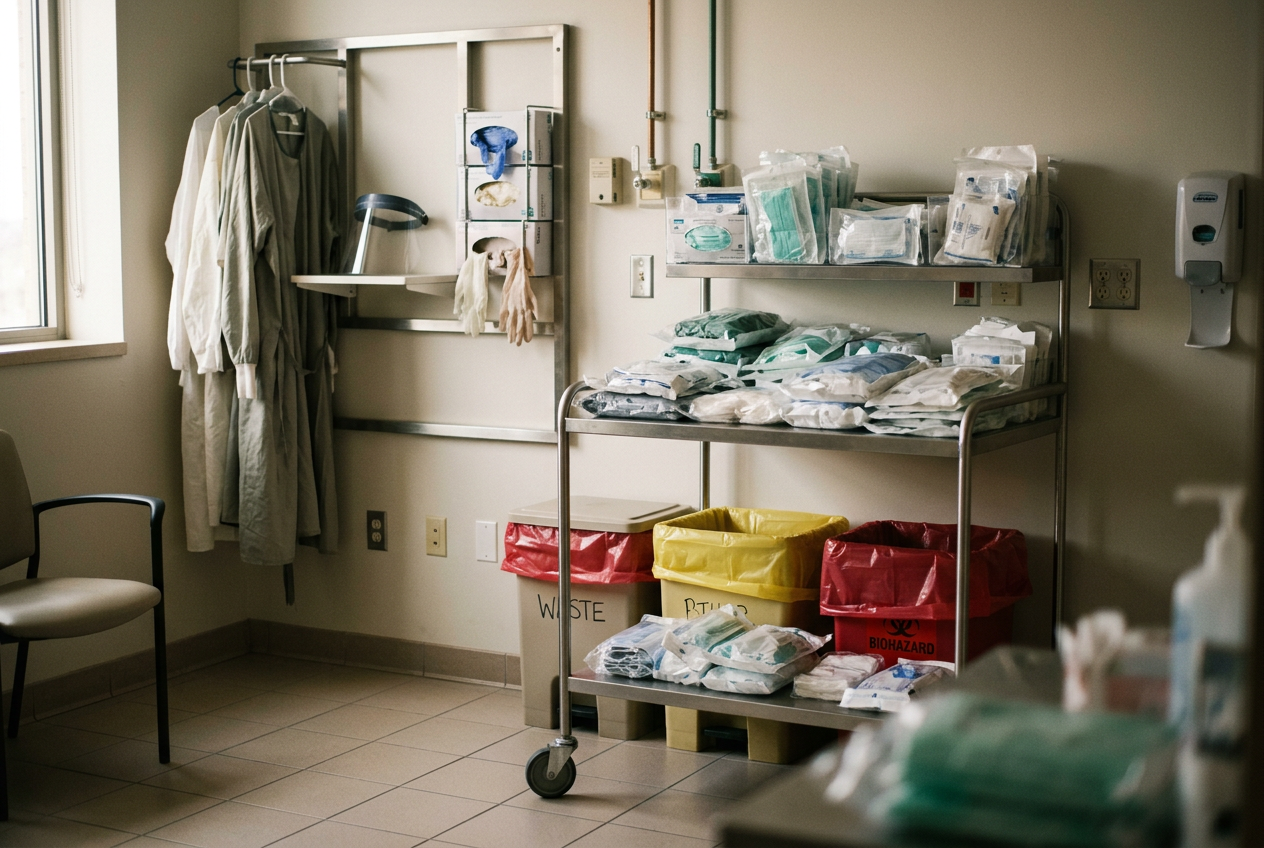
Cruise operators should retain manifests, cabin assignments, duty schedules and medical records. Cleaning crews need instructions for areas that may contain rodent material or patient secretions. Suspected rodent waste should not be dry swept or vacuumed, which can put contaminated particles into the air; approved wet-disinfection methods are preferred.
Walking down the gangway is not the handoff. The useful record is the one that stays with the response, with the last known exposure, destination and unresolved laboratory work entered in the notebook before responsibility passes to another team.
What the outbreak report cannot establish
The WHO notice describes an outbreak investigation, not a randomized or comparative study. It offers no treatment comparator, effect estimate, confidence interval or standardized follow-up analysis. Epidemiologic links can point to plausible transmission chains, but they may not reveal how every infection occurred, especially when rodent exposure and close interpersonal contact happened during the same trip.
A small cruise-associated cluster cannot stand in for every ship or every hantavirus exposure. Cabin sharing, ventilation, itineraries and access to port health services vary. Local teams have to work from the WHO event notice and adapt the response to the jurisdiction in charge, rather than treat one cluster as a permanent rule for every vessel.
Some uncertainty should remain on the page. A passenger may remember seeing rodent droppings but not recall when, or remember a long conversation with an ill traveler without knowing whether there was contact with secretions. Turning either account into a precise exposure date would make the notebook neater and the investigation less honest.
Questions clinicians ask
Should every passenger be tested before leaving the ship?
No. Testing is most useful for someone with compatible symptoms and a defined epidemiologic link. An asymptomatic passenger may receive a negative result before an infection becomes detectable, so testing should not replace exposure classification, symptom information or monitoring arranged by public health.
What should happen if a monitored contact develops fever?
The contact should notify the designated public-health team before seeking in-person care, avoid shared transportation when feasible and receive prompt clinical assessment. Clinicians should reconstruct the exposure timeline, use appropriate precautions and coordinate molecular and serologic testing with the responsible laboratory.
Can an asymptomatic close contact disembark?
Potentially. Disembarkation should be coordinated rather than automatic. Public-health authorities need reliable contact information, an accepted monitoring plan and a clear route to evaluation if symptoms develop. A higher-risk exposure may lead the receiving jurisdiction to impose movement restrictions.
Does an initial negative test rule out Andes virus infection?
Not necessarily. Diagnostic sensitivity depends on the stage of illness, specimen quality and assay type. If the symptoms and exposure remain strongly compatible, clinicians should consult the laboratory and public-health authority about repeat specimens while maintaining the case-management and infection-control measures appropriate to a possible case. The first result stays in the notebook beside the month in which it was collected.
Questions people ask
Should every passenger on the cruise ship be tested for Andes virus?
The response did not treat broad passenger testing as useful. Teams learned that an early negative result in an asymptomatic person could not provide lasting clearance, so they focused on symptoms, credible exposures and public-health follow-up.
Can an asymptomatic close contact disembark from the ship?
The plan allowed disembarkation to be considered after the receiving jurisdiction accepted follow-up. Teams also needed dependable contact information, a monitoring plan and a clear route to evaluation if symptoms developed.
Does an initial negative test rule out Andes virus infection?
The investigation showed that it might not, especially when the specimen was collected early. Clinicians recorded the timing beside the result and coordinated possible repeat molecular or serologic testing when symptoms and exposure remained strongly compatible.
References
- Hantavirus outbreak linked to cruise ship travel — World Health Organization, 2026
- Clinical Overview of Hantavirus — Centers for Disease Control and Prevention, n.d.
- About Hantavirus — Centers for Disease Control and Prevention, n.d.
One story a day
The story of the day, in your inbox
One health journey each morning — no advice, no alarm, just company for the road.