CDC 2026 Malaria Update: Artemether-Lumefantrine Extended to 5 Days for P. falciparum
CDC now recommends a five-day, 10-dose artemether-lumefantrine course for uncomplicated falciparum malaria and after IV artesunate, plus inpatient daily smears for falciparum, knowlesi or unknown species.
 Written and medically reviewed byDr. Abu BakarContributing writer · PharmD, PhD (Pharmacology)
September 7, 2026 · 6 min read
The changes at the bedside
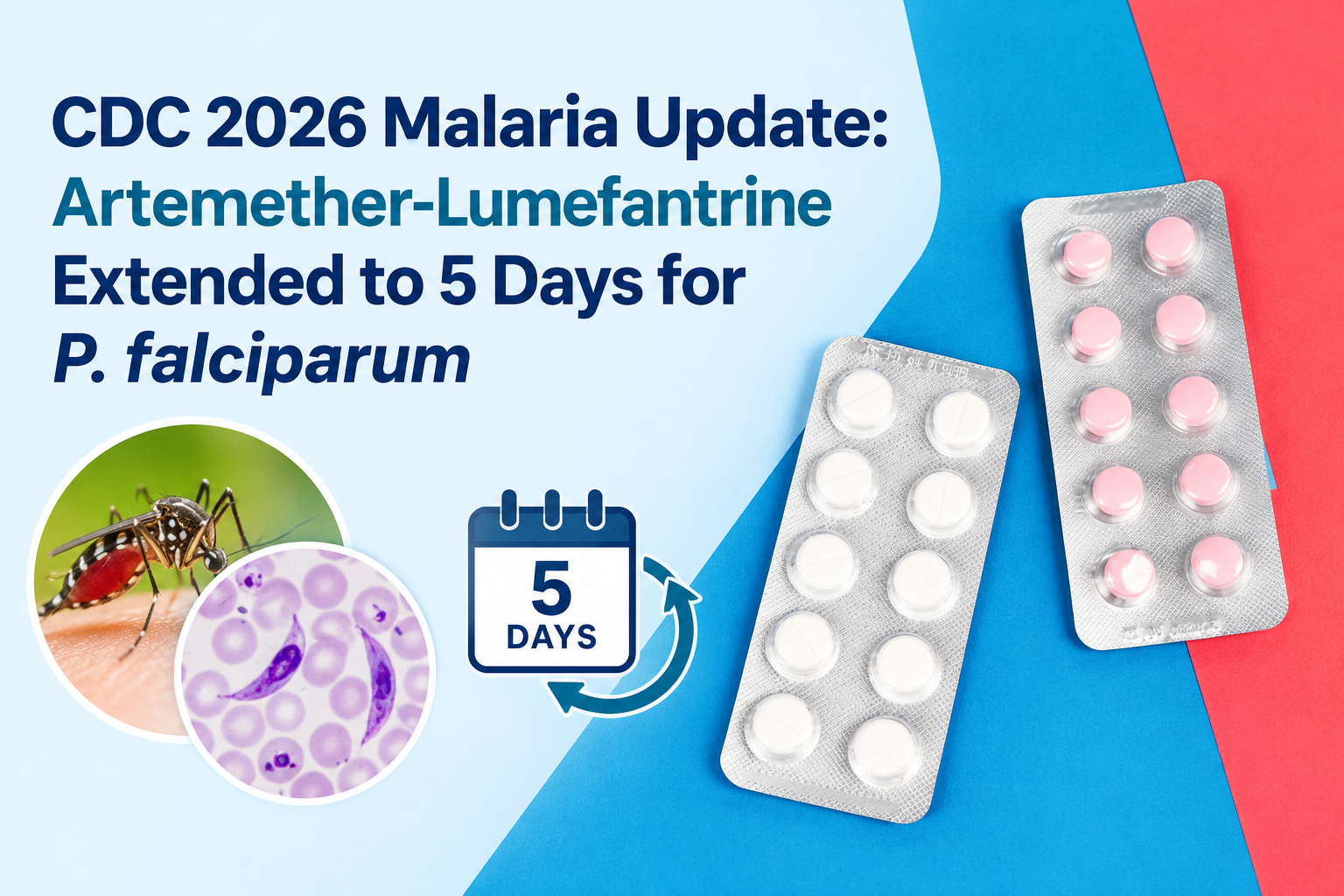
The most useful object for understanding this update may be a pill organizer. A familiar three-day treatment no longer fills the right amount of space. Under the revised CDC guidance, artemether-lumefantrine now extends across five days, with 10 weight-based doses, when clinicians select it for uncomplicated P. falciparum malaria.
The same longer course applies after parenteral artesunate for severe malaria. Once a patient is ready to move to oral treatment, the artesunate already given does not replace any part of the 10-dose artemether-lumefantrine course. That is easy to miss if an electronic prescription still defaults to the older schedule or if the discharge discussion begins with what the patient has already received rather than what remains in the pill organizer.
CDC’s July 2026 update changes two practical parts of US malaria care. One is the duration of artemether-lumefantrine treatment. The other is the level of observation recommended for infections that can worsen quickly, even when the first examination is reassuring. Emergency department pathways, inpatient order sets, and pharmacy defaults may still reflect the six-dose course over three days in the US prescribing information.
| Clinical situation | Artemether-lumefantrine course under updated CDC guidance | Monitoring change |
|---|---|---|
| Uncomplicated P. falciparum malaria | 10 weight-based doses over five days when selected | Hospitalize and obtain daily blood smears |
| Oral follow-on after IV artesunate | Full 10-dose, five-day course when selected | Continue inpatient clinical and parasitologic assessment |
| P. knowlesi infection | Follow the applicable CDC treatment pathway | Hospitalize and obtain daily blood smears |
| Species not yet determined | Manage monitoring as potentially falciparum infection | Hospitalize and obtain daily blood smears while identification proceeds |
Hospitalization does not mean every falciparum, knowlesi, or undifferentiated infection is severe malaria. The recommendation reflects the possibility that parasitemia may rise or the patient may deteriorate after an initially stable presentation. Severe manifestations still call for prompt IV artesunate and supportive care suited to the organ dysfunction present.
The difference between three days and five may look modest on a screen. At discharge, it changes the prescription, the supply that must be available, and the conversation with the patient who is looking down at the pill organizer and trying to understand why treatment continues after the fever has eased.
Applying the longer regimen safely
Blood-smear microscopy remains the foundation of confirmation, with parasite density documented when falciparum malaria is present or cannot yet be ruled out. A rapid diagnostic test may support the initial diagnosis, but it cannot replace microscopy for measuring parasitemia or following the response over time. Species identification can continue while treatment is underway; care should not wait if falciparum infection remains possible.
Artemether-lumefantrine is one option for uncomplicated falciparum malaria, not the only regimen. Selection depends on where the infection was acquired and prior antimalarial exposure, along with contraindications, interactions, pregnancy status, and whether the patient can absorb oral medication. The five-day duration applies when artemether-lumefantrine is the drug selected.
How the medication is taken still matters. Food intake affects artemether-lumefantrine exposure, while vomiting or poor oral tolerance can undermine treatment. The FDA prescribing information remains the source for administration precautions and interaction risks. The CDC table supplies the updated weight-based course.
That split between two sources is where routine systems can become unreliable. A pharmacy screen may continue to populate the labeled three-day regimen, while the CDC page calls for 10 doses over five days. Someone has to notice the mismatch before the tablets reach the pill organizer, particularly when the patient is a child and the dose must come from the current weight-based table rather than an improvised tablet count.
Daily smears should show a trend rather than a stack of positive-or-negative results. When parasite density can be measured, the report allows the treating team to see whether parasitemia is falling as expected. Rising density or persistent symptoms should prompt reassessment, as should new organ dysfunction or an inability to keep oral medication down, because any of those findings may change how the case is classified and treated.
Transitioning after IV artesunate
Patients receiving IV artesunate need serial clinical assessment and repeated measurement of parasitemia. CDC guidance allows a transition to oral follow-on treatment after the patient can tolerate oral medication and parasite density has fallen to the threshold in the severe-malaria pathway. If artemether-lumefantrine is chosen, the next step is the full 10-dose course over five days.
The arithmetic is plain but easy to get wrong: doses of IV artesunate are not subtracted from the oral course.
A transition therefore involves more than sending a prescription to the pharmacy. The treating team needs the latest smear and a weight-based dose, along with evidence that the patient can take oral medication and obtain the complete supply, because a five-day plan is not complete if the pill organizer runs out after the old three-day default.
Discharge also should not rest on completion of the first oral dose. Falciparum malaria now carries an inpatient monitoring recommendation, and the decision to leave the hospital depends on the criteria in current CDC guidance together with the patient’s clinical course and serial parasitemia.
Follow-up remains important after IV artesunate because post-artesunate delayed hemolysis can appear after the acute infection has improved. The CDC severe-malaria guidance describes the timing and components of laboratory follow-up. Extending artemether-lumefantrine completes antimalarial treatment under the revised pathway; it does not replace surveillance for artesunate-associated hemolysis.
What the evidence does and does not establish
This update is federal clinical guidance, not a randomized trial report. The CDC page does not provide a study population or sample size, and it does not report a randomized comparison with an effect estimate and confidence interval for the five-day regimen. It changes the US practice standard, but the page alone does not quantify how much the longer course lowers treatment failure compared with the labeled three-day course.
The guidance addresses malaria diagnosed and treated in the United States, where case volume and access to experienced microscopy differ from conditions in endemic settings. Some hospitals have managed selected uncomplicated cases outside the inpatient setting. The hospitalization recommendation may require them to revise their approach, particularly where rapid microscopy or access to oral and IV antimalarials has not been routine.
There is also a live mismatch between the CDC recommendation and the current US prescribing-information schedule. Hospitals will need to separate newer public-health guidance from older label-based defaults without turning that distinction into paperwork for its own sake. At the bedside, the mismatch remains visible in a very ordinary object: the pill organizer has five days to account for, not three.
Malaria recommendations can change as resistance patterns and surveillance findings change. The CDC page and its linked treatment tables should be checked at the point of care rather than recalled from an older protocol.
Questions clinicians ask
Does every patient receiving artemether-lumefantrine now get 10 doses?
No. The five-day, 10-dose change applies to CDC treatment of uncomplicated P. falciparum malaria and to oral follow-on therapy after IV artesunate when artemether-lumefantrine is selected. Other malaria species and clinical circumstances follow their applicable pathways. The current CDC weight-based table, rather than the number of doses by itself, determines how many tablets are used.
Do IV artesunate doses count toward the 10 oral doses?
No. CDC treats artemether-lumefantrine as a complete oral follow-on course after parenteral artesunate. Once the patient meets the clinical criteria for transition, can tolerate oral medication, and has reached the parasitemia threshold in the severe-malaria pathway, the selected oral regimen begins as a full five-day, 10-dose course.
What if the laboratory cannot identify the malaria species immediately?
An unknown-species infection should be monitored as potentially falciparum malaria while identification continues. CDC recommends hospitalization and daily smears in that setting, since waiting for a final species determination could allow increasing parasitemia or clinical deterioration to go unnoticed.
Can a stable falciparum patient be discharged after the first oral doses?
Initial stability does not override the updated inpatient monitoring recommendation. CDC calls for hospitalization and daily smears for falciparum, knowlesi, and unknown-species infections. Discharge depends on the documented clinical course, serial parasitemia, oral tolerance, and the criteria in current guidance, with the remaining five-day supply still accounted for in the pill organizer.
Questions people ask
Do IV artesunate doses count toward the 10 artemether-lumefantrine doses?
No. The story explains that IV artesunate doses are not subtracted from the full 10-dose oral follow-on course when artemether-lumefantrine is selected.
Why does CDC recommend hospitalization for falciparum, knowlesi, or unknown-species malaria?
These infections can worsen or show rising parasitemia after an initially stable presentation. The updated guidance therefore calls for hospitalization and daily blood smears to follow the clinical course and parasite density.
Why might an artemether-lumefantrine prescription still show a three-day course?
The US prescribing information and some electronic pharmacy defaults may still reflect the older six-dose schedule over three days. The story highlights that CDC guidance now specifies 10 weight-based doses over five days in the covered situations.
References
1. CDC Updates Clinical Guidance on Malaria Diagnosis and Treatment in the United States — Centers for Disease Control and Prevention, 2026 2. Treatment of Uncomplicated Malaria — Centers for Disease Control and Prevention, 2026 3. COARTEM: Drug Approval and Labeling Information — US Food and Drug Administration, 2009
One story a day
The story of the day, in your inbox
One health journey each morning — no advice, no alarm, just company for the road.