Low-Dose Naltrexone Remains Unproven for Long COVID
Small studies report improvements in fatigue, cognition, sleep and pain among people with long COVID, but a systematic review rates the evidence as low certainty.
 Written and medically reviewed byDr. Abu BakarContributing writer · PharmD, PhD (Pharmacology)
September 13, 2026 · 6 min read
The symptom signal is encouraging but inconclusive
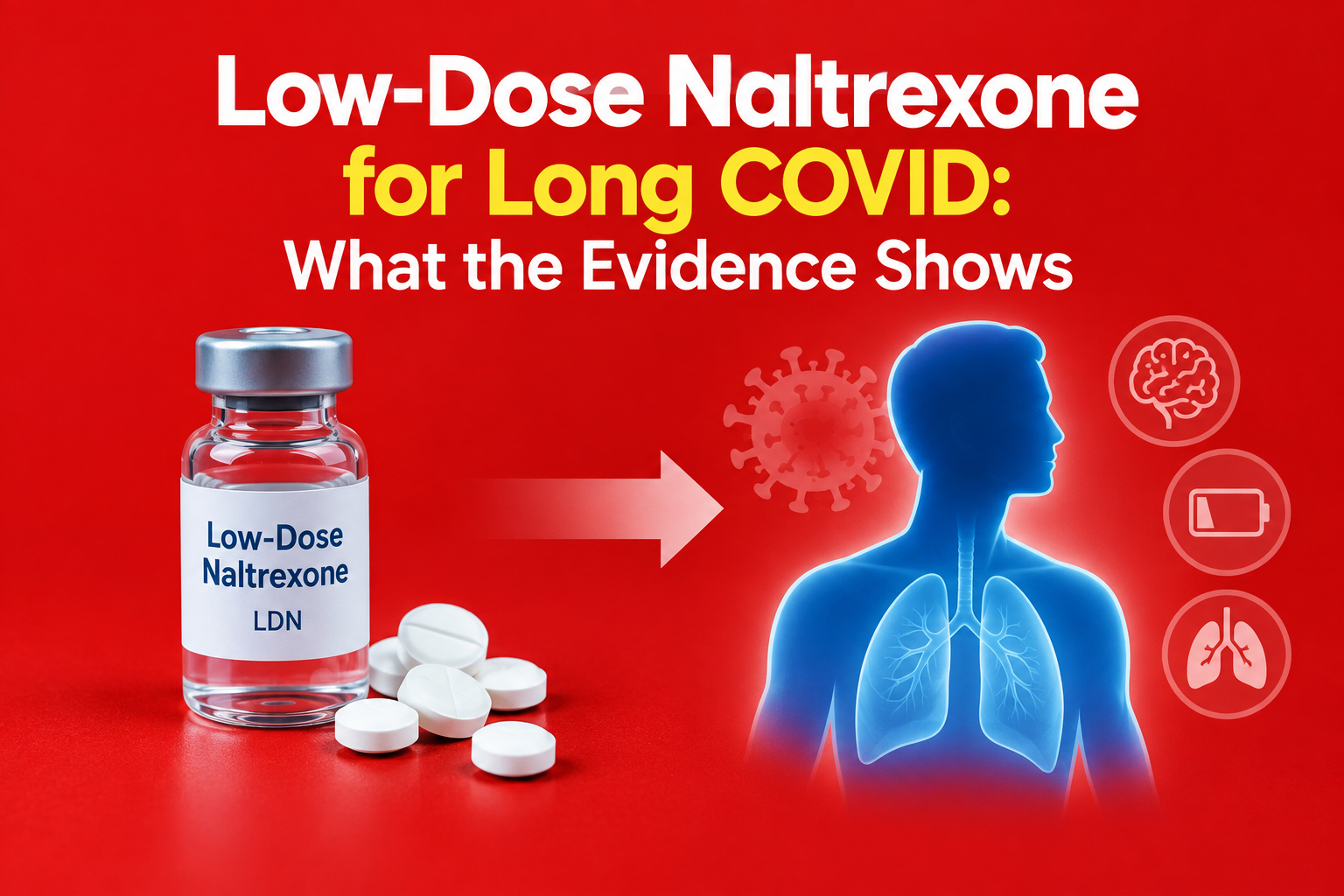
Low-dose naltrexone has been associated with improvements in fatigue, cognitive difficulties, sleep, pain and day-to-day functioning among some people with long COVID. The systematic review and meta-analysis identified a broadly favorable signal across small studies, but rated the certainty of evidence as low. That distinction matters: the findings justify further research, not a conclusion that the drug works.
The underlying studies were largely pre-post or retrospective analyses without untreated or placebo control groups. Participants knew they were receiving the drug, outcomes were usually self-reported, and symptoms were measured before and after treatment. Such designs can detect change over time, but they cannot determine whether naltrexone caused it.
One interventional pre-post study recruited 52 people with long COVID. Thirty-eight started naltrexone, and 36 provided paired questionnaires after approximately two months. The regimen was 1 mg daily during the first month and 2 mg daily during the second. Six of seven self-reported measures improved, including recovery, activity limitation, energy, pain, concentration and sleep; nominal P values for those changes ranged from less than.001 to.031.
Mood did not improve significantly.
These are within-person comparisons, not estimates of benefit against placebo or usual care. Participants could have improved because of natural recovery, changing activity, other treatments, expectations or regression to the mean. Attrition between enrollment and paired assessment creates another possible source of bias.
A separate retrospective academic-center cohort included 59 people prescribed low-dose naltrexone. Doses varied from 0.5 to 6 mg daily, and the median recorded treatment duration was 143 days. Fatigue, post-exertional malaise, unrefreshing sleep and abnormal sleep patterns improved in the medical record, as did the total number of symptoms. Again, there was no concurrent comparator and no blinding, so the observed associations cannot establish causation.
Why meta-analysis does not settle the question
Combining small studies can improve precision when the studies estimate the same causal effect with reasonably comparable methods. It cannot correct systematic weaknesses shared across the evidence base. Pooling before-after changes remains vulnerable to spontaneous improvement, expectancy effects, selective follow-up and changes in co-interventions.
Long COVID also varies substantially between patients. Fatigue and cognitive symptoms may occur alongside post-exertional malaise, autonomic dysfunction, sleep disorders, mood symptoms, respiratory impairment or pain. Studies that use different eligibility criteria, symptom scales, follow-up periods and dose-escalation practices may not be measuring a single treatment effect.
The review’s low-certainty rating therefore reflects more than sample size. Lack of randomization and placebo control raises risk of bias; small cohorts produce unstable estimates; incomplete follow-up can favor participants who tolerated treatment or perceived improvement; and inconsistent outcome definitions limit comparison. Publication bias is also plausible because small positive experiences may be more likely to be reported than neutral ones.
The evidence does not provide a dependable controlled effect size with a confidence interval for the outcomes most relevant to practice. Nor does it establish whether apparent changes exceed a clinically meaningful threshold. Statistical improvement on a symptom score is not necessarily the same as recovery of employment, self-care or tolerance of physical and cognitive activity.
What the evidence supports in practice
Naltrexone is an opioid antagonist approved in the United States for opioid and alcohol dependence, not for long COVID. Use at doses described as “low dose” is off-label. Proposed anti-inflammatory or neuroimmune effects at these doses remain biologically plausible hypotheses rather than proven mechanisms of benefit in long COVID.
Current findings support discussing low-dose naltrexone as an uncertain, experimental option rather than an established treatment. That framing should include the absence of confirmatory randomized evidence, the possibility that symptoms may change without treatment, and the inability of the existing studies to identify which patients are most likely to benefit.
The opioid-blocking action has immediate clinical relevance. Naltrexone can interfere with opioid analgesia and can precipitate withdrawal in a person with physiologic opioid dependence. The FDA prescribing information also addresses hepatic risks and the need to assess opioid exposure. The reassuring tolerability reported in small long COVID cohorts cannot exclude uncommon or delayed harms.
The evidence does not support selecting one long COVID dose as standard. Published cohorts used different starting doses, titration approaches and upper limits, while treatment duration also varied. Comparing outcomes across those uncontrolled regimens cannot identify a dose-response relationship or show that a higher dose is more effective.
Clinical care still requires evaluation for treatable contributors to fatigue, cognitive symptoms and sleep disturbance. The CDC emphasizes that long COVID is heterogeneous and may involve multiple organ systems. An apparent treatment response should not substitute for assessment of medication effects, sleep disorders, anemia, endocrine disease, mood conditions or other diagnoses suggested by the presentation.
The decisive evidence is still missing
A placebo-controlled randomized trial is needed to separate pharmacologic benefit from symptom fluctuation and expectation. It should prespecify a dose and titration strategy, document concurrent therapies, and use validated measures of fatigue, cognition, sleep, pain, post-exertional malaise and physical functioning. Follow-up should be long enough to assess durability after the initial treatment period.
Trials should also report outcomes by clinically meaningful subgroups. A treatment could plausibly help one long COVID phenotype while having little effect in another, but the existing cohorts are too small and heterogeneous to test that possibility reliably. Objective or performance-based outcomes would complement symptom questionnaires, although they must be chosen carefully to avoid worsening post-exertional symptoms.
Safety evidence remains limited. Larger studies should systematically capture adverse effects, discontinuation, liver-related outcomes, opioid exposure and the consequences of interrupted treatment. Funding sources, protocol deviations and complete outcome data also need transparent reporting to permit a more confident risk-of-bias assessment.
Until such evidence is available, improvement after starting low-dose naltrexone should be documented as an individual clinical observation, not proof of efficacy. Association is not causation. The present literature offers a reason to test the drug properly, but not a basis for calling it an effective long COVID therapy.
Questions clinicians ask
Does the review show that low-dose naltrexone works for long COVID?
No. It identifies a possible symptom signal, but the review rates certainty as low because the evidence is dominated by small, uncontrolled studies. Without randomization and a concurrent comparator, improvements cannot be separated confidently from natural recovery, placebo effects, regression to the mean or other care.
What dose has the best evidence?
No optimal dose is established. One pre-post study used 1 mg daily followed by 2 mg daily, while a retrospective cohort recorded doses from 0.5 to 6 mg daily. Those differences were not tested in randomized dose-comparison trials, so they cannot demonstrate a preferred regimen or dose-response relationship.
Is low-dose naltrexone safe in this population?
The small cohorts did not identify a strong safety signal, but they were underpowered to detect uncommon harms. Naltrexone blocks opioid effects and may precipitate withdrawal in opioid-dependent patients; its prescribing information also includes hepatic precautions. Safety conclusions specific to long COVID therefore remain limited.
What result would change clinical confidence?
A sufficiently powered, double-blind randomized trial showing a clinically meaningful advantage over placebo would materially strengthen the evidence. It should use validated symptom and functional outcomes, standardize dosing, report adverse events and attrition fully, and follow participants long enough to establish whether any improvement is durable.
References
1. Effect of low-dose naltrexone for long COVID: a systematic review and meta-analysis — PubMed, 2026 2. Safety and efficacy of low dose naltrexone in a long covid cohort; an interventional pre-post study — PubMed, 2022 3. Low-dose naltrexone use for the management of post-acute sequelae of COVID-19 — PubMed, 2024 4. REVIA (naltrexone hydrochloride tablets) prescribing information — US Food and Drug Administration, 2013 5. Clinical Overview of Long COVID — Centers for Disease Control and Prevention, 2025
One story a day
The story of the day, in your inbox
One health journey each morning — no advice, no alarm, just company for the road.