Parkinson’s Disease Risks With Bilateral Focused Ultrasound
Staged bilateral focused ultrasound produced only small additional motor gains in Parkinson’s disease while leaving more patients with persistent moderate or severe adverse events.
 Written and medically reviewed byRayan SalihContributing writer · PharmD, RPh
September 8, 2026 · 6 min read
The second procedure changed the safety equation
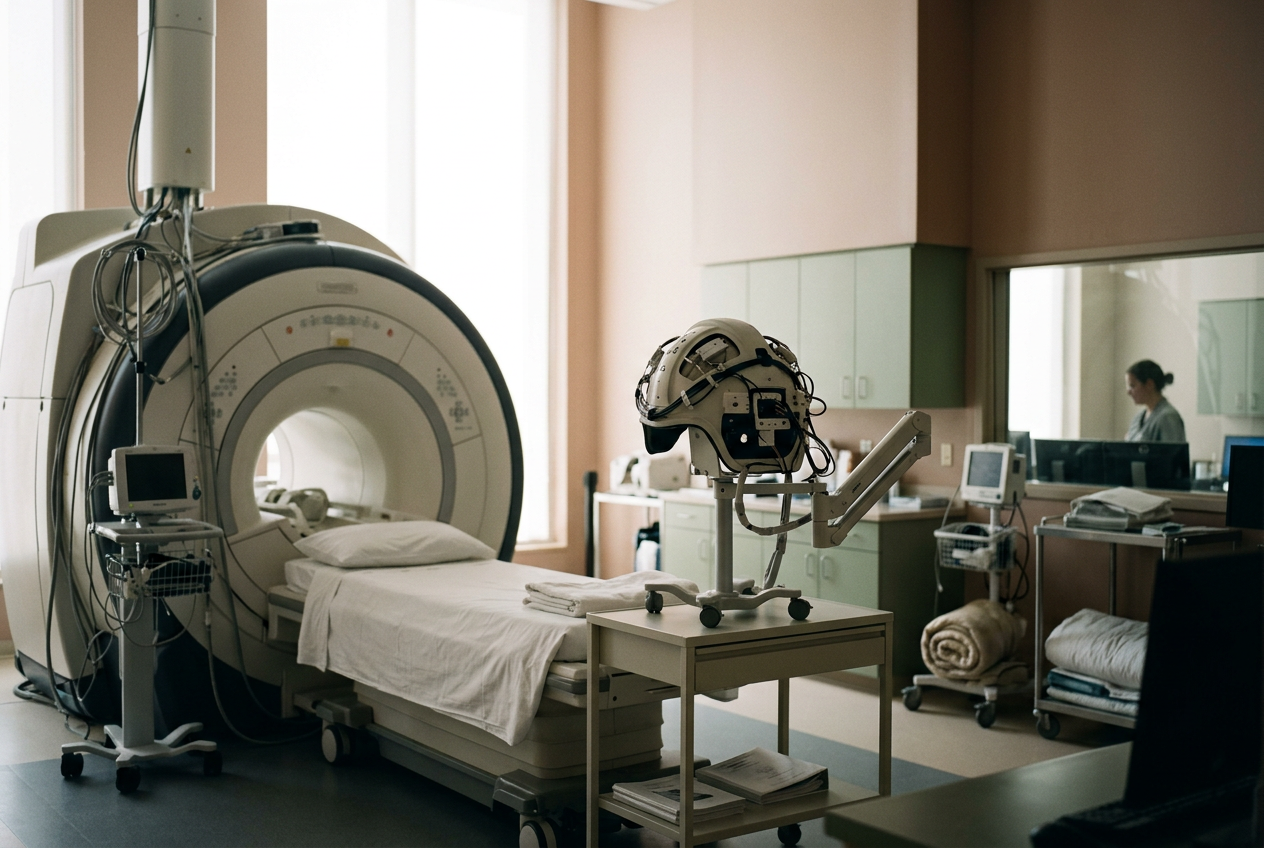
Staged bilateral magnetic resonance-guided focused ultrasound pallidothalamic tractotomy produced only small additional motor gains after the second procedure, according to a 2026 peer-reviewed multicenter trial. Those incremental gains came with more persistent adverse events of moderate or severe intensity than were evident after unilateral treatment.
That distinction matters because lesioning is permanent. Focused ultrasound concentrates acoustic energy under MRI guidance to thermally ablate a selected brain target without an incision. Pallidothalamic tractotomy interrupts fibers carrying output from the internal globus pallidus toward the thalamus, with the aim of reducing Parkinsonian motor complications on the opposite side of the body.
Treating one hemisphere can therefore address the more affected side while leaving the other hemisphere untouched. A second procedure may extend benefit to bilateral symptoms, but it also removes the protection afforded by an intact contralateral network. Functions supported by both hemispheres—including speech, swallowing, gait and postural control—are especially relevant when weighing cumulative risk.
The finding should not be reduced to “bilateral treatment is unsafe.” Rather, it suggests that the marginal benefit of crossing from one treated hemisphere to two may be modest, while the marginal harm may be clinically meaningful and persistent. That is a less favorable trade-off than the improvement observed after the first procedure.
How the staged trial approached bilateral treatment
The study was prospective and conducted across multiple centers in people with Parkinson’s disease and motor complications. Participants underwent MR-guided focused ultrasound pallidothalamic tractotomy in stages, allowing outcomes after the first procedure to be assessed before treatment of the opposite hemisphere.
The clinically important comparison was incremental: how much additional improvement followed the second lesion, and what new or persisting adverse effects accompanied it? This differs from asking whether participants improved relative to their original baseline. A bilateral outcome can remain better than baseline even when the second procedure contributes little benefit and introduces additional disability.
The report characterized the added motor improvement after bilateral treatment as small. At the same time, persistent moderate or severe adverse events became more prominent. Intensity and persistence both matter. A moderate event that affects speech, balance or daily function for months may be more consequential than a larger number of mild, transient symptoms.
Moderate or severe adverse events are not automatically synonymous with regulatory “serious adverse events.” Seriousness is a separate classification based on outcomes such as hospitalization, life-threatening events or major disability. For counseling and policy, however, persistent moderate impairment can still materially alter independence and quality of life.
The source material supplied for this explainer does not reproduce the trial’s enrollment count, numerical effect estimates, confidence intervals or complete follow-up schedule. Those figures should be verified directly in the full peer-reviewed report rather than inferred. The qualitative benefit–risk pattern—small additional motor gains alongside more persistent moderate or severe harms—is the central finding supported here.
Why unilateral lesioning may retain an advantage
The study strengthens a practical argument for stopping after a successful unilateral procedure when the residual symptoms do not justify the additional risk. The first treatment can target the side responsible for the greatest functional burden. If it provides meaningful control, preserving the opposite hemisphere may be valuable even when some bilateral symptoms remain.
Earlier randomized trials established that unilateral focused ultrasound lesioning can improve selected motor outcomes in carefully screened patients. Trials of focused ultrasound subthalamotomy and globus pallidus ablation also documented neurologic adverse effects, reinforcing that therapeutic benefit and lesion-related risk are inseparable. Those procedures use different targets and should not be treated as interchangeable with pallidothalamic tractotomy, but they provide relevant context for irreversible ultrasound lesioning.
The bilateral trial does not establish that every second procedure has an unfavorable balance. A person with severe, medication-refractory symptoms on both sides may value even a modest added motor gain differently from someone whose remaining symptoms are manageable. Baseline speech, cognition, swallowing, gait and postural stability may also influence how consequential a second lesion could be.
Nor does this evidence make a direct comparison with deep brain stimulation. Stimulation requires implanted hardware and ongoing programming, with associated surgical and device-related risks. It is also adjustable and, to a degree, reversible. Focused ultrasound avoids an implant but creates a permanent lesion.
Those differences make individualized, multidisciplinary assessment more informative than a simple ranking of procedures.
In the US context, clinicians and health systems should avoid extrapolating evidence or regulatory status from one focused ultrasound target, indication or laterality to another. Bilateral pallidothalamic tractotomy requires its own evidence on target-specific efficacy, durability and adverse events. Coverage policies and institutional protocols should similarly distinguish unilateral from staged bilateral treatment.
Important uncertainties remain
A prospective multicenter design improves standardized follow-up and gives the findings more relevance than a retrospective case series. Even so, staged procedural studies are vulnerable to selection effects. Only participants considered suitable after the first treatment may proceed to the second, and people who decline further intervention may differ from those who continue.
Without a randomized concurrent group that remains unilateral, changes after the second procedure cannot be separated cleanly from disease progression, medication adjustments, rehabilitation, expectation effects or the durability of the first lesion. Within-participant comparisons help but do not remove these concerns. The study can characterize outcomes after staged treatment; it is less able to prove that bilateral treatment is superior or inferior to a long-term unilateral strategy.
Power is another concern. Persistent disabling events may be uncommon enough that modest samples produce unstable estimates, particularly across centers with different operators or selection practices. Generalizability may also be limited to highly screened participants treated by experienced teams. Real-world candidates with cognitive impairment, substantial axial symptoms or multiple comorbidities may face a different risk profile.
Longer follow-up is essential. Motor benefit may diminish as Parkinson’s disease progresses, while lesion-related speech, gait or swallowing problems may persist. Future research should report patient-relevant function, quality of life, medication use, falls, caregiver burden and time to loss of independence—not only motor scale scores.
Questions clinicians ask
Does this trial show that bilateral focused ultrasound should never be used?
No. It shows that the second staged procedure delivered limited additional motor improvement while increasing concern about persistent moderate or severe adverse events. The evidence supports greater caution and more explicit discussion of marginal benefit, but it does not define an absolute prohibition for every carefully selected person.
Is unilateral pallidothalamic tractotomy proven superior to bilateral treatment?
Not definitively. A staged prospective study can compare outcomes before and after the second lesion, but it cannot fully replace a randomized comparison between continued unilateral management and bilateral treatment. The findings favor unilateral treatment on benefit–risk grounds, yet residual confounding and selection effects remain.
Which outcomes matter most before considering a second procedure?
Residual motor disability should be weighed alongside baseline speech, swallowing, cognition, gait, balance and independence. Because the lesion is permanent, a small motor gain may not offset a persistent functional adverse effect. The patient’s priorities and alternative options are therefore central to interpreting the trial’s average results.
Can evidence from other focused ultrasound targets be applied here?
Only cautiously. Randomized trials of subthalamotomy and globus pallidus ablation show that unilateral focused ultrasound can improve selected Parkinsonian motor outcomes, but targets differ in mechanism and adverse-effect profile. Evidence for one target or laterality should not be assumed to establish the safety of bilateral pallidothalamic tractotomy.
References
- Safety and efficacy of staged bilateral MR-guided focused ultrasound pallidothalamic tractotomy for Parkinson’s disease motor complications — PubMed, National Library of Medicine, 2026
- Trial of Globus Pallidus Focused Ultrasound Ablation in Parkinson’s Disease — The New England Journal of Medicine, 2023
- Randomized Trial of Focused Ultrasound Subthalamotomy for Parkinson’s Disease — The New England Journal of Medicine, 2020
- Parkinson’s Disease — National Institute of Neurological Disorders and Stroke, 2024
One story a day
The story of the day, in your inbox
One health journey each morning — no advice, no alarm, just company for the road.