Tocilizumab Recall Demands Rapid Inventory Controls
One lot of intravenous tocilizumab-aazg (Tyenne) was recalled nationwide over possible glass particles. Infusion centers, pharmacies and clinics should rapidly quarantine stock and trace prior distribution.
 Written and medically reviewed byRayan SalihContributing writer · PharmD, RPh
August 26, 2026 · 7 min read

What changed
Fresenius Kabi initiated a nationwide recall of one lot of tocilizumab-aazg injection, supplied as 400 mg/20 mL vials, because of potential glass particulate contamination, according to an FDA notice posted August 10, 2026. The action requires prompt control wherever the product may be received, stored, compounded, dispensed or infused.
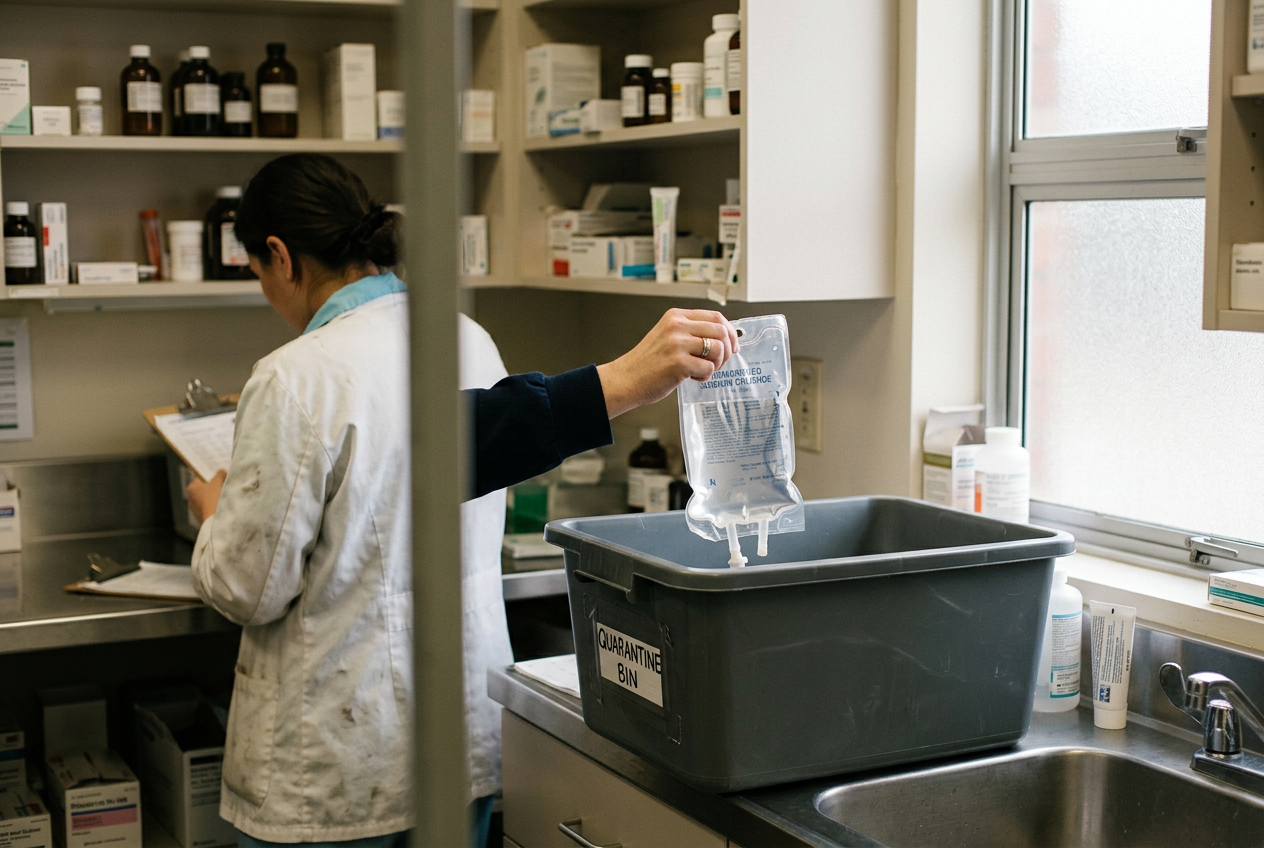
The first operational priority is to prevent another affected vial from reaching a preparation area or patient. Pharmacy leaders should compare every vial and case against the manufacturer’s identifying information in the FDA notice, including the lot and expiration details, rather than relying only on the product name, strength or National Drug Code. Any match should be physically segregated, clearly marked as recalled and blocked electronically from selection or dispensing.
The notice concerns a specific lot, not every vial of tocilizumab-aazg or the entire drug class. Broadly removing unaffected stock could disrupt treatment unnecessarily. Conversely, treating the recall as a purchasing-department issue alone could leave vials in satellite pharmacies, automated inventory systems, clinic refrigerators, infusion carts or stock held by an external compounding service.
Why glass particles matter
An injectable contaminant bypasses the protective barriers of the gastrointestinal tract. The clinical consequences depend on particle size, number, route, deposition and the patient’s underlying condition, making the outcome of any individual exposure difficult to predict.
The FDA recall notice describes risks that range from local irritation or swelling to blockage and clotting within blood vessels. More serious potential outcomes include thrombosis, pulmonary embolism, stroke and severe organ injury. These are hazard statements associated with possible intravenous administration of glass particles; the recall notice does not establish that every affected vial contains particles or that every exposure will produce harm.
A particle may provoke local inflammation or mechanically injure or obstruct a vessel. If particulate material or a resulting thrombus reaches the pulmonary circulation, cardiopulmonary complications may follow. The concern is therefore not limited to a painful infusion site or a visible defect in a vial.
Visual inspection remains important, but it cannot establish that a vial is free of contamination. Particle detection can be affected by particle size, lighting, background, vial geometry and whether material settles outside the observer’s field of view. An in-line filter or routine preparation practice also should not be treated as authorization to use a recalled vial. Recall controls take precedence over attempts to salvage affected inventory.
Immediate controls for care sites
The response should be managed as a closed-loop medication-safety event. Pharmacy, nursing, infusion operations, procurement, risk management and medication-safety personnel may each hold part of the information needed to identify stock and reconstruct its movement.
A practical response includes:
- Stop distribution and use while all on-site inventory is checked against the exact recall identifiers.
- Quarantine affected units in a secured location, separate from usable stock, with clear labeling that prevents accidental return to circulation.
- Place electronic holds in purchasing, inventory, dispensing and compounding systems. Search aliases, package-level records and manually maintained satellite inventories.
- Review receiving records, wholesaler data, interfacility transfers, dispensing logs, compounding records and infusion documentation to determine where affected vials went.
- Contact affiliated clinics, home-infusion partners or contracted compounders that may have received transferred stock.
- Follow the manufacturer’s or distributor’s recall instructions for documentation and return. Preserve chain-of-custody records until reconciliation is complete.
- Record the number of affected vials received, remaining, returned, destroyed if authorized, and potentially administered. Unexplained differences warrant escalation.
Sites that prepared doses centrally should trace both intact vials and preparations made from those vials. A vial may no longer appear in inventory even though its contents entered a compounded dose. Records should connect the recalled lot to preparation identifiers and administration records wherever that information is available.
Patient identification should be based on documented lot-level exposure, not simply receipt of tocilizumab-aazg during the relevant period. If routine systems do not preserve lot numbers through administration, organizations may need to triangulate purchase dates, stock rotation, preparation logs and appointment records. Any resulting list should distinguish confirmed, possible and excluded exposure.
Clinical review after possible administration
The FDA notice supports prompt evaluation of adverse events potentially associated with the recalled product. Clinical review should account for the route and timing of exposure, symptoms, examination findings and alternative explanations. Symptoms that could indicate an acute vascular or organ complication require timely assessment under existing emergency and specialty pathways.
There is no incidence estimate in the recall notice that can quantify an exposed person’s absolute risk. The notice also does not provide evidence for routine imaging, laboratory testing or preventive anticoagulation in every asymptomatic person who may have received a vial from the recalled lot. Those decisions require clinical judgment and should not be inferred from the existence of the recall alone.
Organizations should establish a consistent communication pathway for people with confirmed or credible possible exposure. Communications should identify the recalled product and reason for concern, explain how to obtain clinical advice, and avoid implying that injury has occurred. Relevant adverse events and product-quality problems can be reported through the FDA’s MedWatch program in addition to required internal and manufacturer reporting.
Continuation or substitution of immunomodulatory therapy is a separate clinical decision. The recall applies to the identified lot; it does not itself establish that unaffected tocilizumab-aazg inventory or another presentation is unsafe. Pharmacy and prescriber teams should verify product availability and approved use rather than improvising dose or formulation changes.
Evidence limits
This is a regulatory recall, not a comparative clinical study. There is no enrolled population, comparator, effect estimate, confidence interval or defined follow-up period. The FDA notice identifies a contamination hazard and the potential severity of intravenous exposure, but it does not measure how often affected vials contain glass or how frequently exposed patients experience complications.
The available evidence therefore supports decisive inventory control and exposure tracing, not a numerical prediction of individual risk. Further manufacturer investigation, recall-effectiveness checks or postmarket reports may clarify the extent of distribution and whether clinical events were associated with the lot.
Questions clinicians ask
Should all tocilizumab-aazg inventory be discarded?
No. The FDA action concerns one identified lot of the 400 mg/20 mL vial. Sites should match stock to the exact identifiers in the recall notice, quarantine confirmed matches and retain unaffected inventory unless another safety communication or local quality concern provides a separate reason to hold it.
Is visual inspection enough to release a recalled vial?
No. A vial can appear clear even when contamination is not readily visible, and the recall status is based on the lot designation rather than bedside inspection. A recalled vial should remain quarantined and be handled under the manufacturer’s return instructions, regardless of its appearance or planned use of an in-line filter.
What should be done if an affected vial may have been administered?
The organization should verify the exposure as far as records permit, notify the responsible clinical and safety teams, and arrange appropriate clinical review and communication. The recall notice identifies potentially serious vascular and organ complications, but it does not prescribe universal testing or preventive treatment for every asymptomatic exposure.
Where should suspected adverse events be reported?
Suspected reactions or product-quality problems should move through institutional medication-safety and pharmacovigilance channels and can be submitted to FDA MedWatch. Reports are most useful when they include the product name, lot information, administration timing, clinical course and relevant testing without delaying urgent evaluation or treatment.
References
- Fresenius Kabi Issues Nationwide Recall of Tyenne (tocilizumab-aazg) Injection, 400 mg/20 mL Vials, Due to Glass Particles — US Food and Drug Administration, 2026
- Drug Recalls — US Food and Drug Administration, n.d.
- MedWatch: The FDA Safety Information and Adverse Event Reporting Program — US Food and Drug Administration, n.d.
One story a day
The story of the day, in your inbox
One health journey each morning — no advice, no alarm, just company for the road.