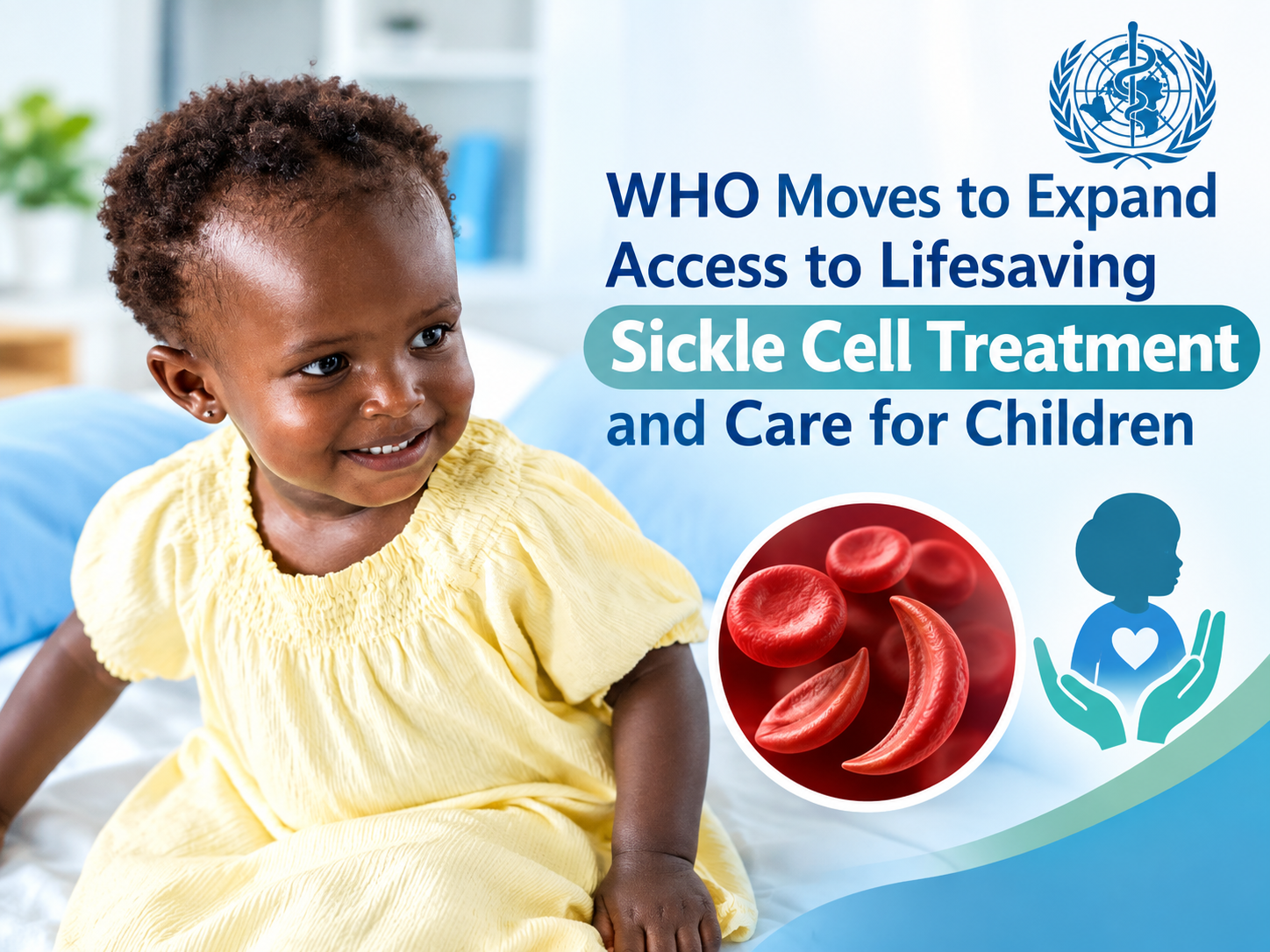
WHO Moves to Expand Access to Lifesaving Sickle Cell Treatment and Care for Children
WHO’s access initiative shifts the pediatric sickle cell agenda toward delivery. Health systems must connect early diagnosis with preventive care, treatment, referral and long-term follow-up through age 19.
 Written and medically reviewed byDr. Abu BakarContributing writer · PharmD, PhD (Pharmacology)
October 4, 2026 · 6 min read
The next challenge is delivery
WHO’s September 2026 update shifts attention from guidance alone to how health systems can put that guidance into practice. WHO’s first guideline on sickle cell disease in children and adolescents covers diagnosis, prevention and clinical management from birth through age 19. The newer access work is aimed at helping countries turn those recommendations into care that children can actually receive.
That distinction matters. A guideline can define the right clinical pathway, but it cannot guarantee that a newborn is screened, a positive result is confirmed, a family is reached or treatment starts on time. Those steps depend on financing, laboratory capacity, medicine supply, trained healthcare workers, referral systems and reliable follow-up.
The whole pathway matters. Health systems need to understand how children enter care, where responsibility moves between services and what happens when a child misses testing, medicine monitoring or specialist assessment. A strong program should connect these steps instead of treating each one as a separate activity.
Build the pathway around early identification
Diagnosis must occur early enough to change care. Where universal newborn screening is feasible, the program needs more than laboratory capacity: standardized specimen collection, confirmatory testing, rapid reporting, family notification and a documented handoff to pediatric services are all required. Screening without linkage risks producing diagnoses without protection.
Countries that cannot immediately offer universal screening may need phased or geographically targeted approaches while building toward broader coverage. Whatever the model, performance should be measured across the complete cascade: eligible newborns screened, results returned, positive screens confirmed and affected infants enrolled in care. Reporting only the number of tests can conceal losses between diagnosis and treatment.
Maternal and newborn services are natural access points. Antenatal records can document parental carrier status when known, while maternity and immunization programs can help identify infants who were not screened at birth. Integrating sickle cell services with these established contacts may reduce missed opportunities, but targeted testing must not become a permanent substitute for equitable population coverage where universal screening is achievable.
Define a minimum pediatric service package
Enrollment should trigger a dependable package rather than a series of isolated visits. Core functions include infection prevention, routine immunization, caregiver education, assessment of growth and development, access to disease-modifying therapy when indicated, pain and fever pathways, transfusion capability, stroke-risk assessment, psychosocial support and referral for complications.
Evidence supporting individual components predates the WHO access initiative. In the multicenter BABY HUG randomized trial, 193 infants aged 9 to 18 months with sickle cell anemia received hydroxyurea or placebo for two years. The treatment did not significantly improve the trial’s primary spleen and renal function endpoints, but it reduced several clinically important events, including pain, dactylitis and hospitalization. The trial established that structured hydroxyurea care can begin in very young children when laboratory monitoring and follow-up are available.
Stroke prevention similarly depends on organized delivery. The randomized STOP trial enrolled 130 children with sickle cell anemia and abnormal transcranial Doppler findings. One stroke occurred among children assigned to regular transfusions, compared with 11 among those receiving standard care, prompting early termination. The practical lesson extends beyond acquiring Doppler equipment: systems need trained operators, quality assurance, timely interpretation and dependable access to transfusion and monitoring for children with abnormal results.
Emergency pathways are another essential part of routine care. Families and frontline clinicians need clear plans for fever, acute chest symptoms, severe anemia, splenic enlargement, neurologic changes and pain that cannot be managed at home. Referral protocols should specify where children go, how transport is arranged and which facility can provide imaging, transfusion, intensive care or specialist consultation.
Access requires medicines, people and financing
Medicine availability is not the same as placement on an essential medicines list. Procurement forecasts must account for a growing cohort identified through screening, while distribution systems must prevent recurrent stockouts at the facilities where children receive follow-up. Laboratory monitoring, safe blood supplies and trained staff must be budgeted alongside the medicine itself.
Workforce design should avoid concentrating every service in tertiary centers. Primary care and district teams can provide scheduled follow-up, vaccination review, caregiver counseling and recognition of complications when they have protocols and specialist support. Regional hubs can provide confirmatory diagnostics, transcranial Doppler assessment, transfusion planning and management of complex complications. Teleconsultation may support this network, but it cannot replace physical access to diagnostics, medicines and emergency treatment.
Coverage policy also shapes adherence. Families may face transport costs, lost wages, laboratory fees and charges for medicines even when a consultation is nominally free. Policymakers should examine these cumulative costs and track whether children are leaving care because of them. Financing arrangements that cover only acute admissions can perpetuate late treatment while underfunding prevention.
Adolescents require an explicit transition plan. Pediatric programs should introduce age-appropriate disease education, reproductive and genetic counseling, mental health support and self-management skills before transfer to adult care. For girls, the pathway should connect hematology with adolescent and reproductive health services, including counseling about pregnancy-related risk and medication review when pregnancy is possible or planned.
Measure continuity, not activity alone
Implementation dashboards should emphasize outcomes and continuity. Useful indicators include age at confirmed diagnosis, time from result to first clinical visit, preventive-care coverage, medicine stockouts, retention in care, completion of indicated stroke screening, emergency visits, hospitalizations, transfusions and deaths. Results should be stratified by geography, sex, socioeconomic position and care setting where data systems permit.
Registries can support recall, quality improvement and procurement forecasting, but they require governance, privacy safeguards and identifiers that work across facilities. Data collection should remain proportionate; an overcomplicated registry can divert scarce staff without improving care. A small, reliable dataset tied to defined actions is more useful than extensive fields that remain incomplete.
What remains uncertain
The WHO update is an implementation announcement, not a comparative trial or completed program evaluation. It does not provide a population size, comparator, effect estimate, confidence interval or follow-up period showing that the access initiative has improved survival, reduced complications or narrowed inequities. Those outcomes will require prospective evaluation as participating health systems adopt the agenda.
Landmark trials establish the efficacy of particular interventions under controlled protocols, but they do not answer every delivery question. Costs, workforce needs, diagnostic capacity and feasibility differ substantially across countries. Results from specialized trial centers may not transfer directly to rural or under-resourced settings, and implementation models should be assessed for reach, safety, retention and equity rather than presumed effective.
Questions clinicians ask
What should happen after a newborn screen is positive?
A positive screening result should lead to confirmatory testing, prompt communication with the family and documented enrollment in pediatric care. The receiving service needs responsibility for preventive care, caregiver education and follow-up; otherwise, screening identifies risk without reliably changing the child’s clinical course.
What is the minimum service package a district should provide?
District services should reliably deliver routine follow-up, preventive care, immunization review, caregiver education, access to indicated medicines and rapid recognition of emergencies. They also need predefined referral links for confirmatory testing, stroke-risk assessment, transfusion support and complex complications that cannot be managed locally.
Is medicine procurement enough to expand hydroxyurea access?
No. BABY HUG shows that hydroxyurea can reduce important clinical events in very young children, but treatment delivery also requires clinician training, laboratory monitoring, counseling, follow-up and consistent supply. Programs should monitor initiation, continuity, safety processes and clinical outcomes rather than counting tablets distributed.
Why should maternal and reproductive health services be involved?
They provide repeated contact points before birth, during delivery and through infancy, making them important for carrier information, newborn testing and linkage to care. Adolescent girls also need coordinated reproductive counseling and medication review before pregnancy, while avoiding the assumption that sickle cell care is solely a maternal-service responsibility.
References
1. WHO moves to expand access to lifesaving sickle cell disease treatment and care for children — World Health Organization, 2026 2. A multicentre randomised controlled trial of hydroxyurea (hydroxycarbamide) in very young children with sickle cell anaemia (BABY HUG): effects on spleen and renal function — The Lancet, 2011 3. Prevention of a first stroke by transfusions in children with sickle cell anemia and abnormal results on transcranial Doppler ultrasonography — The New England Journal of Medicine, 1998
One story a day
The story of the day, in your inbox
One health journey each morning — no advice, no alarm, just company for the road.