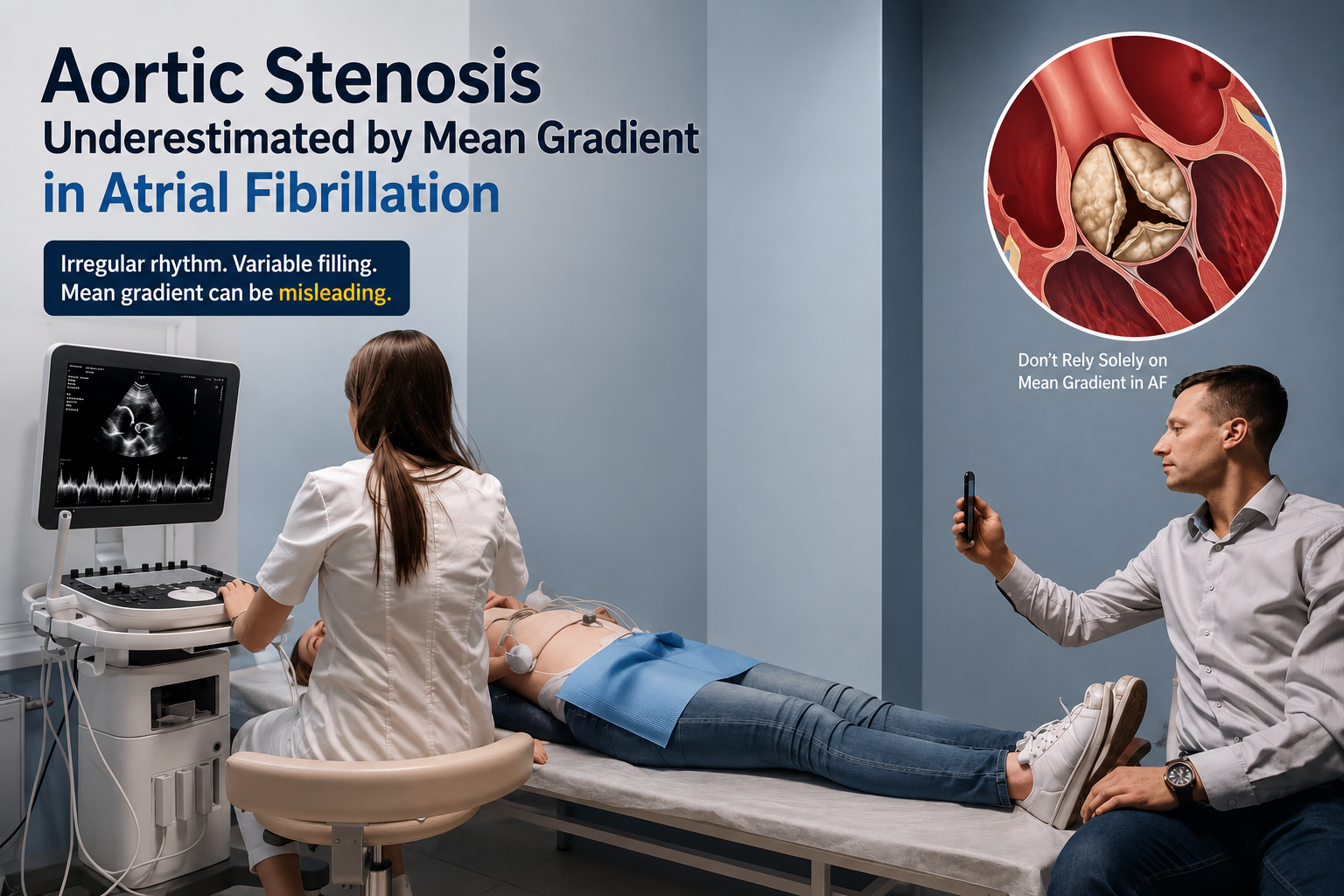
Aortic Stenosis Trial Will Test Beta-Blocker Effects
The multicenter BASE trial will test cardiovascular and metabolic effects of beta-blocker therapy in people with aortic stenosis. Its protocol does not yet provide treatment-effect estimates.
 Written and medically reviewed byRayan SalihContributing writer · PharmD, RPh
November 2, 2026 · 6 min read

Why this trial matters
Beta-blockers have a clear role in several cardiovascular conditions, including selected patients with coronary disease, arrhythmias, hypertension and heart failure. Their place in aortic stenosis is less certain. Slowing the heart rate and reducing contractility may lower myocardial oxygen demand, but clinicians have historically worried that excessive reductions in heart rate, blood pressure or cardiac output could be poorly tolerated when blood must cross a fixed, narrowed valve.
That tension often arises when a patient with aortic stenosis has another plausible reason to receive a beta-blocker. Available evidence has not established whether beta-blockade favorably modifies the physiology or clinical course of aortic stenosis itself. It also has not fully defined which patients can receive the drugs without compromising hemodynamics, exercise capacity or metabolic health.
The BASE protocol addresses this uncertainty with a multicenter, double-blind randomized trial. Participants are assigned to beta-blocker therapy or a blinded control, allowing the completed study to estimate treatment effects more reliably than an observational comparison. Randomization can balance measured and unmeasured prognostic factors between groups, while blinding reduces differences in care, behavior and outcome assessment that could otherwise bias the findings.
Efficacy and safety results are not yet available. The protocol therefore reports no between-group effect size, confidence interval or P value, and it cannot establish clinical benefit or harm. Its immediate contribution is to define a prospective test of a common but unresolved treatment question.
What BASE is designed to measure
BASE is structured to examine cardiovascular and metabolic consequences rather than treating beta-blocker exposure as a simple yes-or-no safety question. That distinction matters because a drug could improve one physiologic measure while worsening another, or alter intermediate markers without changing symptoms or clinical events.
Cardiovascular assessment can help determine whether beta-blockade changes the workload imposed on the left ventricle, the circulation’s response to exertion, or other prespecified measures of cardiac performance. In aortic stenosis, these effects cannot be assumed from studies in populations without valve obstruction. The narrowed valve changes ventricular loading conditions and may limit the ability to increase forward flow when demand rises.
Metabolic endpoints add another dimension. Beta-blockers can differ in their effects on glucose regulation, lipids, body weight and exercise-related energy use. Measuring metabolic outcomes prospectively may clarify whether any cardiovascular signal is accompanied by a trade-off relevant to long-term treatment, particularly in a population likely to have hypertension, diabetes or other cardiometabolic conditions.
The protocol’s multicenter design should broaden recruitment beyond a single institution and test whether trial procedures apply across participating sites. Its double-blind randomized structure also supports causal comparisons between the assigned groups, provided adherence, crossover, and missing data are adequately managed. Exact interpretation will depend on the enrolled severity and symptom profile, exclusion criteria, beta-blocker regimen, duration of follow-up and completeness of outcome ascertainment specified by the protocol.
How the findings could affect practice
The 2020 American College of Cardiology and American Heart Association valve guideline centers management of severe aortic stenosis on symptom status, ventricular function, disease severity and the timing of valve intervention. Beta-blockers are not established as disease-modifying therapy for the obstructed valve. The European valve guideline similarly emphasizes surveillance and valve replacement decisions rather than medical therapy as a substitute for intervention when intervention is indicated.
BASE could inform a different but clinically important question: whether beta-blockers have measurable cardiovascular or metabolic effects in the trial’s defined aortic stenosis population. A favorable pattern across hemodynamic, functional and metabolic outcomes could make clinicians more comfortable using beta-blockers when a recognized indication coexists. An unfavorable pattern could support greater caution, closer monitoring or avoidance in patient groups resembling those studied.
Mixed results would require more nuance. For example, improvement in a physiologic endpoint without better symptoms or functional capacity would not by itself prove that beta-blockers improve patient-centered outcomes. Conversely, a small change in an intermediate marker may be clinically unimportant if treatment is well tolerated and effectively addresses another condition.
The completed trial’s effect estimates and confidence intervals will be central. Confidence intervals should show whether the data are compatible with clinically meaningful benefit, no important difference or harm. P values alone will not answer that question. Absolute event rates, withdrawals, adverse events and treatment adherence will also be needed to judge applicability.
BASE should not be interpreted as testing beta-blockers against valve replacement. Medical therapy does not remove the mechanical obstruction caused by a stenotic aortic valve. For patients who meet criteria for intervention, trial findings about beta-blockade would complement rather than replace established evaluation for surgical or transcatheter valve treatment.
Important limits before results arrive
The main limitation is straightforward: this is a protocol, not a completed trial report. Enrollment, retention, adherence and endpoint collection remain to be demonstrated. No causal treatment conclusion can be drawn until randomized outcomes are reported.
Generalizability will depend on who is enrolled. Findings may not extend beyond the protocol’s severity range, symptom status, ventricular function, comorbidity profile or safety exclusions. Trial participants may also receive closer monitoring than patients in routine practice.
Power will matter, especially for uncommon clinical events. If BASE is designed primarily around physiologic or metabolic outcomes, it may not be large or long enough to determine effects on mortality, heart-failure hospitalization or the need for valve intervention. Such endpoints could remain uncertain even if the trial provides clear mechanistic findings.
Interpretation should also account for the specific beta-blocker, achieved exposure, treatment separation between groups, funding and investigator disclosures reported with the final results. Findings from one regimen should not automatically be generalized to every drug in a pharmacologically diverse class.
Questions clinicians ask
Should BASE change prescribing now?
No. A trial protocol establishes the question and analytic plan but provides no treatment-effect estimate. Current beta-blocker decisions should continue to reflect recognized indications, contraindications, hemodynamic status and the patient’s valve disease, rather than an assumption that BASE has already shown benefit or harm.
Should beta-blockers be stopped when aortic stenosis is diagnosed?
The protocol alone does not support automatic discontinuation. Some patients have another clinical indication for beta-blockade, and abrupt changes can create separate risks. The relevant issue is individualized assessment of symptoms, blood pressure, heart rate, ventricular function and the reason the drug was prescribed while awaiting randomized results.
Which BASE endpoints will be most practice-relevant?
Patient-centered outcomes such as symptoms, exercise function, adverse events and treatment discontinuation will be especially informative. Cardiovascular and metabolic markers can explain mechanism and identify trade-offs, but surrogate changes should not be treated as proof of fewer hospitalizations, delayed valve replacement or longer survival unless those outcomes are directly measured.
Could a positive result replace valve intervention?
No. Beta-blockade cannot correct the fixed valve narrowing. Even if BASE reports favorable cardiovascular or metabolic effects, those findings would need to be incorporated alongside guideline-based surveillance and timely evaluation for transcatheter or surgical valve replacement when clinically indicated.
References
1. Protocol for BASE: Beta‑Blocker Therapy in Aortic Stenosis Evaluation Trial — PubMed Central, 2026 2. 2020 ACC/AHA Guideline for the Management of Patients With Valvular Heart Disease — Circulation, 2021 3. 2021 ESC/EACTS Guidelines for the Management of Valvular Heart Disease — European Heart Journal, 2021
One story a day
The story of the day, in your inbox
One health journey each morning — no advice, no alarm, just company for the road.