SGLT2 Inhibitors vs GLP-1 Receptor Agonists: What Cardiovascular Evidence Shows
A randomized-trial review favors SGLT2 inhibitors for heart failure hospitalization, while mortality differences from GLP-1 receptor agonists remain less certain.
 Written and medically reviewed byDr. Abu BakarContributing writer · PharmD, PhD (Pharmacology)
October 11, 2026 · 6 min read
The clearest separation is in heart failure
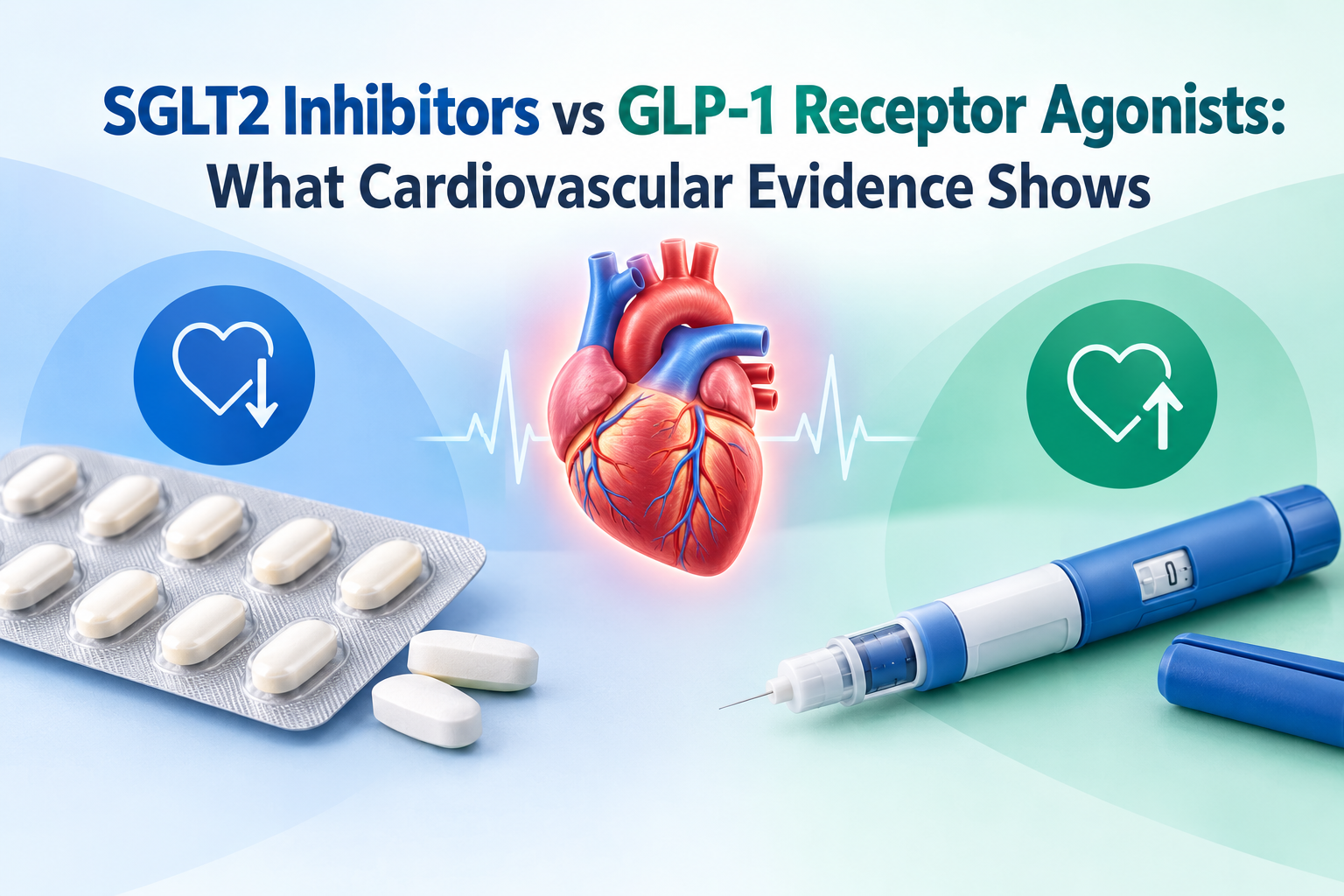
A new systematic review and meta-analysis of randomized trials compared sodium-glucose cotransporter 2 (SGLT2) inhibitors and glucagon-like peptide-1 (GLP-1) receptor agonists across ventricular arrhythmias, cardiovascular mortality, all-cause mortality, and hospitalization for heart failure. Its main practical message is not that one class is uniformly superior. Rather, the relative signal depends on which cardiovascular outcome matters most.
The evidence most clearly favors SGLT2 inhibitors when prevention of heart failure hospitalization is the priority. That finding is consistent with the broader SGLT2 trial program, in which reductions in heart failure events have appeared across type 2 diabetes, chronic kidney disease, and heart failure populations, including people without diabetes.
For cardiovascular and all-cause mortality, the comparison is less decisive. Both classes have produced mortality benefits in randomized outcome trials, but differences between them are smaller and harder to establish than the heart failure signal. A finding that one class reaches statistical significance while another does not would not, by itself, prove that their effects differ; that requires a valid between-class comparison.
Ventricular arrhythmias are the least settled outcome. The new analysis brings an important but relatively uncommon end point into the comparison, yet arrhythmic events are generally captured less consistently than death or hospitalization. Definitions may include sustained ventricular tachycardia, ventricular fibrillation, resuscitated cardiac arrest, or adverse-event reports, depending on the trial. Consequently, any apparent class difference should be treated as hypothesis-generating unless supported by prospectively adjudicated events and a sufficiently precise confidence interval.
| Cardiovascular priority | Comparative interpretation | Confidence for class selection |
|---|---|---|
| Hospitalization for heart failure | SGLT2 inhibitors have the more consistent favorable signal | Highest among the outcomes assessed |
| Cardiovascular mortality | Both classes are beneficial in relevant populations; comparative superiority is uncertain | Moderate for class benefit, lower for between-class ranking |
| All-cause mortality | Effects appear broadly favorable, without a secure basis for declaring one class superior | Moderate for class benefit, lower for between-class ranking |
| Ventricular arrhythmias | A possible difference requires cautious interpretation because events are uncommon and variably captured | Low |
How the comparison was constructed
The review synthesized randomized trials rather than observational prescribing data. That design reduces confounding within each contributing trial because treatment assignment was randomized. It does not automatically create a randomized comparison between SGLT2 inhibitors and GLP-1 receptor agonists, however. Much of the evidence base for these drug classes comes from separate placebo-controlled programs enrolling different populations at different times.
This distinction matters. An indirect comparison assumes that the trial groups are sufficiently similar for their relative effects to be compared. Yet SGLT2 trials include substantial numbers of participants selected for symptomatic heart failure or chronic kidney disease, whereas many GLP-1 receptor agonist trials were designed around type 2 diabetes and atherosclerotic cardiovascular risk. Baseline ejection fraction, kidney function, background therapy, diabetes status, and event risk may therefore differ materially.
Follow-up also varies across the contributing trials, so there is no single duration that describes the full analysis. Mortality and heart failure hospitalization are usually prespecified and independently adjudicated in cardiovascular outcome trials. Ventricular arrhythmias may not be. Pooling relative effects can improve statistical power, but it cannot fully correct differences in outcome definitions, surveillance, trial eligibility, or competing risks.
The established class-specific meta-analyses provide useful context. Randomized SGLT2 inhibitor trials have consistently shown their largest cardiovascular effect on heart failure hospitalization, with additional kidney and mortality benefits in selected populations. GLP-1 receptor agonist trials have demonstrated reductions in major cardiovascular events and favorable mortality outcomes in people with type 2 diabetes, particularly those with established or elevated atherosclerotic risk. Those patterns support a priority-based interpretation rather than a universal hierarchy.
Choosing around the dominant cardiovascular risk
The comparison supports SGLT2 inhibitor selection when heart failure is established or when avoiding heart failure hospitalization is the dominant objective. This is a class-level conclusion, not evidence that every agent has identical data in every phenotype. Clinicians still need to match the individual drug to its FDA-approved indication and the population studied in its pivotal trials.
When atherosclerotic cardiovascular disease, excess weight, or the need for greater glucose lowering dominates, GLP-1 receptor agonists may remain attractive even if SGLT2 inhibitors rank better for heart failure hospitalization. Those considerations were not all tested by the outcomes in this review. Conversely, a favorable GLP-1 receptor agonist profile for atherosclerotic events should not be assumed to provide the same degree of protection from heart failure admission as an SGLT2 inhibitor.
The classes are also not necessarily alternatives. Many people with type 2 diabetes, chronic kidney disease, obesity, or cardiovascular disease may be eligible for both, provided contraindications, tolerability, access, and treatment burden are addressed. The review compares average class effects; it does not establish that combination therapy is superior to either class alone for ventricular arrhythmias or mortality.
For policy and formulary decisions, the findings argue against treating cardiovascular benefit as one interchangeable category. Coverage criteria that recognize heart failure, kidney disease, atherosclerotic risk, and obesity as distinct therapeutic priorities are more consistent with the evidence than a single preferred class for every high-risk patient.
Important uncertainties remain
The main limitation is the absence of a broad head-to-head randomized trial program. Indirect comparisons can suggest that treatment effects differ, but cross-trial variation can influence the ranking. Even sophisticated meta-analytic methods depend on assumptions about comparability and cannot reproduce randomization between drug classes.
Class-level pooling introduces additional heterogeneity. Agents differ in trial populations, indications, follow-up, background treatment, and outcome definitions. Rare ventricular arrhythmias are especially vulnerable to limited power, incomplete ascertainment, and unstable estimates. Publication bias and selective outcome reporting are also harder to exclude for an end point that was not central to many trials.
Generalizability depends on who was enrolled. Evidence from diabetes cardiovascular outcome trials may not transfer fully to people without diabetes, while dedicated heart failure trials may not answer questions in lower-risk primary prevention populations. Absolute benefit will also vary substantially with baseline event risk, even when relative effects are similar.
Questions clinicians ask
Does this review show that SGLT2 inhibitors are better overall?
No. It supports a stronger SGLT2 inhibitor signal for preventing heart failure hospitalization, but “overall” benefit depends on the outcome and population. Mortality comparisons are less conclusive, and the review does not erase established GLP-1 receptor agonist benefits for patients with type 2 diabetes and atherosclerotic cardiovascular risk.
Should ventricular arrhythmia risk determine which class is used?
Not on this evidence alone. Ventricular arrhythmias are uncommon, and their definitions and ascertainment can differ among trials. The result may help frame future research, but established indications, heart failure status, kidney function, atherosclerotic risk, adverse effects, and access provide a firmer basis for current class selection.
Can the two classes be used together for cardiovascular protection?
They can be used together in appropriately selected patients, but this meta-analysis does not prove that combination therapy reduces arrhythmias, hospitalization, or mortality more than either class alone. The rationale should rest on the patient’s separate glycemic, weight, kidney, heart failure, and atherosclerotic risk priorities, alongside labeled indications and tolerability.
How should a formulary interpret the findings?
A formulary should avoid collapsing all cardiovascular outcomes into a single class claim. The evidence supports preserving access to SGLT2 inhibitors when heart failure prevention is central and to GLP-1 receptor agonists when other cardiometabolic priorities predominate. Indirect comparative rankings should not be treated as proof of head-to-head superiority.
References
1. Meta-analysis compares SGLT2 inhibitors and GLP-1 receptor agonists for cardiovascular outcomes — PubMed, 2026 2. SGLT2 inhibitors for primary and secondary prevention of cardiovascular and renal outcomes in type 2 diabetes: a systematic review and meta-analysis of cardiovascular outcome trials — The Lancet, 2019 3. Cardiovascular, mortality, and kidney outcomes with GLP-1 receptor agonists in patients with type 2 diabetes: a systematic review and meta-analysis of randomised trials — The Lancet Diabetes & Endocrinology, 2021
One story a day
The story of the day, in your inbox
One health journey each morning — no advice, no alarm, just company for the road.