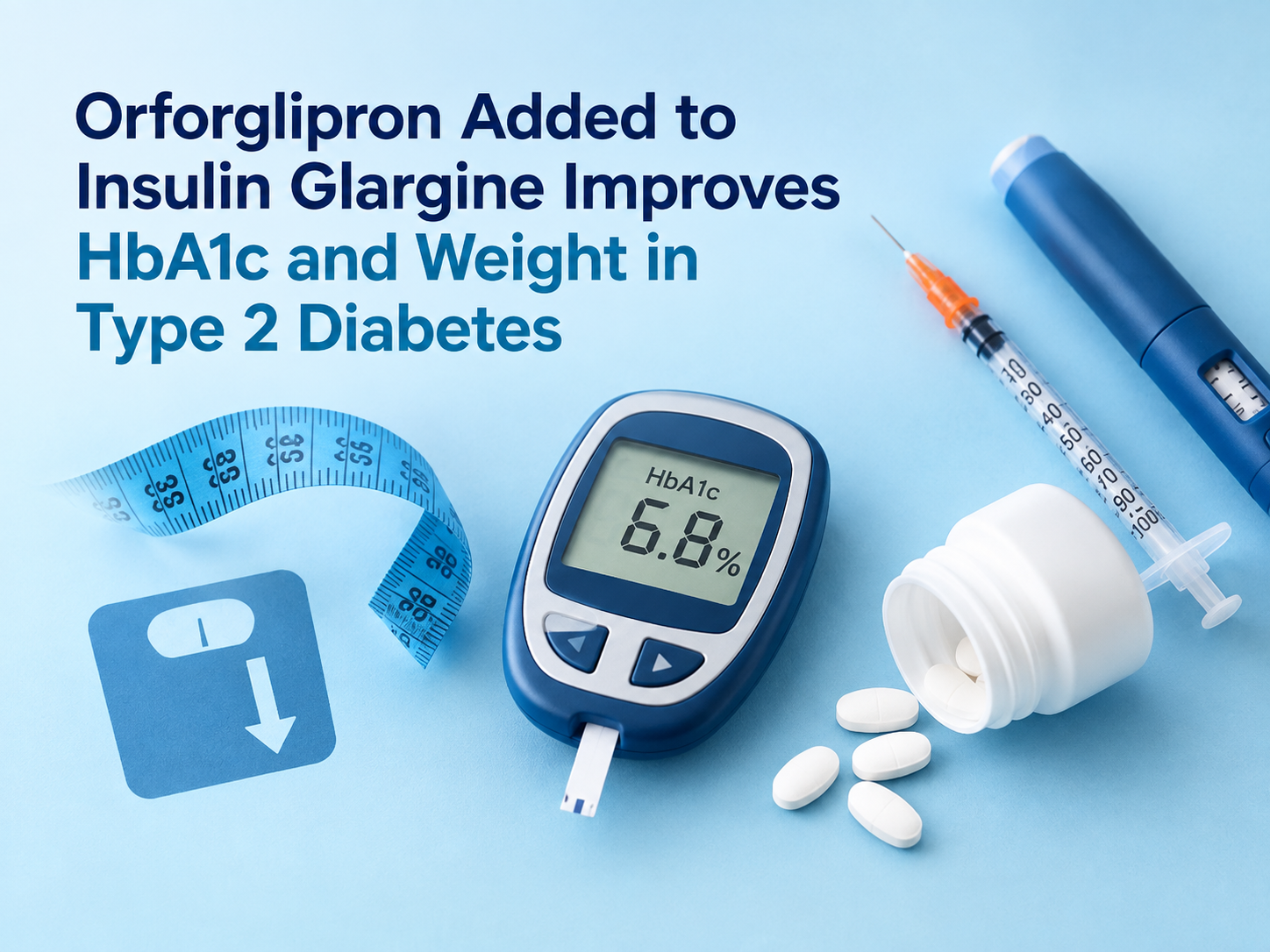
Orforglipron Added to Insulin Glargine Improves HbA1c and Weight in Type 2 Diabetes
ACHIEVE-5 reports better glycemic control and weight outcomes without more hypoglycemia when oral orforglipron is added to titrated insulin glargine, but the numerical results are essential to judge clinical value.
 Written and medically reviewed byDr. Abu BakarContributing writer · PharmD, PhD (Pharmacology)
October 4, 2026 · 6 min read
A favorable result, with important details still needed
The peer-reviewed ACHIEVE-5 report addresses a common clinical problem: adults with type 2 diabetes who remain above their glycemic target despite basal insulin titration. Its title-level conclusion is clinically encouraging. Adding oral orforglipron, a small-molecule glucagon-like peptide-1 receptor agonist, reportedly improved glycemic control and weight without producing more hypoglycemia than the comparator strategy.
That combination of outcomes matters. Increasing basal insulin can lower glucose, but it may also contribute to weight gain and hypoglycemia, particularly when fasting glucose is already near target or when insulin is intensified beyond what fasting measurements justify. An add-on therapy that lowers HbA1c while reducing weight could address postprandial and other glucose abnormalities without relying solely on more insulin.
The supplied PubMed citation, however, does not include the numerical trial results. The absolute and between-group changes in HbA1c and body weight, confidence intervals, prespecified estimands and exact hypoglycemia rates therefore cannot be reported responsibly from the information provided. Those values determine whether a statistically positive trial translates into a clinically meaningful benefit.
The same caution applies to the phrase “without more hypoglycemia.” It may mean that event rates were numerically similar, that a comparison was not statistically significant, or that a prespecified noninferiority criterion was met. These are not interchangeable conclusions. The full report should be used to establish which interpretation ACHIEVE-5 supports.
Why the insulin-glargine design matters
ACHIEVE-5 evaluated oral orforglipron as an addition to titrated insulin glargine rather than as a replacement for basal insulin. The population therefore represents people already requiring insulin whose diabetes remained inadequately controlled, not people choosing a first injectable or oral glucose-lowering treatment.
A titration protocol is central to interpreting the result. If insulin glargine was adjusted to comparable fasting glucose targets across study groups, differences in HbA1c could more plausibly reflect the added glucose-lowering effect of orforglipron. Conversely, unequal insulin titration, protocol-directed insulin reductions or different rescue-treatment use could influence both glycemic and hypoglycemia outcomes.
The comparator also matters. For a placebo-controlled add-on trial, the practical comparison is orforglipron plus optimized basal insulin versus optimized basal insulin alone. That design can establish the drug’s incremental efficacy when randomization, adherence and treatment exposure are adequate. It does not establish superiority over injectable GLP-1 receptor agonists, dual incretin therapies, sodium-glucose cotransporter 2 inhibitors or prandial insulin unless those treatments were directly studied.
Key design details requiring confirmation in the full publication include the randomized population size, orforglipron dose groups, background medications, baseline HbA1c and weight, insulin-titration algorithm, primary estimand and follow-up duration. Attrition and treatment discontinuation are especially relevant for an oral GLP-1 receptor agonist because gastrointestinal adverse effects can affect both tolerability and interpretation of weight loss.
How the finding could affect practice
The evidence supports considering the therapeutic concept rather than automatically escalating basal insulin. For adults who remain above target on appropriately titrated insulin glargine, an effective GLP-1 receptor agonist may offer glycemic improvement together with weight reduction. The reported absence of additional hypoglycemia would strengthen that rationale if confirmed by event rates using standard definitions.
Clinical interpretation should begin with the glucose pattern. A patient with fasting glucose near target but persistently elevated HbA1c may have postprandial hyperglycemia that is unlikely to improve safely through continued basal-insulin escalation alone. In that setting, an add-on treatment affecting glucose-dependent insulin secretion, glucagon signaling, appetite and weight could be more physiologically aligned with the remaining problem.
Oral administration may broaden acceptability for some adults who prefer not to add another injection. It does not eliminate treatment burden, however. Adherence, administration requirements, gastrointestinal tolerability, access and cost can determine whether efficacy observed in a trial is reproduced in routine care.
Hypoglycemia risk also remains individualized. A neutral group-level comparison does not mean that no participant developed clinically important low glucose. Risk may differ according to insulin dose, kidney function, meal regularity, glucose monitoring, age and use of sulfonylureas or other background therapies. Any protocol-directed insulin adjustments made when orforglipron was initiated would be important to translate correctly rather than infer from the headline result.
Regulatory status is a separate question from trial efficacy. Before clinical use in the United States, clinicians would need to confirm approval, labeled indications, contraindications, dosing and safety information through FDA sources. A positive peer-reviewed trial alone does not establish that a product is approved or define how it should be prescribed.
Uncertainties that limit the conclusion
The immediate limitation is incomplete quantitative reporting in the supplied evidence summary. Without arm-level effect sizes, confidence intervals, event definitions and discontinuation rates, the benefit-risk balance cannot be independently appraised. The publication’s funding statement, sponsor involvement and author conflicts also require review because these details were not provided.
Trial duration will determine how confidently the findings can be extended beyond initial glucose and weight responses. Longer observation is needed to assess durability, uncommon adverse events and whether insulin requirements continue to diverge. ACHIEVE-5 also cannot by itself establish cardiovascular, kidney or mortality benefit unless it was designed and powered for those outcomes.
Generalizability depends on who enrolled. Results may not transfer fully to people with advanced kidney or liver disease, recurrent severe hypoglycemia, marked insulin deficiency, very high insulin requirements, frailty or substantial gastrointestinal disease if those groups were excluded or underrepresented. Race, ethnicity, age, diabetes duration and geographic representation also matter.
Overall, ACHIEVE-5 appears to support oral orforglipron as an effective add-on to titrated basal insulin, with a favorable direction of effect across HbA1c, weight and hypoglycemia. Whether the magnitude is sufficient to change practice depends on the full numerical results, tolerability, insulin-dose changes, regulatory review and comparison with established alternatives.
Questions clinicians ask
Does ACHIEVE-5 support adding orforglipron instead of increasing basal insulin?
It supports that strategy in adults who remained inadequately controlled despite titrated insulin glargine, particularly when weight is also a concern. The evidence should not be generalized to every elevated HbA1c; fasting and postprandial glucose patterns, current insulin titration and the trial’s eligibility criteria remain important.
Does “without more hypoglycemia” mean insulin doses need no adjustment?
No. A group-level finding does not establish that insulin can remain unchanged for every patient. The full protocol is needed to determine whether insulin was proactively reduced, held stable or titrated according to glucose values when orforglipron was started.
How meaningful is the reported weight benefit?
The direction is favorable, especially because basal insulin commonly complicates weight management. Clinical importance cannot be judged from the citation alone, however, because the absolute weight change, between-group difference, confidence interval and proportion achieving categorical weight-loss thresholds were not supplied.
Is ACHIEVE-5 enough to establish long-term safety or cardiovascular benefit?
No. A glycemic efficacy trial can characterize common adverse events and hypoglycemia over its follow-up period, but it generally cannot establish uncommon or long-latency risks. Cardiovascular or kidney benefit requires dedicated outcomes evidence unless those endpoints were prospectively assessed with sufficient duration and statistical power.
References
1. Orforglipron added to titrated insulin glargine improves glycemic control and weight in type 2 diabetes (ACHIEVE-5) — PubMed, National Library of Medicine, 2026 2. ClinicalTrials.gov Search Results for ACHIEVE-5 — ClinicalTrials.gov, National Library of Medicine, n.d. 3. Drugs@FDA: FDA-Approved Drugs — US Food and Drug Administration, n.d.
One story a day
The story of the day, in your inbox
One health journey each morning — no advice, no alarm, just company for the road.