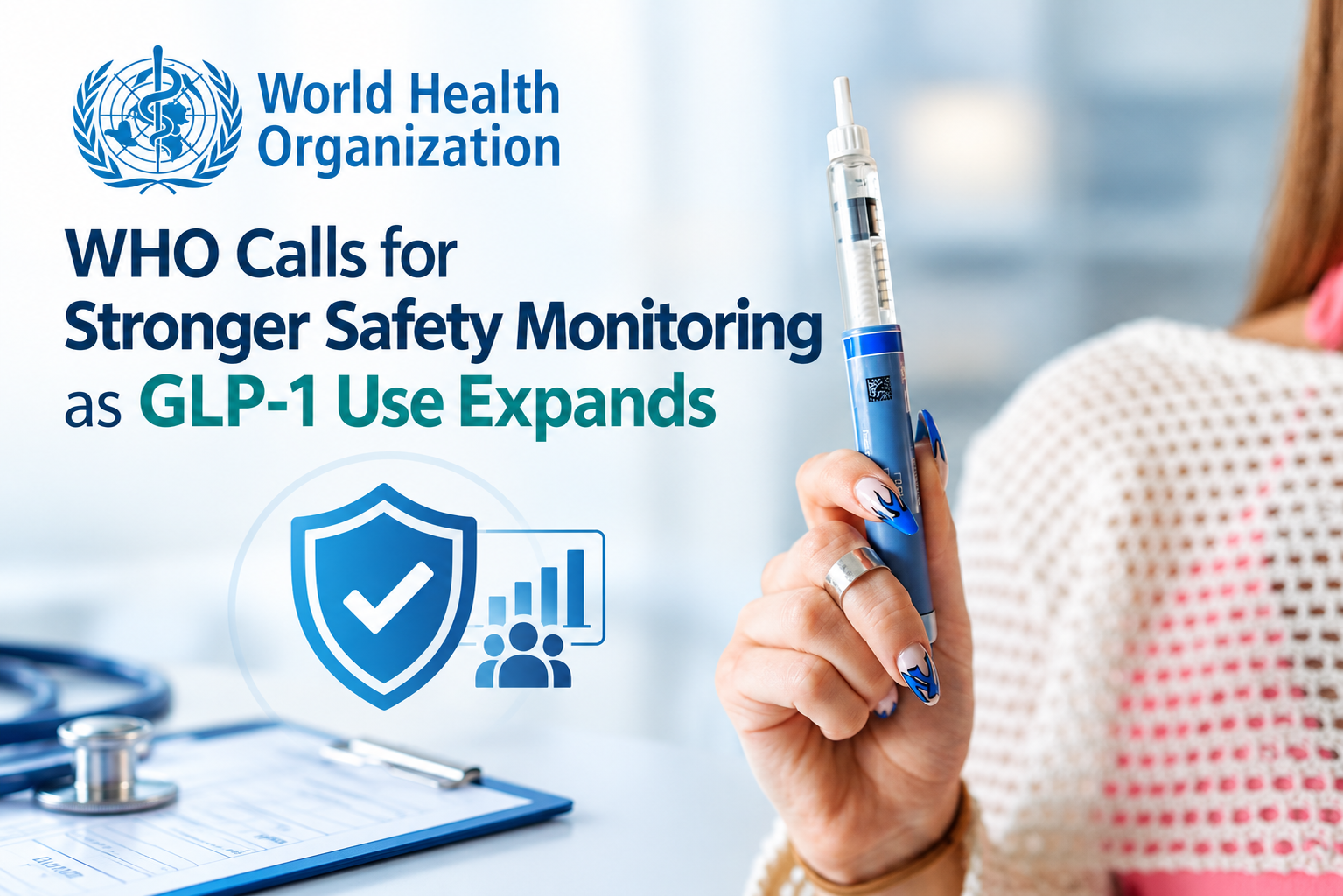
WHO Calls for Stronger Safety Monitoring as GLP-1 Use Expands
WHO is calling for stronger safety monitoring as GLP-1 use for weight loss grows worldwide. Clinicians need reliable prescribing, follow-up and adverse-event reporting systems.
 Written and medically reviewed byDr. Abu BakarContributing writer · PharmD, PhD (Pharmacology)
September 20, 2026 · 7 min read
TheBrief
WHO says expanding GLP-1 use for weight loss requires stronger safety monitoring and appropriate-use safeguards. Clinicians should pair prescribing with structured follow-up, product verification, and clear documentation of reportable events.
What changed
The WHO statement places greater emphasis on pharmacovigilance as GLP-1 medicines become more widely used for weight management. As exposure expands across countries, indications, and supply channels, uncommon adverse events, medication errors, product-quality problems, and experiences in less-studied populations may become easier to detect, but only when health systems consistently capture and report them.
The statement comes from a joint meeting of WHO safety advisory committees. It is a regulatory safety communication rather than a randomized trial or comparative effectiveness study. It does not provide a treatment-effect estimate, incidence rate, confidence interval, or defined follow-up period. Its main message is preparedness: expanding use should be supported by systems that can identify emerging safety signals and distinguish them from known, labeled effects.
That distinction matters because an adverse-event report does not prove that a medicine caused the event. Reports may be incomplete, influenced by increased public attention, or missing an untreated comparison group. Their main value is in helping identify possible safety signals that need further evaluation.
These patterns can then prompt more focused epidemiologic studies, regulatory review, inspections, label changes, or additional risk-minimization measures.
Why population-scale exposure changes the risk picture
Premarketing trials are designed to evaluate efficacy and common adverse events in defined study populations. They are less suited to identifying extremely rare outcomes, longer-term effects, medication errors, off-label use, or problems that emerge in groups that were excluded or only lightly represented in trials. Rapid uptake can also create practical risks such as confusion between concentrations, switching products, duplicate treatment, and use of medicines from unverified sources.
Population-level monitoring should therefore go beyond checking for expected gastrointestinal symptoms. A useful safety record should connect the event with the exact product, indication, treatment timeline, dose history, other medicines, and relevant medical conditions. When available, manufacturer information, lot number, dispensing source, and whether the medicine was FDA-approved or compounded can help distinguish a potential class-related signal from a formulation, quality, or administration problem.
In the United States, this distinction is particularly relevant when patients receive compounded or otherwise unapproved GLP-1 products during shortages or through online channels. FDA states that unapproved GLP-1 products do not undergo its premarket review for safety, effectiveness, and quality. The agency has also reported dosing errors involving compounded injectable semaglutide, including confusion caused by different concentrations and instructions expressed in units rather than milligrams.
These concerns do not mean that every reported event was caused by a GLP-1 medicine, nor do they establish an unfavorable benefit-risk balance for approved products. They show why product source, formulation, concentration, and administration method should be part of the safety assessment.
Prescribing priorities at the point of care
Appropriate use starts with confirming the treatment indication and consulting the current prescribing information for the specific product. GLP-1-based medicines are not interchangeable simply because they act on the same biological pathway. Indications, contraindications, warnings, titration schedules, dosing instructions, and delivery devices can differ, so clinicians should not transfer a dose or schedule from one formulation to another.
Medication reconciliation should identify other GLP-1-based treatments, glucose-lowering medicines that may affect hypoglycemia risk, and medicines whose use could be disrupted by significant gastrointestinal symptoms. The baseline assessment should also consider conditions addressed by the selected product’s warnings and precautions, previous intolerance, hydration and nutritional status, and reproductive plans when clinically relevant.
The product itself is part of the prescribing decision. Clinicians and pharmacists should confirm whether the product is FDA-approved, where it will be dispensed, and whether the patient can identify the prescribed concentration and delivery device. When a compounded product is considered in circumstances permitted by law, differences in concentration, syringe markings, and administration instructions require particular attention. Compounded medicines are not FDA-approved substitutes that have undergone the same premarket evaluation.
Access and continuity also affect medication safety. Treatment interruptions, unsupervised restarting, or switching between products can create administration errors and avoidable intolerance. A follow-up plan should anticipate supply problems rather than leaving patients to improvise with leftover medicine, unfamiliar concentrations, or products from uncertain sources.
What follow-up should capture
Follow-up should be structured enough to identify clinically meaningful changes over time without treating every expected symptom as an emergency. At a minimum, the record should document treatment dates, the actual product used, dose changes, adherence, tolerability, and whether symptoms appeared after treatment started or after a dose increase. Weight trends and treatment goals remain relevant, but they should not replace a basic safety review.
Questions should address the severity and persistence of gastrointestinal symptoms, the patient’s ability to maintain fluids and nutrition, and symptoms that may correspond to warnings in the product’s prescribing information. Patients with diabetes may require individualized glucose monitoring when other glucose-lowering therapy is changed. Laboratory testing should be based on the patient’s clinical condition, comorbidities, concurrent treatment, and the applicable product label rather than a universal laboratory panel applied to every GLP-1 user.
Clinicians should also confirm what the patient is actually taking or injecting. Packaging, concentration, device type, and source may differ from what the prescriber expects. This can become especially important after telehealth prescribing, cash purchases, shortages, or transitions between approved and compounded products.
A reportable event should be documented in enough detail to make the case clinically interpretable. Useful information includes onset and resolution dates, seriousness, medical evaluation, treatment interruption, rechallenge when it occurred, concomitant medicines, relevant test results, and product identifiers. FDA MedWatch accepts reports from healthcare professionals as well as patients and consumers, and suspected adverse reactions can be reported even when causality remains uncertain.
Limits of the evidence
WHO’s statement does not quantify the incidence of a specific adverse event, compare individual GLP-1 products, or establish a new causal association. Spontaneous reporting systems can be affected by underreporting, duplicate reports, missing clinical information, and increased reporting after publicity. They also generally cannot provide exposure-adjusted incidence rates because the number and characteristics of people receiving a medicine are uncertain.
The practical conclusions are therefore focused on safety systems rather than new treatment restrictions. The available evidence supports better event detection, documentation, and reporting as GLP-1 use expands. It does not justify adding unlisted contraindications, ordering identical laboratory tests for every patient, or automatically attributing a new symptom to treatment without considering other possible causes.
Important gaps remain in areas such as long-term outcomes across diverse populations, repeated treatment interruptions, switching between formulations, and the role of compounded or falsified products in reported harms. Linked prescribing, dispensing, and clinical-outcome information can provide more context than raw adverse-event counts alone.
Questions clinicians ask
Does WHO’s statement identify a new GLP-1 adverse effect?
Not on the evidence described in the statement. It is a call for stronger monitoring and appropriate use as exposure grows, rather than a comparative study establishing a new event rate or causal association. Any emerging signal would require clinical review and, where possible, controlled observational or trial evidence.
What should I document when a patient reports a suspected reaction?
Record the event timeline, seriousness, dose history, concomitant medicines, relevant comorbidities, evaluation and outcome. Also capture the exact product, manufacturer, lot number, concentration, device and dispensing source when available; those details can help distinguish a pharmacologic signal from a dosing or product-quality problem.
Should every patient receive the same laboratory monitoring?
No universal laboratory panel follows from WHO’s statement. Monitoring should reflect the specific product’s US prescribing information, the patient’s comorbidities, concurrent therapy and symptoms. Clinical assessment is particularly important when persistent gastrointestinal effects could compromise hydration, nutrition or the safe use of other medicines.
When should a suspected event be reported to FDA?
Serious, unexpected or clinically significant suspected reactions, medication errors and product-quality concerns can be submitted through FDA MedWatch. Proof of causality is not required. Prompt reporting is most useful when it includes clinical chronology and precise product information, particularly for compounded, unfamiliar or potentially falsified products.
References
1. Statement From the Joint Meeting of the Advisory Committee on Safety of Medicinal Products (ACSoMP) and the Global Advisory Committee on Vaccine Safety (GACVS) on the Safe and Appropriate Use of GLP-1 Receptor Agonists-and-the-global-advisory-committee-on-vaccine-safety-\(gacvs\)-on-the-safe-and-appropriate-use-of-glp-1-receptor-agonists) — World Health Organization, 2026 2. FDA’s Concerns With Unapproved GLP-1 Drugs Used for Weight Loss — US Food and Drug Administration, 2025 3. FDA Alerts Health Care Providers, Compounders and Patients of Dosing Errors Associated With Compounded Injectable Semaglutide Products — US Food and Drug Administration, 2024 4. MedWatch: The FDA Safety Information and Adverse Event Reporting Program — US Food and Drug Administration, 2025
One story a day
The story of the day, in your inbox
One health journey each morning — no advice, no alarm, just company for the road.