Retatrutide Monotherapy in Early Type 2 Diabetes: Glycemic Control and Weight Loss
In a randomized trial, retatrutide monotherapy lowered glycated hemoglobin and body weight in adults with type 2 diabetes inadequately controlled by diet and exercise.
 Written and medically reviewed byDr. Abu BakarContributing writer · PharmD, PhD (Pharmacology)
September 13, 2026 · 6 min read
Glycemic control and weight improved together
In a randomized trial of about 1,000 adults whose type 2 diabetes was inadequately controlled with diet and exercise alone, once-weekly retatrutide produced clinically meaningful reductions in glycated hemoglobin, or A1C, over 40 weeks. Participants receiving retatrutide also lost substantially more weight than those receiving placebo.
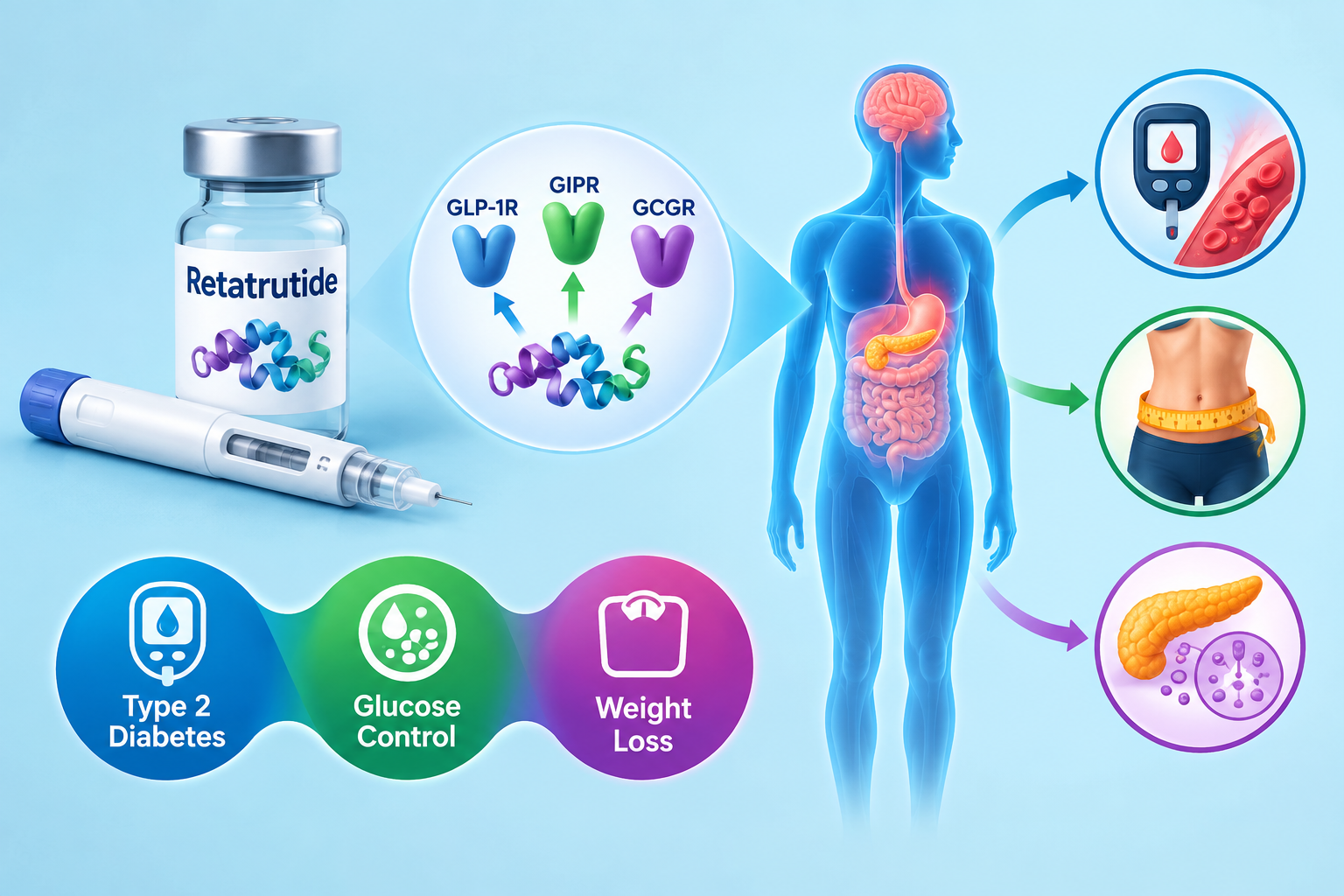
Retatrutide activates glucose-dependent insulinotropic polypeptide, glucagon-like peptide-1 and glucagon receptors. That combination is intended to address hyperglycemia while increasing satiety and energy expenditure. The trial therefore tested a broader metabolic mechanism than selective GLP-1 receptor agonism or dual GIP and GLP-1 receptor agonism.
Across the evaluated retatrutide groups, mean A1C reductions were approximately 1.7 to 2.0 percentage points. Mean body-weight reductions ranged from about 10% to nearly 17%, with the largest change observed in the highest-dose group. Improvements in both outcomes were greater than with placebo, and the trial reported statistically significant between-group differences.
| Outcome at 40 weeks | Retatrutide finding | Interpretation |
|---|---|---|
| Mean A1C change | Approximately −1.7 to −2.0 percentage points across groups | Large average glycemic improvement from baseline |
| Mean body-weight change | Approximately −10% to nearly −17% across groups | Dose-related weight reduction accompanied glycemic improvement |
| Comparison | Greater improvement than placebo | Supports a treatment effect under randomized conditions |
| Clinically significant hypoglycemia | Uncommon | Consistent with an incretin-based mechanism when used without insulin or a sulfonylurea |
These results matter because excess weight and hyperglycemia often need to be addressed simultaneously in early type 2 diabetes. A treatment capable of producing substantial movement in both measures could alter how clinicians weigh initial pharmacotherapy, particularly when obesity is an important treatment consideration.
The evidence does not, however, establish that retatrutide should replace currently available first-line options. The trial tested efficacy and safety against placebo rather than against metformin, semaglutide, tirzepatide or another active glucose-lowering drug.
A monotherapy trial in early disease
Eligible participants had type 2 diabetes that remained above target despite diet and exercise. Studying retatrutide as monotherapy reduced the influence of background glucose-lowering drugs and made its direct metabolic effects easier to assess.
Participants were randomly assigned to placebo or one of several retatrutide regimens administered once weekly, with gradual dose escalation used to improve tolerability. The primary efficacy assessment occurred at 40 weeks. Randomization supports a causal interpretation of differences observed between the assigned groups during that period.
The study population is relevant to decisions about starting medication because participants were not being evaluated as add-on candidates after failure of multiple therapies. Even so, trial eligibility criteria generally produce a more selected population than routine clinical practice. People with advanced complications, complex comorbidity, substantial renal or hepatic impairment, or a history of poor medication tolerance may be underrepresented.
A1C and body weight are clinically useful outcomes, but they are intermediate outcomes. The study was not designed or long enough to determine whether retatrutide prevents myocardial infarction, stroke, kidney failure, retinopathy or premature death. Those questions require dedicated outcome trials and longer observation.
Tolerability remains central to treatment choice
Gastrointestinal events were the dominant adverse-effect signal. Nausea, diarrhea and vomiting occurred more often with retatrutide than with placebo and tended to be more frequent at higher exposure. Most were reported as mild or moderate and were concentrated around dose escalation, although some participants discontinued treatment because of adverse events.
That pattern resembles the tolerability profile of other incretin-based therapies, but familiarity with a drug class should not be treated as proof that the safety profile is interchangeable. Retatrutide’s glucagon receptor activity is pharmacologically distinct, and broader or longer use could reveal effects that a 40-week efficacy trial cannot characterize fully.
Clinically significant hypoglycemia was uncommon in this monotherapy setting. That finding should not be generalized automatically to combination treatment with insulin or insulin secretagogues, where the background regimen can materially change hypoglycemia risk.
The trial also cannot answer how persistent the weight loss will be, what happens after treatment is stopped, or whether participants can maintain higher-dose therapy over several years. For chronic treatment, adherence, access, out-of-pocket costs and gastrointestinal tolerability may narrow the gap between efficacy under trial conditions and effectiveness in practice.
What the evidence supports now
The results provide proof that simultaneous GIP, GLP-1 and glucagon receptor agonism can produce substantial glycemic and weight effects as initial drug monotherapy. For clinicians and guideline panels, the trial adds a potentially important option to a treatment landscape increasingly shaped by weight, cardiovascular risk, kidney disease and patient preferences rather than A1C alone.
It does not provide an active-comparator hierarchy. Without head-to-head data, the magnitude of benefit cannot be reliably ranked against metformin, GLP-1 receptor agonists or dual GIP and GLP-1 receptor agonists. Differences between separate trials in baseline A1C, body weight, estimands, adherence and handling of rescue therapy make indirect comparisons especially uncertain.
Regulatory review is another boundary. A positive peer-reviewed trial does not itself confer US marketing authorization, determine labeling or establish insurance coverage. Prescribing decisions require an approved indication and label, while formulary decisions also depend on comparative value and budget impact.
Important uncertainties
Forty weeks is too short to characterize durability or uncommon adverse events. The placebo comparison establishes short-term efficacy but does not show whether retatrutide offers better net benefit than established initial therapies. Generalizability may also be limited by the selected trial population and structured escalation and follow-up.
As with many large drug-development trials, sponsorship and investigator financial relationships should be considered when interpreting the report. Randomization and peer review strengthen the evidence, but independent replication, transparent reporting and postauthorization surveillance remain important.
Future studies will need to clarify long-term cardiovascular and kidney outcomes, safety during prolonged treatment, effectiveness in more diverse clinical populations, and outcomes when retatrutide is combined with other glucose-lowering drugs. Active-comparator trials would be particularly useful for initial-therapy decisions.
Questions clinicians ask
Does this trial establish retatrutide as preferred first-line therapy?
No. It shows that retatrutide was more effective than placebo for lowering A1C and body weight in adults inadequately controlled with lifestyle measures. It did not directly compare retatrutide with metformin, semaglutide, tirzepatide or other established options, and it does not settle questions of long-term outcomes, access or value.
How relevant are the weight findings for diabetes care?
They are highly relevant because obesity can worsen insulin resistance and influence treatment priorities. The magnitude of average weight loss was notable, but trial averages do not predict an individual response, and the study does not establish whether weight loss and glycemic improvement remain durable over years or after treatment withdrawal.
Is hypoglycemia a major concern with monotherapy?
Clinically significant hypoglycemia was uncommon when retatrutide was used without insulin or a sulfonylurea. That finding applies to the studied monotherapy setting; risk could differ if the drug is eventually used with treatments that independently cause hypoglycemia.
What adverse effects are most likely to affect uptake?
Nausea, diarrhea and vomiting were the principal tolerability concerns, with greater gastrointestinal burden at higher exposure. Gradual escalation may improve tolerability, but the trial still recorded adverse-event discontinuations, and longer studies are needed to define persistence, uncommon harms and real-world adherence.
References
1. Retatrutide, a triple agonist (GIP, GLP-1, glucagon), improves glycaemic control and weight in type 2 diabetes — PubMed, National Library of Medicine, 2026 2. Insulin, Medicines, & Other Diabetes Treatments — National Institute of Diabetes and Digestive and Kidney Diseases, n.d. 3. Drugs@FDA: FDA-Approved Drugs — US Food and Drug Administration, n.d.
One story a day
The story of the day, in your inbox
One health journey each morning — no advice, no alarm, just company for the road.