Semaglutide and Cardiovascular Risk: What a 2026 Meta-Analysis Shows
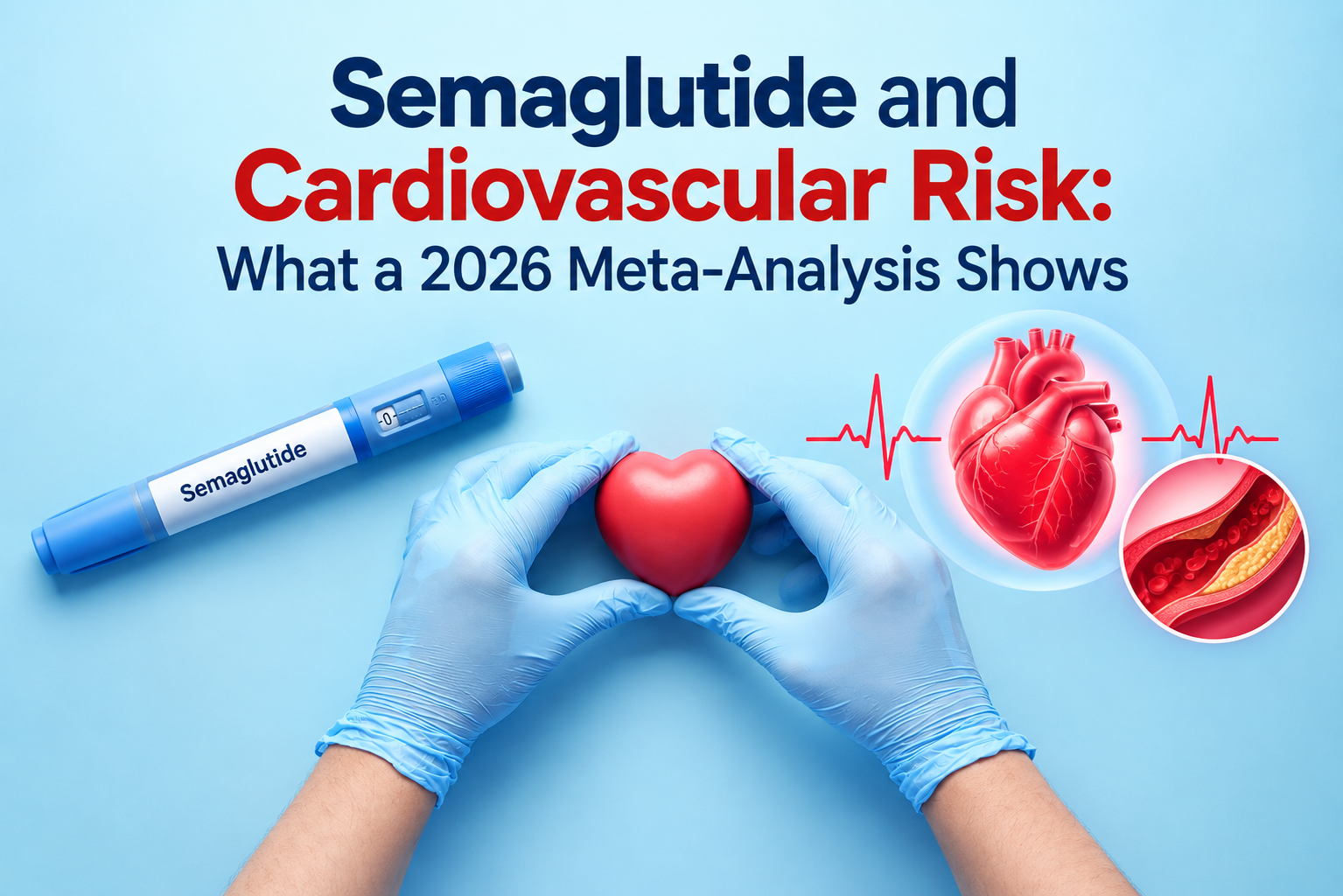
A 2026 meta-analysis estimated 32% lower odds of major cardiovascular events with semaglutide. The result supports cardiovascular benefit discussions but requires context on heterogeneity, absolute risk and indication.
 Written and medically reviewed byDr. Abu BakarContributing writer · PharmD, PhD (Pharmacology)
September 13, 2026 · 6 min read
A favorable estimate that needs clinical translation
The pooled odds ratio for major adverse cardiovascular events, or MACE, was 0.68 in the 2026 meta-analysis. Expressed correctly, this means the estimated odds of an event were 32% lower among participants receiving semaglutide than among those in the comparator groups.
That is a potentially important effect, but “32% lower” can be misunderstood. An odds ratio is not the same as a risk ratio, particularly when events are common, and it says nothing by itself about the number of events prevented. Absolute benefit depends on baseline cardiovascular risk, follow-up time and the endpoint definition used in each study.
For example, the same relative effect would prevent more events in people with established atherosclerotic cardiovascular disease than in a lower-risk population. Shared decision-making therefore needs an estimate of baseline risk and, where available, trial-specific absolute event rates rather than the pooled odds ratio alone.
The evidence summary available for this brief reports the pooled OR of 0.68 but does not provide its confidence interval, total sample size, number of included studies or pooled follow-up duration. Those details are necessary to judge precision and should be checked in the full meta-analysis before the estimate is incorporated into guidelines, formularies or comparative-effectiveness assessments.
What random-effects pooling changes
A random-effects model does not assume that every included study is estimating one identical treatment effect. Instead, it treats the studies as sampling from a distribution of potentially different effects. That is often reasonable when trials vary by diabetes status, obesity criteria, baseline cardiovascular disease, semaglutide formulation, dose, comparator, follow-up or MACE definition.
The resulting OR of 0.68 is therefore an average across the included evidence, not a promise that every eligible population will experience a 32% reduction in odds. The pooled estimate may be influenced by both large cardiovascular outcomes trials and smaller studies, depending on the review’s eligibility criteria and weighting method.
Between-study heterogeneity matters as much as the modeling choice. A broad confidence interval around the pooled effect, a wide prediction interval or substantial inconsistency would reduce confidence that a similar effect will appear in a new clinical setting. Conversely, directionally consistent results across distinct populations would strengthen the case that the signal is not confined to glucose lowering in type 2 diabetes.
Meta-analysis also cannot repair weaknesses in its component studies. Pooling may increase statistical precision, but it does not eliminate endpoint differences, selective reporting, loss to follow-up or variation in background cardiovascular therapy. If observational studies were included alongside randomized trials, their estimates would remain vulnerable to confounding and should not be interpreted as establishing causation.
Evidence beyond glycemic control
The strongest argument that semaglutide’s cardiovascular benefit is not solely a consequence of improved glycemic control comes from SELECT. That randomized, placebo-controlled trial enrolled 17,604 adults with preexisting cardiovascular disease and overweight or obesity but without diabetes. Over a mean follow-up of 39.8 months, MACE occurred in 6.5% of participants assigned subcutaneous semaglutide and 8.0% assigned placebo, corresponding to a hazard ratio of 0.80 with a 95% confidence interval of 0.72 to 0.90.
Earlier cardiovascular outcomes trials studied people with type 2 diabetes at high cardiovascular risk. SUSTAIN-6 found fewer MACE events with subcutaneous semaglutide over 104 weeks, while PIONEER 6 established cardiovascular safety for oral semaglutide but had a confidence interval compatible with both meaningful benefit and little effect.
| Evidence | Population and comparator | Follow-up | MACE result |
|---|---|---|---|
| 2026 meta-analysis | Semaglutide studies pooled against included comparators | Not specified in the supplied summary | OR 0.68; CI not specified in the supplied summary |
| SELECT | 17,604 adults with cardiovascular disease and overweight or obesity, without diabetes; placebo-controlled | Mean 39.8 months | 6.5% vs 8.0%; HR 0.80 (95% CI, 0.72-0.90) |
| SUSTAIN-6 | 3,297 adults with type 2 diabetes at high cardiovascular risk; placebo-controlled | 104 weeks | 6.6% vs 8.9%; HR 0.74 (95% CI, 0.58-0.95) |
| PIONEER 6 | 3,183 adults with type 2 diabetes at high cardiovascular risk; placebo-controlled | Median 15.9 months | 3.8% vs 4.8%; HR 0.79 (95% CI, 0.57-1.11) |
These effect measures should not be treated as interchangeable. The meta-analysis reports an odds ratio, whereas the cardiovascular outcomes trials reported hazard ratios that account for time to event. The trials also evaluated different formulations and populations. Their broad directional alignment is clinically relevant, but direct numerical comparisons can mislead.
How the result fits current practice
The pooled estimate can support a discussion of cardiovascular outcomes when semaglutide is otherwise being considered for an evidence-based, labeled use. It is especially relevant when a patient’s baseline risk resembles populations represented in cardiovascular outcomes trials.
In the United States, semaglutide already has formulation-specific labeling. In 2024, the FDA approved semaglutide marketed as Wegovy to reduce the risk of cardiovascular death, nonfatal myocardial infarction and nonfatal stroke in adults with cardiovascular disease and either obesity or overweight. The meta-analysis does not broaden that population, transfer the indication automatically to every semaglutide product or establish a class-wide effect for all glucagon-like peptide-1 receptor agonists.
For policy decisions, the 0.68 estimate should not be converted directly into a number needed to treat. That calculation requires an absolute event difference over a defined period in a defined population. Trial-specific event rates are more suitable for benefit projections, although their transportability still depends on whether real-world patients receive comparable background prevention and have similar competing risks.
Important uncertainties remain
The meta-analysis is secondary evidence. Its credibility depends on the search strategy, study selection, risk-of-bias assessment, endpoint harmonization and handling of heterogeneity. Without the full confidence interval and heterogeneity statistics in the supplied summary, the precision and likely range of effects cannot be independently characterized here.
Generalizability also remains limited. Evidence from people with established cardiovascular disease or high-risk type 2 diabetes does not necessarily apply to younger, lower-risk populations without cardiovascular disease. Longer-term effects, discontinuation patterns, adverse-event tradeoffs and outcomes after treatment cessation need consideration alongside MACE.
Funding and author conflicts reported by the meta-analysis and its component trials should be reviewed when interpreting the synthesis. Even a statistically persuasive pooled estimate does not create a new regulatory indication; it organizes existing evidence and helps identify how consistently the cardiovascular signal appears across studies.
Questions clinicians ask
Does an OR of 0.68 mean cardiovascular risk falls by 32%?
Not exactly. It indicates 32% lower odds in the pooled analysis, not necessarily 32% lower probability of an event. The absolute reduction depends on baseline risk and follow-up, while the difference between odds and risk becomes more important as events become more frequent.
Does this show benefit independent of glucose lowering?
SELECT provides the clearest support because it enrolled adults with cardiovascular disease and overweight or obesity who did not have diabetes. Its 20% relative reduction in time-to-first MACE indicates that improved glycemic control is not required for cardiovascular benefit in that specific population.
Should the pooled estimate replace individual trial results?
No. The meta-analysis gives an average across studies, whereas individual trials provide population definitions, event rates, follow-up and formulation-specific evidence needed for clinical translation. Both levels are useful, but trial-specific absolute outcomes are generally more informative for discussing expected benefit.
Does the meta-analysis create a broader semaglutide indication?
No. Regulatory indications remain product- and population-specific. The pooled result may strengthen confidence in a cardiovascular benefit signal, but it should not be used to extend labeling to unstudied populations, formulations or risk groups without supporting trial and regulatory evidence.
References
1. Semaglutide reduced major adverse cardiovascular events in a meta-analysis — PubMed, 2026 2. Semaglutide and Cardiovascular Outcomes in Obesity without Diabetes — New England Journal of Medicine, 2023 3. Semaglutide and Cardiovascular Outcomes in Patients with Type 2 Diabetes — New England Journal of Medicine, 2016 4. Oral Semaglutide and Cardiovascular Outcomes in Patients with Type 2 Diabetes — New England Journal of Medicine, 2019
One story a day
The story of the day, in your inbox
One health journey each morning — no advice, no alarm, just company for the road.