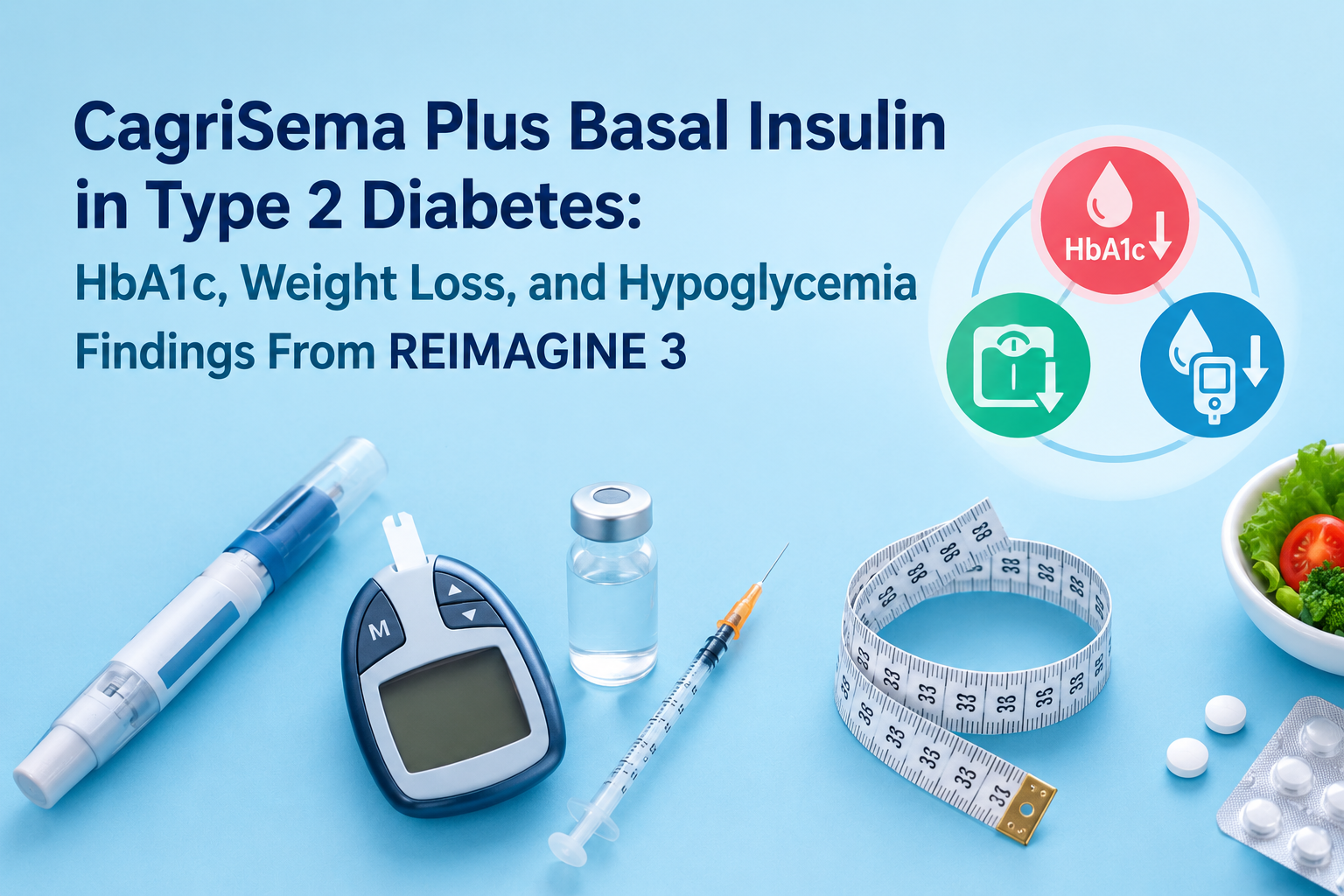
CagriSema Plus Basal Insulin in Type 2 Diabetes: HbA1c, Weight Loss, and Hypoglycemia Findings From REIMAGINE 3
REIMAGINE 3 found glycemic and weight benefits when cagrilintide-semaglutide was added to basal insulin in adults with type 2 diabetes. Hypoglycemia remains central to interpreting treatment escalation.
 Written and medically reviewed byDr. Abu BakarContributing writer · PharmD, PhD (Pharmacology)
September 7, 2026 · 6 min read
A dual approach to persistent hyperglycemia and excess weight
The phase 3 REIMAGINE 3 trial takes on a familiar problem in insulin-treated type 2 diabetes. Glucose remains above target, weight makes further insulin intensification less appealing, and the next step is not always obvious. The study found that once-weekly cagrilintide-semaglutide, usually shortened to CagriSema, improved HbA1c and body weight when added to basal insulin.
I kept a notebook beside the trial record while reviewing it. On one page, the central finding was easy to write down: HbA1c fell, and weight fell too. The harder questions took more space.
Cagrilintide is a long-acting amylin analog. Semaglutide is a glucagon-like peptide-1 receptor agonist. They affect appetite, food intake and glucose regulation in different but potentially complementary ways, which helps explain the interest in combining them for people whose diabetes remains inadequately controlled with basal insulin.
Efficacy is only part of the decision. Once insulin is already in the regimen, another glucose-lowering drug has to be considered alongside hypoglycemia, changes in insulin use, gastrointestinal adverse effects and the burden of another injectable. A lower HbA1c is less persuasive if people reach it through an avoidable rise in symptomatic or severe hypoglycemia.
What REIMAGINE 3 adds
REIMAGINE 3 was a peer-reviewed phase 3 trial in adults with type 2 diabetes inadequately managed with basal insulin. Its reported result addresses the trade-off that often follows insulin intensification: glucose may improve while weight moves in the wrong direction. With CagriSema, both HbA1c and body weight declined.
The notebook has blank spaces under that sentence. The bibliographic record supplied for this briefing does not show the arm-level sample sizes, numerical differences between groups, confidence intervals, follow-up duration or adjudicated hypoglycemia rates. Reconstructing those values from announcements, or borrowing them from another CagriSema study, would create a level of certainty the available record does not support.
The full peer-reviewed report matters here. It should show the prespecified estimand, explain how basal insulin was adjusted and provide the safety results by comparator, because each of those details can change how a seemingly straightforward HbA1c result should be read.
Baseline HbA1c and body mass index are relevant. So are the type and dose of basal insulin, background use of metformin or sodium-glucose cotransporter 2 inhibitors, and any insulin reduction at the start of treatment. Reducing insulin can limit early hypoglycemia, but it may also alter the net HbA1c difference that emerges between trial groups.
Definitions matter too. Glucose readings below 70 mg/dL are not the same as clinically significant episodes below 54 mg/dL, and neither is equivalent to a severe event requiring another person’s assistance. The proportion of participants affected tells one part of the story, while event rates and recurrent episodes tell another. Even a reassuringly small number of severe events may leave a trial unable to rule out a meaningful treatment difference.
How the result fits existing escalation evidence
CagriSema is a newer combination, though the broader treatment idea is established. In the 30-week SUSTAIN 5 randomized trial, semaglutide added to basal insulin reduced HbA1c by 1.4 percentage points with the 0.5-mg dose and 1.8 points with the 1-mg dose. The reduction with placebo was 0.1 point. Mean body weight declined by 3.7 kg and 6.4 kg in the semaglutide groups, compared with 1.4 kg in the placebo group.
Those figures occupy a full section of the notebook because they provide context, not a substitute for the missing REIMAGINE 3 numbers.
In SUSTAIN 5, severe or blood glucose-confirmed symptomatic hypoglycemia occurred numerically more often with semaglutide than with placebo, although the differences were not statistically significant. Participants with a screening HbA1c of 8% or lower had basal insulin reduced by 20% when treatment started, a protocol decision that shows how insulin management can shape a safety result.
The 40-week SURPASS-5 trial offers another useful benchmark. Tirzepatide added to titrated insulin glargine produced mean HbA1c reductions of about 2.1 to 2.4 percentage points, depending on dose, versus 0.86 point with placebo. Weight fell by 5.4 to 8.8 kg with tirzepatide and rose by 1.6 kg with placebo. Clinically significant or severe hypoglycemia was documented in the active-treatment groups and the placebo group, which is important context because every participant remained on insulin.
None of this establishes that CagriSema is more or less effective than semaglutide or tirzepatide. The studies used different populations, background therapies, insulin algorithms and follow-up periods. Their statistical approaches also differed. What they do show is why clinicians are interested in adjunctive incretin-based treatment: substantial glucose improvement may arrive with weight loss rather than the gain often seen when insulin is intensified.
Implications for treatment escalation
If the complete REIMAGINE 3 report shows that the HbA1c and weight benefits occurred with comparable rates of clinically significant and severe hypoglycemia, CagriSema could strengthen the case for trying a weight-directed injectable before moving to a more complex insulin regimen. That possibility may matter most when fasting glucose is reasonably controlled but HbA1c remains elevated, a pattern in which simply pushing basal insulin higher can have diminishing value.
It is not a replacement for every use of prandial insulin. Rapid-acting insulin remains a potent option when post-meal hyperglycemia is pronounced, when catabolic symptoms are present or when noninsulin therapies are unsuitable. Treatment discontinuation and gastrointestinal tolerability also belong in the comparison. Insulin requirements, access and whether a person can stay with the regimen matter outside a trial.
I wrote “access” in the notebook without a number beside it. A clinical result does not establish a US indication, a coverage policy or a preferred position in treatment guidelines. Regulatory status and prescribing information require separate review, while payers and health systems will consider acquisition costs against possible changes in insulin use, weight-related complications and regimen complexity. REIMAGINE 3 was not an economic evaluation.
Important uncertainties
The main limitation of this briefing is the source record itself. The supplied PubMed citation does not offer enough accessible numerical detail to verify sample size, comparator-specific treatment effects, confidence intervals or hypoglycemia rates. Without those values, it is not possible to make a firm judgment that the glycemic and weight improvements came with no increase in hypoglycemia.
Generalizability needs attention as well. People in phase 3 trials receive structured follow-up and protocol-based insulin management, conditions that may be difficult to reproduce in routine US care, particularly when glucose monitoring is inconsistent or follow-up is hard to arrange. Results may apply less clearly to people with advanced kidney disease, recurrent severe hypoglycemia, frailty or substantial insulin deficiency if those groups were excluded or sparsely represented.
Funding and investigator conflicts should be reviewed in the full publication. Commercial sponsorship is common in late-stage drug development and does not invalidate a randomized trial, but the reliability of the result still rests on prespecified analyses, complete adverse-event reporting and consistency across the reported estimands.
Questions clinicians ask
Does REIMAGINE 3 support adding CagriSema before mealtime insulin?
The efficacy finding supports weight-directed combination therapy as an escalation concept when basal insulin is no longer enough. It does not show superiority over prandial insulin unless prandial insulin was the randomized comparator. Glucose patterns and evidence of insulin deficiency remain relevant, as do tolerability, regulatory status and access.
Can insulin doses be reduced when combination therapy begins?
That depends on the REIMAGINE 3 protocol and any eventual prescribing information. Earlier basal-insulin trials involving semaglutide and tirzepatide used protocol-defined insulin reductions or limits for some participants. Those safeguards cannot be turned into an assumed CagriSema rule without verified trial or label information.
Did CagriSema increase hypoglycemia?
The reported efficacy finding does not answer that question. The needed results include comparator-specific rates of glucose below 54 mg/dL, severe events, total events over exposure time and changes in insulin dose. Similar percentages of participants with hypoglycemia could still hide a difference in repeated episodes.
Who may not be represented well by the trial?
The result may apply less well to adults with recurrent severe hypoglycemia, advanced comorbidity, marked insulin deficiency or barriers to glucose monitoring if few such participants enrolled. Eligibility criteria and subgroup analyses are needed before extending the average finding to higher-risk patients. The last line in the notebook remains unfinished after “below 54 mg/dL.”
Questions people ask
Did CagriSema increase hypoglycemia when added to basal insulin?
The available trial record did not provide comparator-specific rates of clinically significant or severe hypoglycemia. In reviewing the evidence, I found that insulin-dose changes and repeated-event rates are also needed before judging the safety trade-off.
Can CagriSema be used before adding mealtime insulin?
The findings support weight-directed combination therapy as a possible escalation concept when basal insulin is insufficient. However, the trial record described here did not establish superiority over mealtime insulin, and regulatory status, tolerability and access require separate consideration.
Should basal insulin be reduced when starting CagriSema?
The supplied record did not show how basal insulin was adjusted in REIMAGINE 3. Earlier trials of other therapies used protocol-defined reductions for some participants, but I could not treat those approaches as a CagriSema rule without verified trial or prescribing information.
References
1. CagriSema Plus Basal Insulin Improves HbA1c and Weight in Type 2 Diabetes (REIMAGINE 3) — PubMed, 2026 2. Semaglutide Added to Basal Insulin in Type 2 Diabetes (SUSTAIN 5): A Randomized, Controlled Trial — PubMed, 2018 3. Effect of Subcutaneous Tirzepatide vs Placebo Added to Titrated Insulin Glargine on Glycemic Control in Patients With Type 2 Diabetes: The SURPASS-5 Randomized Clinical Trial — PubMed, 2022
One story a day
The story of the day, in your inbox
One health journey each morning — no advice, no alarm, just company for the road.