SGLT2 Inhibitors Linked to Better HFpEF Outcomes in Type 2 Diabetes
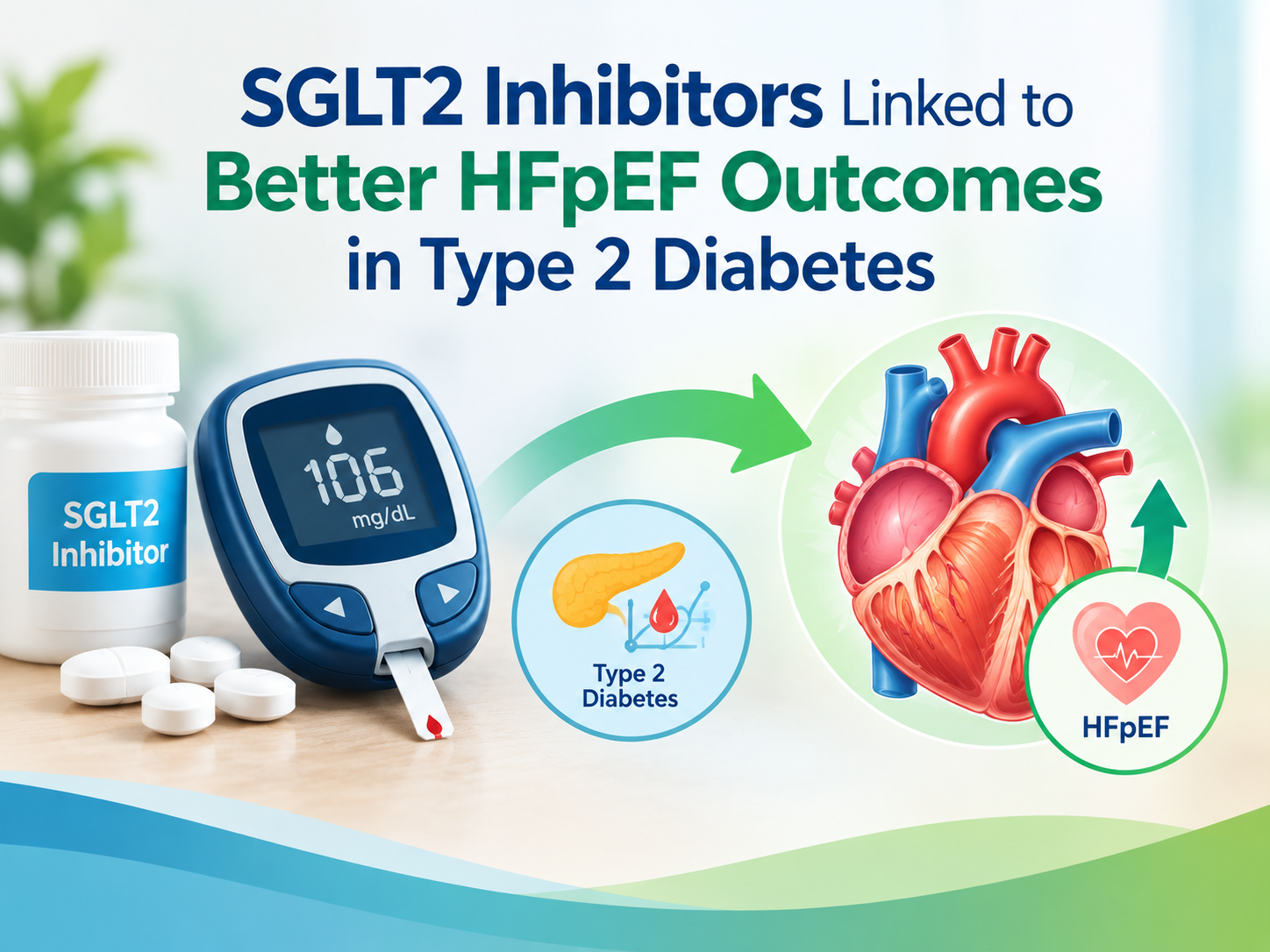
A nationwide cohort associated SGLT2 inhibitors with lower heart-failure hospitalization and all-cause mortality risks than DPP-4 inhibitors or sulfonylureas in HFpEF and type 2 diabetes.
 Written and medically reviewed byDr. Abu BakarContributing writer · PharmD, PhD (Pharmacology)
September 27, 2026 · 6 min read
A real-world advantage over two glucose-lowering alternatives
The REFINE-HFpEF nationwide cohort study compared sodium-glucose cotransporter 2, or SGLT2, inhibitors with dipeptidyl peptidase-4, or DPP-4, inhibitors and sulfonylureas among people who had heart failure with preserved ejection fraction and type 2 diabetes. SGLT2 inhibitor use was associated with lower risks of heart-failure hospitalization and all-cause mortality than either comparator class.
That result is clinically relevant because these drug classes may all lower glucose, but they do not carry equivalent evidence for heart-failure outcomes. In a patient who has both HFpEF and type 2 diabetes, treatment selection can therefore address more than glycated hemoglobin. Avoiding decompensation, hospitalization and premature death may be at least as important as achieving an incremental difference in glucose control.
The finding should still be read as an association. A nationwide observational cohort can evaluate routine practice at a scale and breadth often unavailable in randomized trials, but it cannot establish that the drug itself caused the observed difference. Treatment choice, kidney function, frailty, socioeconomic factors, prescribing access and clinicians’ assessments of prognosis may all influence both exposure and outcomes.
The evidence extract available for this brief did not include verified numerical details for cohort size, follow-up duration, adjusted effect estimates or confidence intervals. Those values are therefore not reproduced here. Their absence limits assessment of the magnitude and precision of the reported associations, even though the direction of the findings is clear from the primary record.
How the cohort fits with randomized evidence
REFINE-HFpEF addresses an active-comparator question that placebo-controlled HFpEF trials did not directly answer: among people needing glucose-lowering treatment, how do outcomes with an SGLT2 inhibitor compare with outcomes under DPP-4 inhibitor or sulfonylurea treatment in routine care?
Randomized trials provide important context. EMPEROR-Preserved enrolled patients with symptomatic heart failure and a left ventricular ejection fraction above 40%, with or without diabetes. Over a median 26.2 months, empagliflozin reduced the composite of cardiovascular death or hospitalization for heart failure compared with placebo, with a hazard ratio of 0.79 and a 95% confidence interval of 0.69 to 0.90. The benefit was driven mainly by fewer heart-failure hospitalizations.
DELIVER similarly enrolled patients with heart failure and an ejection fraction above 40%, including people with and without type 2 diabetes. Over a median 2.3 years, dapagliflozin reduced worsening heart failure or cardiovascular death, with a hazard ratio of 0.82 and a 95% confidence interval of 0.73 to 0.92.
| Evidence source | Comparison | Main outcome | Reported estimate | Follow-up |
|---|---|---|---|---|
| REFINE-HFpEF | SGLT2 inhibitors vs DPP-4 inhibitors or sulfonylureas | Heart-failure hospitalization and all-cause mortality | Lower risks reported; verified estimates unavailable in the supplied extract | Not available in the supplied extract |
| EMPEROR-Preserved | Empagliflozin vs placebo | Cardiovascular death or heart-failure hospitalization | HR 0.79 (95% CI, 0.69–0.90) | Median 26.2 months |
| DELIVER | Dapagliflozin vs placebo | Worsening heart failure or cardiovascular death | HR 0.82 (95% CI, 0.73–0.92) | Median 2.3 years |
These trials establish that SGLT2 inhibition reduces worsening heart-failure events across the mildly reduced and preserved ejection-fraction range. REFINE-HFpEF adds comparative-effectiveness evidence against two commonly used glucose-lowering classes and reports an association with lower all-cause mortality. It does not replace the randomized evidence, and the mortality association requires particular caution because residual confounding can strongly affect observational survival comparisons.
Implications for glucose-lowering drug selection
The combined evidence supports considering heart-failure outcomes explicitly when choosing glucose-lowering therapy for a person with HFpEF and type 2 diabetes. If multiple agents are otherwise reasonable, the randomized reduction in worsening heart failure and the directionally consistent real-world comparison strengthen the case for an SGLT2 inhibitor rather than selecting solely on glucose-lowering potency or familiarity.
That conclusion does not mean DPP-4 inhibitors and sulfonylureas are interchangeable comparators or universally inappropriate. Their effects, adverse-event profiles, costs and clinical roles differ. Sulfonylureas can cause hypoglycemia and weight gain, while DPP-4 inhibitors generally have modest glucose-lowering effects and class members do not all have identical heart-failure data. The cohort’s class-level comparisons should not erase distinctions among individual drugs.
Selection also remains conditional on contraindications, kidney function, volume status, concurrent diuretic therapy, infection risk, affordability and the patient’s treatment priorities. SGLT2 inhibitors have recognized risks, including genital mycotic infections, volume depletion and rare ketoacidosis that may occur without marked hyperglycemia. Temporary interruption may be appropriate around prolonged fasting, acute illness or surgery under applicable labeling and clinical protocols.
For health systems and formularies, the study reinforces the value of evaluating diabetes medications by cardiorenal outcomes rather than acquisition cost alone. Coverage rules that make an SGLT2 inhibitor substantially harder to obtain than a comparator may have consequences for heart-failure care, although this cohort by itself cannot quantify the effect of any specific coverage policy.
Important uncertainties
The principal limitation is the nonrandomized design. Even with statistical adjustment, unmeasured differences can remain between people prescribed an SGLT2 inhibitor and those prescribed a DPP-4 inhibitor or sulfonylurea. Healthy-user effects, contraindication-related channeling and differences in specialist access could make SGLT2 inhibitor recipients appear to have better outcomes independently of treatment.
Outcome definitions and exposure measurement also matter. Administrative or registry-based studies may misclassify HFpEF, omit changes in ejection fraction and treat pharmacy dispensing as a proxy for medication use. Switching, discontinuation and addition of other therapies can complicate interpretation. The degree to which REFINE-HFpEF addressed these issues should be assessed from the full methods and sensitivity analyses.
Generalizability depends on the health system, population and prescribing period represented in the nationwide data. Funding, author disclosures and prespecified analytic choices should also be reviewed in the complete publication. Most importantly, the study does not prove that initiating an SGLT2 inhibitor instead of either comparator will reduce mortality for every patient with HFpEF and diabetes.
Questions clinicians ask
Should HFpEF outweigh a small difference in glucose lowering?
Often, HFpEF should materially influence the choice because SGLT2 inhibitors have randomized evidence for reducing worsening heart-failure events. Glycemic efficacy still matters, but selection can reasonably prioritize a therapy that addresses both diabetes and a major source of hospitalization, provided safety, kidney function, access and patient preferences are also considered.
Does this cohort prove that SGLT2 inhibitors reduce mortality?
No. REFINE-HFpEF reports lower all-cause mortality in SGLT2 inhibitor users than in users of DPP-4 inhibitors or sulfonylureas, but observational comparisons remain vulnerable to residual confounding. The result is supportive and clinically important, not equivalent to a randomized demonstration of a survival benefit.
Can the finding be applied to every SGLT2 inhibitor?
The report concerns the SGLT2 inhibitor class, while the strongest HFpEF randomized evidence comes from empagliflozin and dapagliflozin. Clinicians should align selection with the evidence and current US labeling for the individual product rather than assume that every agent has identical outcome data.
What should be checked before choosing therapy?
Review kidney function, volume status, diuretic use, hypoglycemia risk from concurrent drugs, prior genital infections, ketoacidosis risk, planned fasting or surgery, cost and coverage. Those factors can alter the benefit-risk balance even when heart-failure outcome evidence favors an SGLT2 inhibitor at the population level.
References
1. Clinical effectiveness of sodium-glucose cotransporter 2 inhibitors in heart failure with preserved ejection fraction: nationwide cohort study (REFINE-HFpEF) — PubMed, 2026 2. Empagliflozin in Heart Failure with a Preserved Ejection Fraction — The New England Journal of Medicine, 2021 3. Dapagliflozin in Heart Failure with Mildly Reduced or Preserved Ejection Fraction — The New England Journal of Medicine, 2022
One story a day
The story of the day, in your inbox
One health journey each morning — no advice, no alarm, just company for the road.