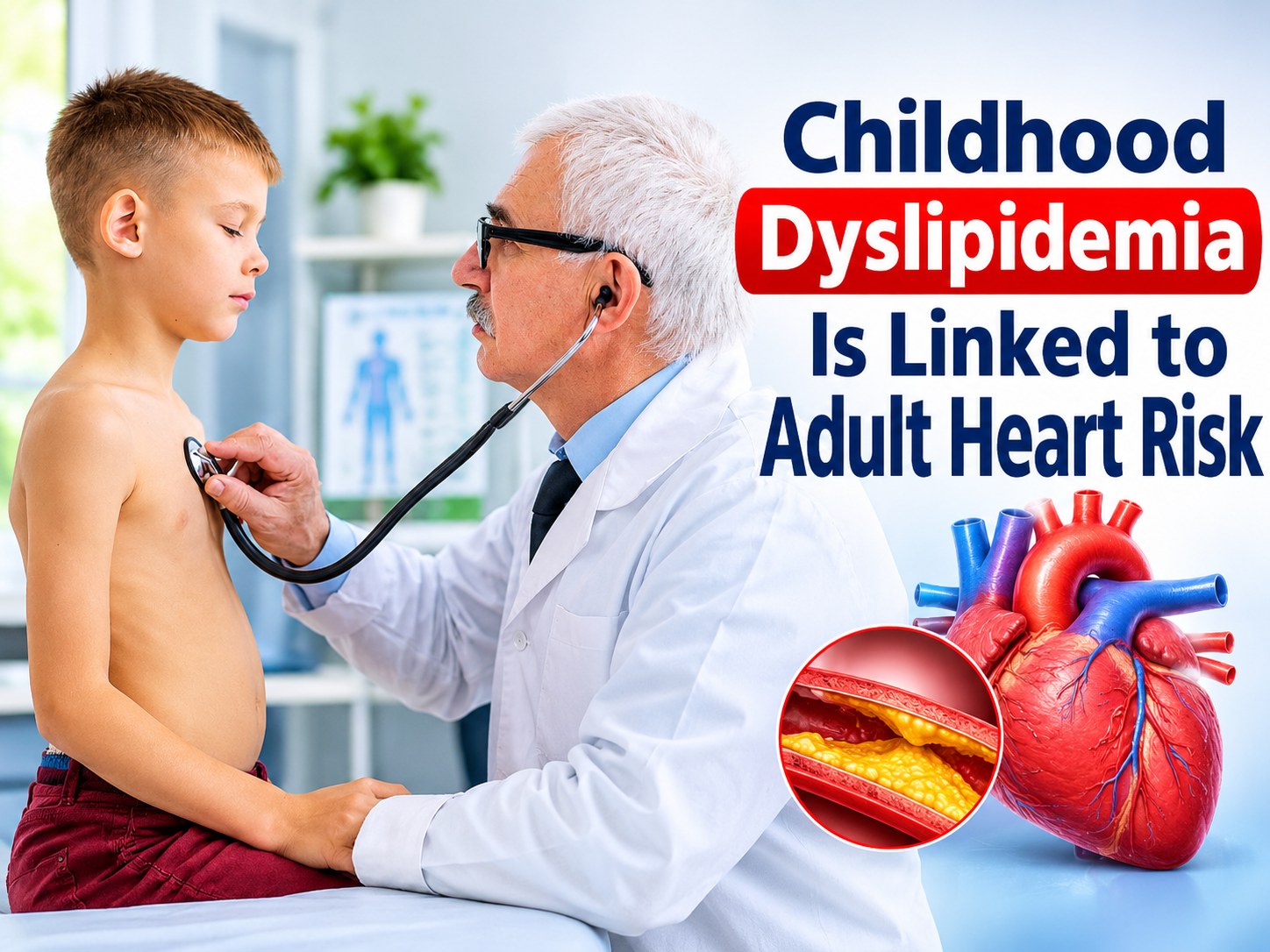
Childhood Dyslipidemia Is Linked to Adult Heart Risk
A pooled longitudinal cohort linked elevated non-HDL cholesterol in youth—particularly persistent elevation—to cardiovascular events decades later. Normalization by adulthood was associated with lower risk.
 Written and medically reviewed byDr. Abu BakarContributing writer · PharmD, PhD (Pharmacology)
November 29, 2026 · 7 min read
Persistent elevation carried the clearest signal
A pooled analysis of six prospective cohorts found that elevated non-high-density lipoprotein cholesterol, or non-HDL cholesterol, during childhood was associated with cardiovascular events in adulthood. The strongest association appeared among participants whose dyslipidemia persisted after they reached adulthood.
The analysis included 5,121 participants from cohorts in the United States, Finland and Australia. Lipids were assessed at a mean age of 10.7 years and again at a mean age of 26.6 years. Over a mean 35.2 years of follow-up from childhood, 147 participants experienced a fatal or nonfatal cardiovascular event.
Compared with participants who had normal non-HDL cholesterol in both childhood and adulthood, those with persistent dyslipidemia had an adjusted hazard ratio for cardiovascular disease of 5.17, with a 95% confidence interval of 2.80 to 9.56. Participants who developed dyslipidemia only in adulthood also had higher risk, although the estimate was less precise. Those whose childhood elevation had resolved by adulthood did not have a statistically significant excess risk.
| Non-HDL cholesterol pattern | Adjusted hazard ratio | 95% confidence interval |
|---|---|---|
| Normal in childhood and adulthood | 1.00 | Reference |
| Elevated in childhood, normal in adulthood | 1.13 | 0.50–2.56 |
| Normal in childhood, elevated in adulthood | 2.17 | 1.00–4.69 |
| Elevated in childhood and adulthood | 5.17 | 2.80–9.56 |
The pattern is clinically important, but it should not be interpreted as proof that normalizing cholesterol eliminates harm from earlier exposure. The resolved group had relatively few events and a wide confidence interval. Treatment, changes in weight and diet, and other health behaviors may also distinguish people whose lipids improved from those whose dyslipidemia persisted.
Why exposure during youth may matter
Non-HDL cholesterol is calculated by subtracting HDL cholesterol from total cholesterol. It captures cholesterol carried by atherogenic particles, including low-density lipoprotein, very-low-density lipoprotein and remnant lipoproteins. Because it does not require fasting and incorporates more atherogenic particles than LDL cholesterol alone, it is useful in pediatric assessment, particularly when triglycerides are elevated.
Atherosclerosis develops over years rather than beginning abruptly in middle age. Prolonged exposure to atherogenic lipoproteins promotes their retention within the arterial wall, followed by inflammatory signaling, foam-cell formation and plaque development. An elevated value in childhood can therefore indicate both current particle exposure and a longer future exposure window.
The broader International Childhood Cardiovascular Cohort Consortium supports that life-course interpretation. In a separate analysis of 38,589 participants followed for a mean of 35 years, childhood risk factors—including total cholesterol, body mass index, systolic blood pressure, smoking and youth smoking exposure—were associated with fatal and nonfatal cardiovascular events in adulthood. Because these are observational findings, they establish prognostic relationships rather than proving that any one childhood measurement directly caused an event.
Dyslipidemia in children has several pathways
The most common pediatric pattern is associated with excess adiposity and insulin resistance. It often combines elevated triglycerides, reduced HDL cholesterol and mildly to moderately elevated LDL or non-HDL cholesterol. Diet, limited physical activity, diabetes and some medication exposures can contribute, but the phenotype should not automatically be attributed to lifestyle.
Secondary causes include hypothyroidism, nephrotic syndrome, chronic kidney disease, diabetes, cholestatic liver disease and systemic inflammatory conditions. Corticosteroids, retinoids, some antipsychotics, immunosuppressants and other medicines may alter lipid values. Clinical context, growth patterns, family history and the degree of elevation help determine whether further evaluation is warranted.
Inherited disorders are especially important when LDL cholesterol is markedly elevated or premature atherosclerotic cardiovascular disease occurs in close relatives. Heterozygous familial hypercholesterolemia causes lifelong LDL exposure from birth and may be missed when testing depends solely on family history, because relatives can be undiagnosed or family histories incomplete.
Long-term follow-up of children with familial hypercholesterolemia provides supportive, although not definitive, treatment evidence. In a 20-year follow-up of 214 patients who had participated in a childhood pravastatin trial, carotid intima-media thickness progression was similar to that of unaffected siblings. By age 39, cardiovascular events had occurred in 1% of the treated patients, compared with 26% among their affected parents by the same age. That parent-offspring comparison was observational and spans different treatment eras, so it cannot isolate the effect of statin therapy.
Implications for practice and policy
The cohort findings support viewing pediatric dyslipidemia as a longitudinal risk marker rather than an isolated laboratory abnormality. A persistently elevated non-HDL cholesterol level identifies a group with substantially higher observed event risk, while improvement by adulthood appears favorable. The evidence supports confirming abnormal results and addressing modifiable contributors early, without assuming that every elevation requires medication.
US pediatric guidance has recommended universal lipid assessment once between ages 9 and 11 and again between ages 17 and 21, with selective earlier testing for children who have relevant family histories, high-risk conditions or other cardiovascular risk factors. A nonfasting non-HDL cholesterol measurement can be used initially, while abnormal findings generally require confirmation and more complete evaluation.
Management depends on severity and cause. Nutrition, physical activity, weight-related care where appropriate, tobacco avoidance and control of diabetes or other secondary disorders form the foundation. Marked or persistent LDL elevation, suspected familial hypercholesterolemia, or dyslipidemia in a child with a high-risk medical condition may justify specialist involvement and consideration of medication under pediatric guidance.
What the cohorts cannot settle
The principal study was observational, so residual confounding and selection bias remain possible. Lipids measured at scheduled visits may not represent exposure throughout childhood and adulthood, and only 147 cardiovascular events occurred. That limited the precision of subgroup estimates, particularly for participants whose dyslipidemia resolved.
The cohorts also began decades ago in three high-income countries. Changes in diet, obesity prevalence, lipid treatment and cardiovascular care may affect present-day absolute risk and limit generalizability to other populations. Most importantly, the analysis did not randomize screening or treatment. It cannot determine which pediatric screening strategy improves clinical outcomes or how much risk reduction is produced by a specific intervention.
Questions clinicians ask
Which lipid measure is most useful for initial pediatric assessment?
Non-HDL cholesterol is practical because it can be calculated from a nonfasting lipid panel and captures cholesterol across atherogenic particles. An abnormal screening result should be confirmed and interpreted alongside LDL cholesterol, triglycerides, HDL cholesterol, family history, medications and conditions that can produce secondary dyslipidemia.
Does normalization by adulthood erase the added risk?
The cohort found no statistically significant excess risk among participants whose elevated childhood non-HDL cholesterol had normalized by adulthood. However, the confidence interval was wide, and the observational design cannot prove that lowering cholesterol reversed risk. The result is reassuring but should not be treated as evidence that earlier exposure becomes irrelevant.
When should an inherited disorder be considered?
Familial hypercholesterolemia becomes more likely with marked, repeated LDL elevation, premature cardiovascular disease in close relatives or similarly elevated cholesterol across generations. Secondary causes should still be assessed. Family history alone is not sufficiently sensitive because affected relatives may be young, untreated, unavailable or unaware of their diagnosis.
Does this evidence prove that universal screening prevents events?
No. The pooled cohorts show that childhood lipids predict later outcomes, but they did not compare screening strategies or randomize treatment. The findings strengthen the rationale for identifying persistent dyslipidemia, while questions about the optimal screening schedule, treatment thresholds and population-level benefit still require longer-term comparative evidence.
References
1. Childhood Cardiovascular Risk Factors and Adult Cardiovascular Events — The New England Journal of Medicine, 2022 2. Expert Panel on Integrated Guidelines for Cardiovascular Health and Risk Reduction in Children and Adolescents: Summary Report — Pediatrics, 2011 3. 20-Year Follow-up of Statins in Children with Familial Hypercholesterolemia — The New England Journal of Medicine, 2019
One story a day
The story of the day, in your inbox
One health journey each morning — no advice, no alarm, just company for the road.