Cyclosporiasis Surveillance Shows Substantial 2026 Burden
CDC counted 17,180 laboratory-confirmed US cyclosporiasis cases since May 1, 2026, while at least 11,844 additional cases remained under investigation.
 Written and medically reviewed byRayan SalihContributing writer · PharmD, RPh
September 4, 2026 · 6 min read

The surveillance signal
I wrote the figures in a notebook after reading CDC’s August 2026 surveillance update: 17,180 confirmed cases, 922 hospitalizations, two deaths, and at least 11,844 cases still being investigated. The update covers less than four months. These are documented surveillance findings, not an estimate of every US infection.
The 922 hospitalizations amount to 5.4% of confirmed cases. Two deaths amount to about 0.012%. Those crude proportions come straight from the published totals, but they should not be read as population-level hospitalization or fatality risks, since the update does not establish whether all outcomes were reported or how many infections were never detected.
| Surveillance measure | Reported count | Context |
|---|---|---|
| Laboratory-confirmed cases | 17,180 | Reported since May 2026 |
| Hospitalizations | 922 | 5.4% of confirmed cases |
| Deaths | 2 | Approximately 0.012% of confirmed cases |
| Additional cases under investigation | At least 11,844 | Equal to 68.9% of the confirmed count |
| Simple total if all pending cases were confirmed | At least 29,024 | Scenario, not a burden estimate or forecast |
The pending number takes up nearly as much space in my notebook as the confirmed one, and that feels right. If all 11,844 reports were distinct and eventually met the same confirmation criteria, the current count would rise by almost 69%, reaching at least 29,024. It is arithmetic, not a prediction. Investigators may rule out some reports, find duplicates, or leave records unresolved.
How the count should be read
This is ongoing national surveillance. It is not a randomized trial, a cohort study, or a representative population survey. The reported population consists of laboratory-confirmed US cases received during the surveillance period, plus another large group still being evaluated. The update offers no unexposed comparison group, confidence interval, p-value, or defined clinical follow-up period.
A case reaches that notebook count only after a series of ordinary but uncertain steps: someone becomes ill and seeks care, a clinician considers cyclosporiasis, the right stool test is ordered, a laboratory detects the parasite, and the finding reaches public health authorities. A miss anywhere along that path lowers case ascertainment. Wider use of multiplex testing or greater clinical awareness can push the detected total upward, though that alone would not prove that true incidence increased at the same rate.
The figures also do not show that one food, supplier, or outbreak accounts for every case. Cyclosporiasis is caused by the parasite Cyclospora cayetanensis and is commonly associated with contaminated food or water. The organism must spend time outside the body before it becomes infectious, which makes direct person-to-person spread unlikely. Food histories and supply-chain investigation matter here, even when patients are struggling to remember what they ate weeks earlier.
Recognition and reporting priorities
Prolonged or relapsing watery diarrhea should keep cyclosporiasis in the differential diagnosis, particularly with appetite loss, weight loss, cramping, bloating, nausea, or fatigue. Exposure histories can cover fresh produce, meals away from home, shared events, and international travel. Travel is not required for infection.
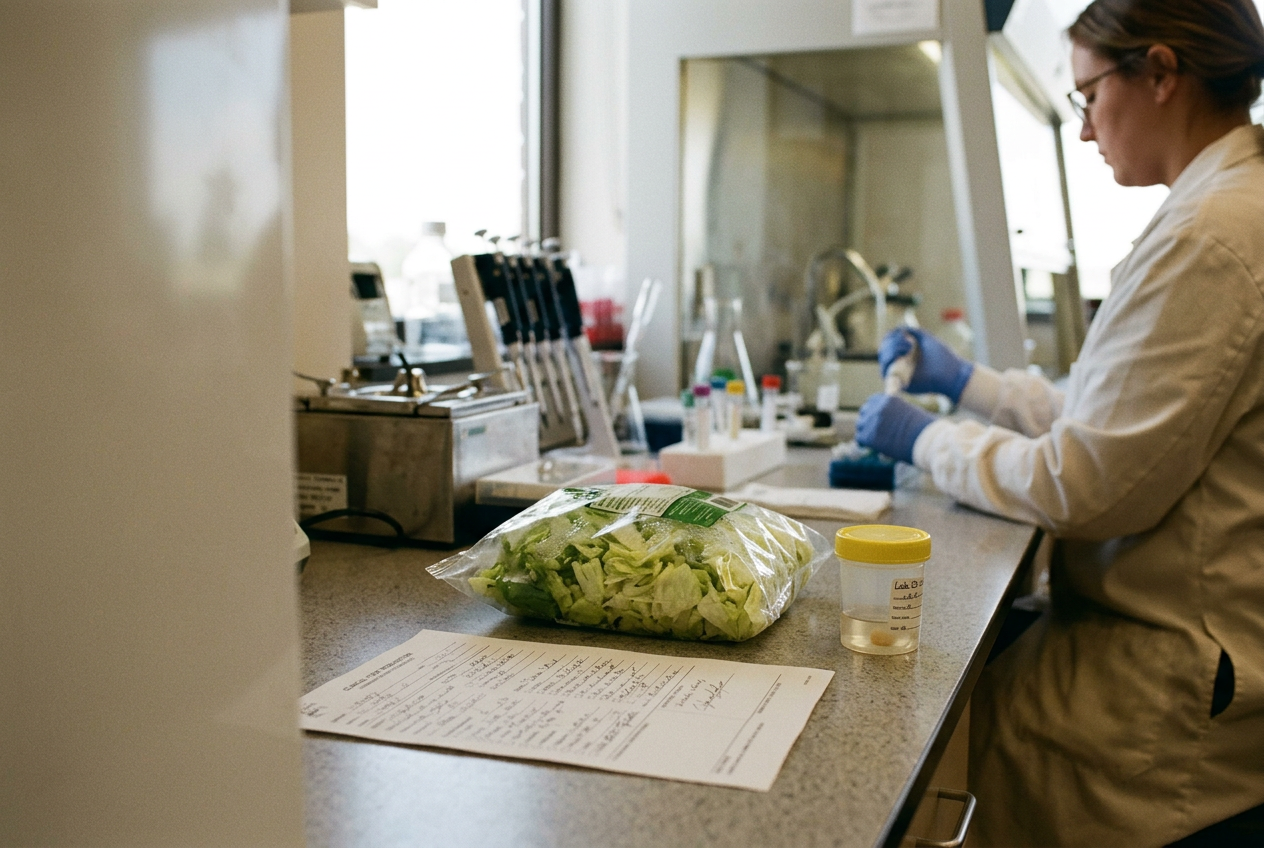
Testing practices help decide whether an illness ever appears in surveillance. CDC’s clinical guidance says clinicians may need to request Cyclospora testing specifically, since routine ova-and-parasite examinations and gastrointestinal panels do not always include it. The parasite may be shed intermittently, so one negative specimen may not settle the question when clinical suspicion remains high; CDC notes that stool specimens collected on different days may be necessary.
A positive result reaches beyond individual care. Prompt reporting through the state or local process gives investigators a better chance to ask about food purchases while receipts, store histories, and household records can still help. It also allows teams to compare exposures and look for clusters. Clinicians and laboratories cannot assume that electronic reporting completes every local requirement.
There is another risk at the bedside: stopping the search too soon. Symptoms can overlap with other infectious and noninfectious gastrointestinal conditions, and coinfection can occur. The high case activity supports considering targeted testing sooner. It does not support diagnosing cyclosporiasis from symptoms or a remembered meal alone.
Public health capacity is part of case detection
The 11,844 pending cases are a measure of workload as much as uncertainty. Each report may require confirmation, duplicate review, collection of illness and exposure dates, interviews, medical-record review, or coordination between jurisdictions, and delays can hold up both the national count and the search for a shared food source.
That is why laboratory equipment is only part of capacity. Health departments also need trained interviewers, surveillance systems that can exchange information, timely laboratory reporting, and staff able to connect epidemiologic findings with food traceback work. Consistent questionnaires help because people may have eaten many produce items during the relevant exposure period and often cannot recall stores or purchase dates without receipts or other records.
Stable staffing matters between seasonal surges, too. Temporary workers can help move reports, but experienced staff tend to know where incomplete records stall and how to coordinate across jurisdictional lines. Policymakers looking at preparedness should read the pending caseload beside the confirmed count. In my notebook, 11,844 is not a footnote.
It is a second large number waiting for work.
What remains uncertain
Underascertainment is the central limitation. People with mild illness may stay home. Clinicians may not order the relevant test, and laboratories differ in access to sensitive methods. Reporting delays also mean a total released in August 2026 can rise later even when those patients became ill much earlier.
Uncertainty runs the other way for pending reports. Not every case under investigation will become laboratory confirmed, and the update does not provide enough information to calculate a confirmation rate, model a final US total, or assign specific shares to particular foods. It cannot establish why the burden reached this level. It also cannot tell us how much changing test use contributed.
Hospitalizations and deaths deserve attention, but aggregate totals cannot reveal the circumstances of each outcome or whether reporting was complete. The surveillance data support conclusions about documented volume and the pressure on investigators. They do not support blaming a particular product, exposure, or policy failure without outbreak and traceback evidence.
Questions clinicians ask
When should I consider testing for Cyclospora?
Consider it in patients with persistent or relapsing watery diarrhea, especially with cramping, bloating, appetite loss, weight loss, or fatigue. Fresh-produce exposure, meals connected to a cluster, or international travel may strengthen suspicion. A patient who has not traveled can still have a domestically acquired infection.
Is Cyclospora included on a routine stool panel?
Not necessarily. CDC advises clinicians to request Cyclospora testing specifically because availability varies among ova-and-parasite examinations and multiplex gastrointestinal panels. Since organisms may be shed intermittently, specimens collected on separate days may be needed when suspicion remains after an initial negative result.
What should happen after a positive result?
Clinical care and public health notification should follow local processes. Prompt reporting helps investigators collect food histories, receipts, and purchase locations before memory fades. Laboratories and clinicians should also check whether their jurisdiction needs additional information or specimen submission.
Do the pending cases mean the total will reach 29,024?
No. The figure comes from adding all 11,844 pending cases to the 17,180 confirmed cases. Some reports may be excluded, duplicated, or never resolved, while infections that were not tested or reported remain outside both numbers. I left 29,024 in the notebook, with “scenario” written beside it.
Questions people ask
Do the pending cyclosporiasis cases mean the total will reach 29,024?
No. I treated 29,024 only as an arithmetic scenario that assumes every pending report is distinct and confirmed. Some reports may be excluded, duplicated, or remain unresolved, while untested infections would still be missed.
Why can cyclosporiasis be missed by routine stool testing?
The story found that routine ova-and-parasite examinations and gastrointestinal panels do not always include Cyclospora. The parasite may also be shed intermittently, so an initial negative specimen does not capture every infection.
Can Cyclospora spread directly from person to person?
The organism must spend time outside the body before becoming infectious, making direct person-to-person spread unlikely. The investigation therefore focuses on food and water exposures, including fresh produce, meals, purchase records, and supply chains.
References
- Cyclosporiasis Cases in the United States — Centers for Disease Control and Prevention, 2026
- Clinical Overview of Cyclosporiasis — Centers for Disease Control and Prevention, n.d.
- About Cyclosporiasis — Centers for Disease Control and Prevention, n.d.
One story a day
The story of the day, in your inbox
One health journey each morning — no advice, no alarm, just company for the road.