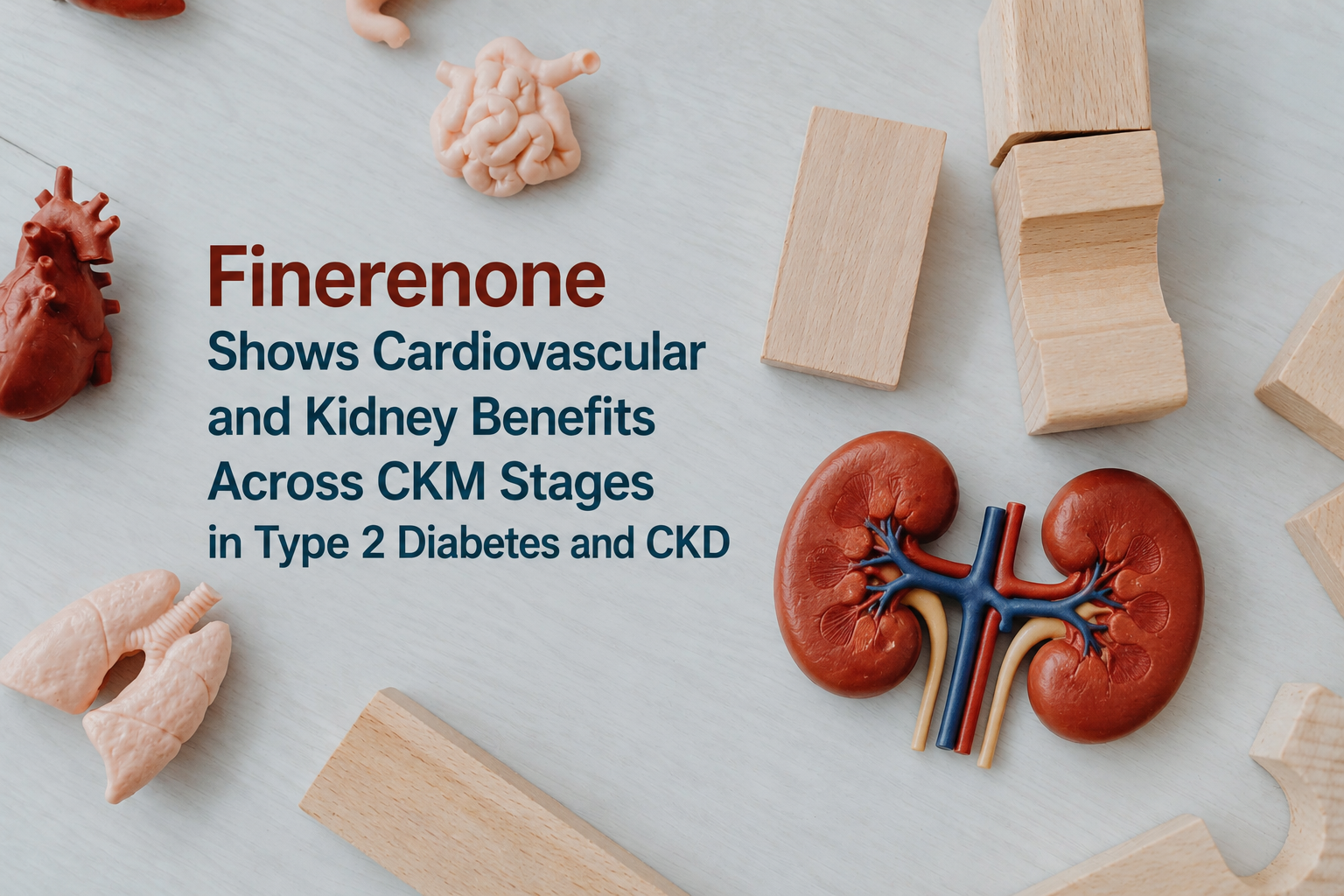
Finerenone Shows Cardiovascular and Kidney Benefits Across CKM Stages in Type 2 Diabetes and CKD
A secondary analysis found that finerenone reduced cardiovascular and kidney events across CKM stages in adults with type 2 diabetes and CKD, while favoring CKM stage regression over progression.
 Written and medically reviewed byDr. Abu BakarContributing writer · PharmD, PhD (Pharmacology)
August 23, 2026 · 7 min read
TheBrief:
Finerenone lowered the risk of cardiovascular and kidney events across the cardiovascular-kidney-metabolic (CKM) stages studied in adults with type 2 diabetes and chronic kidney disease (CKD). CKM staging may help clinicians better understand and discuss a patient's overall risk, but decisions about starting and monitoring finerenone should still be based on kidney function, albuminuria, serum potassium, background treatment, and other individual clinical factors.
Benefits extended across the CKM spectrum
A secondary analysis published in JAMA Cardiology found that finerenone was associated with fewer cardiovascular and kidney events across the cardiovascular-kidney-metabolic, or CKM, stages represented in its trial population. Participants assigned to finerenone were also more likely to move to a lower CKM stage and less likely to progress over time than those assigned to placebo.
The finding matters because CKM staging integrates cardiovascular disease, metabolic disease and kidney dysfunction rather than treating each as a separate problem. Adults with type 2 diabetes and chronic kidney disease often accumulate risk across all three domains, but their absolute risk can differ substantially depending on whether they have risk factors alone, subclinical cardiovascular disease or established cardiovascular disease.
Finerenone’s relative treatment effect appeared broadly consistent across the analyzed stages. That supports considering the drug’s evidence across a range of CKM severity rather than reserving it solely for people with established cardiovascular disease. It does not establish CKM stage as a new prescribing criterion, and the analysis should not be read as evidence for treatment in stages or populations that were not enrolled in the parent trials.
The underlying pooled program had already shown reductions in separate cardiovascular and kidney composite outcomes. Over a median follow-up of about three years, the principal results were:
| Outcome in the pooled trial program | Finerenone | Placebo | Relative effect |
|---|---|---|---|
| Cardiovascular composite | 12.7% | 14.4% | Hazard ratio 0.86; 95% CI, 0.78-0.95 |
| Kidney composite | 5.5% | 7.1% | Hazard ratio 0.77; 95% CI, 0.67-0.88 |
| Permanent discontinuation for hyperkalemia | 1.7% | 0.6% | Descriptive safety comparison |
These pooled estimates provide context for the stage-based analysis. The newer work asks whether those benefits are preserved when participants are organized by overall CKM burden and whether treatment is associated with favorable movement between stages.
How the analysis was constructed
The investigators conducted a secondary analysis of individual participant data from two randomized, double-blind, placebo-controlled phase 3 trials. Together, the trials included 13,026 adults with type 2 diabetes and chronic kidney disease who were receiving maximally tolerated renin-angiotensin system blockade. Participants were randomly assigned to finerenone or placebo and followed for a median of approximately three years.
The parent trials enrolled complementary CKD populations. One emphasized more advanced kidney disease and kidney outcomes; the other included a broader range of CKD and emphasized cardiovascular outcomes. Pooling them increased statistical precision and allowed investigators to examine treatment effects across a wider cardiorenal risk continuum.
For the secondary analysis, participants were classified according to CKM stage using available baseline clinical data. Because everyone had type 2 diabetes and CKD, the analysis did not represent the full population-level CKM spectrum, particularly people in stages 0 or 1 without established metabolic risk or kidney disease. The relevant comparisons were among the more advanced stages represented by trial-eligible adults.
Investigators assessed cardiovascular and kidney outcomes within CKM strata and examined changes in CKM stage during follow-up. The absence of a meaningful difference in treatment effect by baseline stage suggests that CKM severity did not materially modify finerenone’s relative benefit in this population. Favorable stage transitions offer a complementary signal, although stage movement is a constructed outcome influenced by the variables available, their measurement schedule and the staging algorithm.
Randomization strengthens causal interpretation of the finerenone-versus-placebo comparison. Still, the CKM classification and transition analyses were secondary rather than the original primary trial questions. They are best viewed as an informative reanalysis of randomized evidence, not as an independent trial designed to validate treatment based on CKM stage.
Translating CKM stage into treatment decisions
The analysis supports using CKM stage as a risk-framing and longitudinal monitoring tool. It does not replace the clinical variables used to determine whether finerenone fits the evidence base: type 2 diabetes, albuminuric CKD, estimated glomerular filtration rate, serum potassium, use of an angiotensin-converting enzyme inhibitor or angiotensin receptor blocker, and the presence of contraindications or important drug interactions.
Absolute benefit is also likely to vary. A consistent relative effect can translate into a larger absolute reduction among patients with more advanced CKM disease because their baseline event risk is higher. Conversely, people at lower absolute risk may have a smaller near-term benefit even when the relative effect is similar. The stage analysis therefore informs risk communication, but it does not eliminate individualized assessment.
Longitudinal CKM review may help clinicians see whether risk is accumulating across organ systems. Follow-up can incorporate estimated glomerular filtration rate, urine albumin-to-creatinine ratio, potassium, blood pressure, glycemic measures, heart failure status and incident atherosclerotic cardiovascular disease. Movement to a lower stage should not be interpreted as cure; residual kidney and cardiovascular risk can remain substantial.
Safety monitoring remains central. Finerenone can increase serum potassium, and permanent discontinuation for hyperkalemia was more frequent than with placebo in the pooled trials. Kidney function and potassium should be assessed according to the US prescribing information and the patient’s clinical context. CKM stage itself does not capture all factors that alter hyperkalemia risk, including concurrent medications and acute illness.
The trial program also predates today’s widespread combined use of sodium-glucose cotransporter 2 inhibitors and glucagon-like peptide-1 receptor agonists. Those therapies were used by a minority of participants at baseline. Finerenone should therefore be placed within contemporary layered risk reduction, rather than viewed as a substitute for established glucose, blood pressure, lipid, kidney and cardiovascular management.
Important uncertainties
This was a post hoc secondary analysis, so CKM stage subgroups and transitions may be vulnerable to multiplicity, missing measurements and misclassification. The parent trials were not originally powered to establish efficacy separately within every CKM stage, and a nonsignificant interaction does not prove identical effects across all subgroups.
Generalizability is also bounded by the enrollment criteria. Participants had type 2 diabetes and CKD, generally with albuminuria, and were receiving background renin-angiotensin system therapy. The results should not be extrapolated automatically to people without diabetes, without albuminuria, with earlier CKM stages, or outside the kidney-function and potassium ranges studied.
The parent trials were sponsored by Bayer, the manufacturer of finerenone, and financial relationships reported by investigators should be considered when interpreting the secondary analysis. Replication in independent cohorts and prospective testing of CKM-guided treatment strategies would strengthen confidence that stage transitions add clinical value beyond conventional kidney and cardiovascular measures.
Questions clinicians ask
Should CKM stage determine whether finerenone is started?
No. The analysis supports CKM staging as a way to summarize risk and discuss expected benefit, but it did not test a CKM stage-based prescribing strategy. Selection should remain anchored to the studied and labeled population, including type 2 diabetes, CKD characteristics, potassium, kidney function and optimized renin-angiotensin system blockade.
Does CKM regression mean cardiorenal risk has resolved?
No. Regression indicates favorable movement within a staging framework, not elimination of diabetes, CKD or cardiovascular vulnerability. Clinicians should continue monitoring albuminuria, estimated glomerular filtration rate, potassium and cardiovascular status, even when a patient’s calculated CKM stage improves.
Is the benefit limited to patients with established cardiovascular disease?
The analysis suggests not. Relative cardiovascular and kidney benefits were observed across the CKM stages represented, including participants without established clinical cardiovascular disease. However, everyone had type 2 diabetes and CKD, so these findings do not support extrapolation to low-risk adults or people in CKM stages absent from the trials.
How should hyperkalemia affect follow-up?
Hyperkalemia was more common with finerenone, and treatment discontinuation for elevated potassium occurred more often than with placebo. Baseline and follow-up potassium and kidney-function assessment remain necessary under the US prescribing information, with additional attention during acute illness or changes in medications that affect potassium.
Questions people ask
What is CKM syndrome?
CKM syndrome stands for cardiovascular-kidney-metabolic syndrome. It describes the close connection between metabolic conditions such as diabetes, kidney disease, and cardiovascular disease. Problems in one area can increase the risk of problems in the others.
Can finerenone protect both the heart and kidneys?
In the studied population of adults with type 2 diabetes and CKD, finerenone reduced the risk of important cardiovascular and kidney outcomes compared with placebo. Whether it is appropriate for an individual patient depends on their kidney function, albuminuria, potassium level, current medicines, and overall clinical condition.
References
1. Finerenone Reduces Cardiovascular-Kidney-Metabolic Events in Type 2 Diabetes and Chronic Kidney Disease — JAMA Cardiology, 2026 2. Cardiovascular and Kidney Outcomes With Finerenone in Patients With Type 2 Diabetes and Chronic Kidney Disease: The FIDELITY Pooled Analysis — European Heart Journal, 2022 3. Effect of Finerenone on Chronic Kidney Disease Outcomes in Type 2 Diabetes — The New England Journal of Medicine, 2020 4. Cardiovascular Events With Finerenone in Kidney Disease and Type 2 Diabetes — The New England Journal of Medicine, 2021
One story a day
The story of the day, in your inbox
One health journey each morning — no advice, no alarm, just company for the road.