Impella Controller Recall Tests Circulatory Support Readiness
The FDA’s removal of affected Impella controllers requires hospitals using temporary mechanical circulatory support to reconcile inventory, preserve unaffected capacity and test escalation plans.
 Written and medically reviewed byRayan SalihContributing writer · PharmD, RPh
November 18, 2026 · 6 min read
What changed at the bedside
The FDA device safety action dated August 26, 2026, concerns the removal of Abiomed Automated Impella Controllers. These controllers operate and monitor Impella heart pumps used for temporary mechanical circulatory support. A reduction in available controllers can therefore affect readiness even when compatible pump catheters remain stocked.
This is not only a supply-chain problem. Impella support is used in time-sensitive critical care settings, and controller availability is part of the clinical pathway from patient selection and device insertion through monitoring, transport and weaning. If teams discover an affected controller only when support is being considered, they may lose time locating an alternative or arranging transfer.
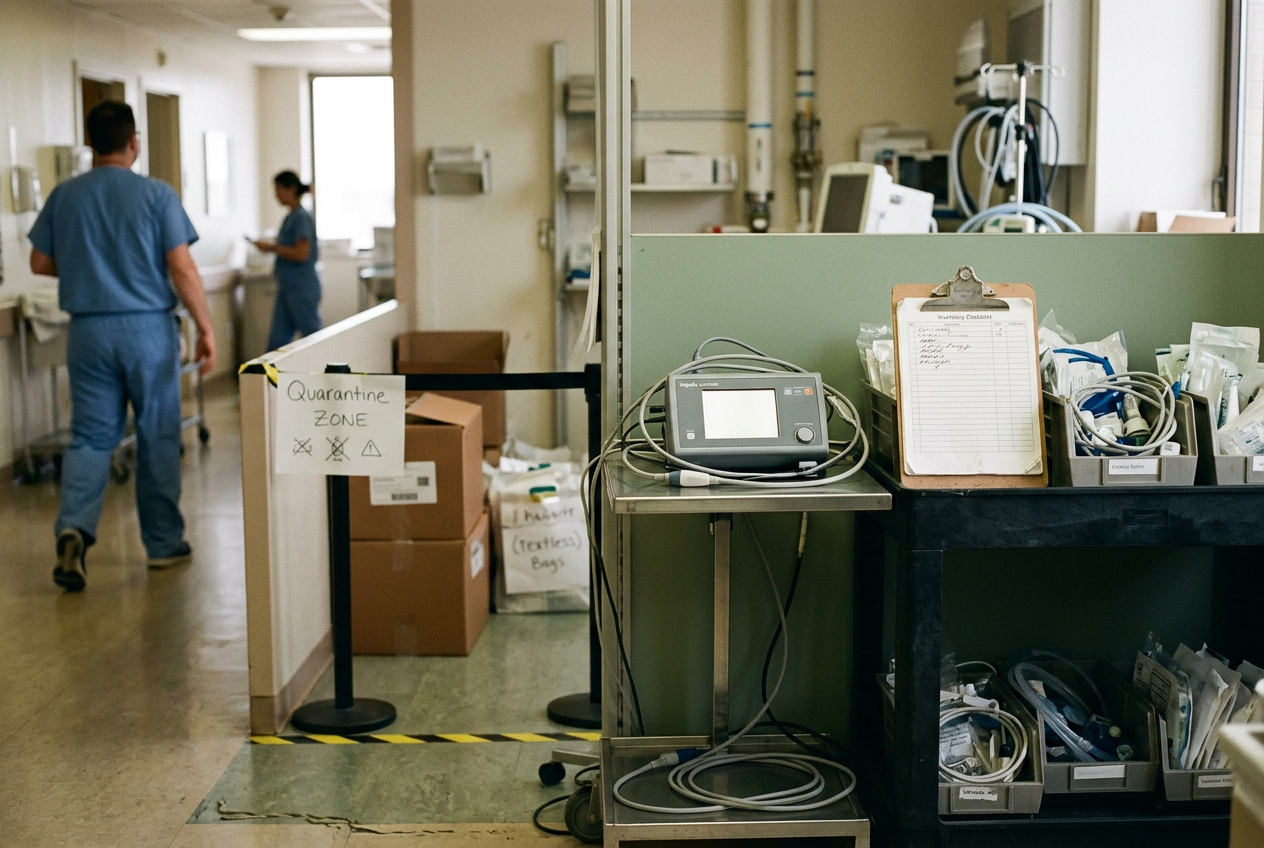
Hospitals should distinguish the recalled equipment from unaffected controllers and from other components in the Impella system. Broadly removing equipment without checking the FDA and manufacturer identifiers could unnecessarily reduce capacity. Conversely, leaving an affected controller in a catheterization laboratory, operating room, emergency department or transport inventory creates the possibility that it will be selected during an urgent case.
The FDA notice is a regulatory device safety source, not a comparative clinical study. It does not provide an effect estimate, confidence interval or controlled comparison of outcomes with affected versus unaffected controllers. The practical signal is the removal itself and the resulting need to know, in real time, which consoles remain available and where they are located.
A focused readiness review
The first task is to reconcile the physical and electronic inventory. Device management, supply chain, biomedical engineering and clinical service leaders should compare each controller’s model, serial number and other identifiers with the affected population described in the recall communication. Local asset lists may not show equipment that is on loan, under repair, assigned to transport or stored in procedural areas, so a physical check matters.
Segregate affected units and label them according to the recall instructions, while keeping unaffected equipment accessible. The local record should capture each controller’s status, location, compatibility, maintenance state and expected replacement or remediation date. Hospitals should also identify who is authorized to release a controller for use and how they document that decision outside regular business hours.
A useful review goes beyond counting consoles. It asks whether the remaining system can support the hospital’s usual peak demand, an ongoing case plus an emergency, and interdepartmental transport. These are scenario tests, not universal staffing or inventory thresholds. Appropriate capacity will differ between a tertiary shock center, a hospital that performs high-risk percutaneous coronary intervention and a facility that stabilizes patients before transfer.
The review should include related dependencies: compatible disposables, backup power, secure mounting, transport capability, trained staff and access to technical support. An available controller does not create usable capacity if the appropriate pump components are absent or if the personnel expected to operate it have not maintained competency.
Building contingencies without closing access
The aim is selective risk control, not automatically suspending temporary mechanical circulatory support. A hospital can preserve time-sensitive access by defining what happens when its normal controller pool is reduced and by communicating that plan to the teams most likely to activate it.
Contingency planning should identify a primary unaffected controller, a verified backup and the escalation route if neither is available. The plan may include replacement or loaner arrangements with the manufacturer, an internal process for moving equipment between locations, and transfer agreements with centers able to provide equivalent support. Any sharing arrangement should account for transport time, device compatibility, maintenance responsibility and the possibility that neighboring hospitals are responding to the same recall.
Clinical leaders should revisit how they escalate a potential case. The relevant pathway may involve interventional cardiology, cardiac surgery, critical care, emergency medicine, perfusion, nursing, biomedical engineering and the transfer center. A current contact roster and a single accountable coordinator can prevent parallel calls and conflicting information during an emergency.
Brief simulation can expose gaps. A tabletop exercise might begin with an unstable patient for whom temporary support is being considered while the nearest controller is quarantined. The team should be able to determine which unit is available, how quickly it can arrive, who confirms its status, and when to activate an alternative support or transfer pathway. The exercise should test communication and logistics rather than presume that Impella is appropriate for every scenario.
For patients already receiving support, decisions about changing equipment must follow the specific FDA and manufacturer instructions and an individualized clinical assessment. A recall should not become an improvised bedside exchange. The hazards of continued use, interruption of support and transition to another controller or support strategy are not interchangeable, particularly in a hemodynamically unstable patient.
Oversight, communication and reporting
Hospitals should issue concise internal communication that identifies the affected equipment, the location of unaffected controllers, the quarantine process and the escalation contact. A message that merely says “Impella recall” may be misread as applying to every controller or every pump in the system. Version control is important as replacement inventory arrives or regulatory instructions change.
Recall response should also be visible to the hospital’s device safety or product recall committee. That group can track completion of inventory checks, confirmation that affected units cannot be selected, replacement timelines, and any cases delayed, transferred or managed with an alternative strategy because of controller availability.
Suspected device-related malfunctions, injuries and near misses should move through the hospital’s established reporting process and, when applicable, FDA MedWatch. Reports should preserve relevant device identifiers and event details without delaying immediate patient care. Internal review can also capture operational near misses that may not meet external reporting criteria but still reveal a readiness weakness.
Important evidence limits
The cited regulatory material establishes a device removal but does not answer how many US hospitals will experience a shortage, how long replacement will take, or whether the action changes patient outcomes. No comparative denominator or follow-up period is available from this evidence base. Local demand, controller mix and transfer geography will determine the operational effect, limiting generalizability across institutions.
Questions clinicians ask
Does the recall mean all Impella support should stop?
No. The available regulatory description concerns affected Automated Impella Controllers, not a blanket withdrawal of every Impella component. Hospitals should match device identifiers to the FDA and manufacturer instructions, quarantine the specified equipment and preserve access to verified unaffected capacity rather than assuming the entire platform is unavailable.
What should be checked before the next emergency case?
Teams should know which unaffected controller is immediately available, whether it is compatible with the planned support system, and who can verify and release it around the clock. They should also confirm backup power, necessary components, trained personnel, technical support and the trigger for transfer or an alternative support pathway.
Should a controller be exchanged in a patient already on support?
That decision should follow the recall’s device-specific instructions and an individualized assessment of the risks of continued use, interruption and exchange. The regulatory notice alone does not provide comparative outcome data supporting a universal bedside exchange strategy, so teams should avoid unscripted transitions in unstable patients.
How can hospitals tell whether the contingency plan is adequate?
A short tabletop drill can test whether staff can locate an unaffected controller, verify its status and escalate within the clinically relevant window. The plan should also account for simultaneous demand, interdepartmental transport and regional constraints, because a neighboring center may be managing the same recall and may not have spare capacity.
References
1. Abiomed Removes Automated Impella Controllers — US Food and Drug Administration, 2026 2. Recalls, Corrections and Removals (Devices) — US Food and Drug Administration, n.d. 3. MedWatch: The FDA Safety Information and Adverse Event Reporting Program — US Food and Drug Administration, n.d.
One story a day
The story of the day, in your inbox
One health journey each morning — no advice, no alarm, just company for the road.