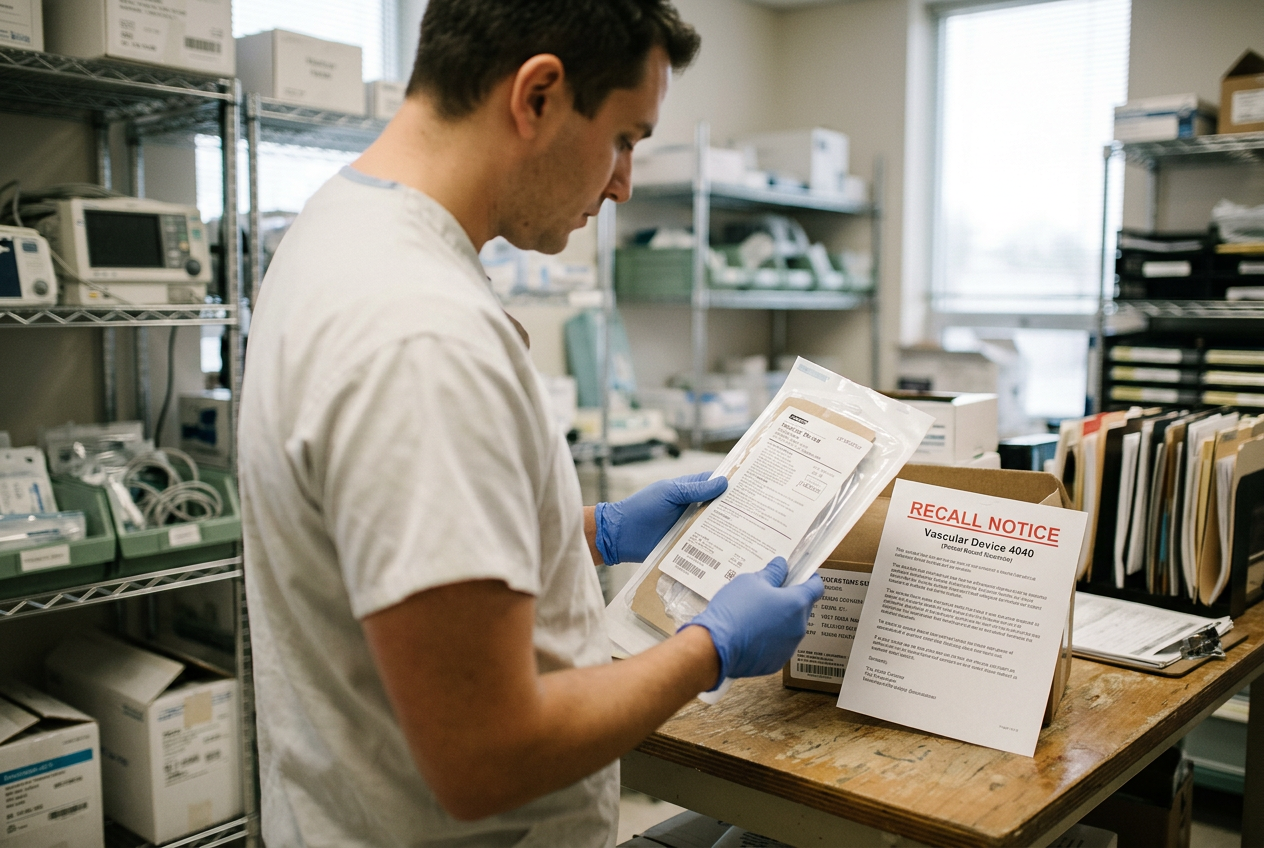
Impella Introducer Correction Highlights Major Bleeding Risk
The FDA's Class I correction covers catheter introducer kits used with Impella heart pumps. Bleeding complaints, including reports associated with deaths, make rapid product identification and clinical vigilance essential.
 Written and medically reviewed byRayan SalihContributing writer · PharmD, RPh
October 12, 2026 · 7 min read

Why the correction matters now
The FDA's August 10, 2026, action concerns catheter introducers supplied for use with Impella mechanical circulatory support systems. Abiomed and Oscor issued the correction after complaints involving bleeding, including complaints associated with patient deaths. A Class I designation is the FDA's most serious recall classification: use of an affected product may reasonably cause serious adverse health consequences or death.
The immediate clinical issue is not simply that bleeding has been reported. Impella support commonly involves large-bore arterial access in patients who are already critically ill, often receive anticoagulation or antiplatelet therapy, and may have limited physiologic reserve. An introducer-related problem can therefore compound procedural blood loss or make an evolving hemorrhage harder to recognize and control.
The FDA notice is a regulatory safety action, not a comparative clinical study. It does not provide a treated-versus-control estimate, confidence interval, or defined follow-up period from which to calculate relative risk. Complaints involving deaths also do not, by themselves, prove that the introducer caused those deaths. They establish a serious safety signal requiring action and investigation.
What the Class I designation establishes
A device correction is an action intended to address a product problem at its location of use. It is not necessarily synonymous with removing every product from the market or explanting a device from every patient. Hospitals should use the FDA and manufacturer notices to determine the affected catalog numbers, lot identifiers, handling steps, and whether particular units must be returned, replaced, relabeled, inspected, or otherwise managed.
The distinction matters because this correction concerns introducer kits used with Impella pumps. It should not be interpreted as evidence that every Impella pump is affected or that the pump's circulatory-support function has broadly failed. The specific product identity and its role in the procedure must be confirmed before teams decide how the notice applies to inventory, planned cases, or patients who have already undergone placement.
Class I does not quantify how frequently the defect occurs. The designation reflects the potential severity of harm when the problem does occur. Major hemorrhage can require transfusion, procedural intervention, escalation of vasopressor or circulatory support, prolonged hospitalization, or treatment of organ injury caused by hypoperfusion.
Reports submitted through postmarket surveillance are also vulnerable to underreporting, duplicate reporting, incomplete clinical details, and reporting stimulated by publicity. The FDA cautions that adverse-event databases cannot be used alone to establish incidence or causation because the total number of exposed devices and relevant patient-level comparators are generally unavailable.
Recognizing a clinically important bleed
Introducer-related bleeding may be immediately visible, but a dry skin surface does not exclude significant blood loss. Concern should rise with persistent access-site oozing, bleeding around a connector or hemostatic component, an expanding groin or soft-tissue hematoma, unexplained hypotension, increasing vasopressor need, falling hemoglobin, transfusion requirement, or new pain and swelling near the access route.
Concealed retroperitoneal or deep-tissue bleeding is particularly important after femoral access. The significance of any individual sign depends on timing, baseline anemia, anticoagulation, procedural blood loss, hemodynamic trajectory, and other potential bleeding sources. The correction does not make every episode of anemia or shock an introducer malfunction; it makes the affected component one of the causes that should be considered promptly.
Documentation can help connect bedside findings with device surveillance. Useful details include the exact kit and lot, when the introducer was opened and used, the stage of the procedure when bleeding appeared, concomitant antithrombotic therapy, interventions required, transfusion burden, and patient outcome. Preserving the device when feasible and following institutional reporting pathways can support evaluation without delaying urgent clinical care.
What health systems can do immediately
The first operational task is traceability. Cath labs, operating rooms, hybrid suites, intensive care units, supply-chain teams, and risk-management staff need the same current list of affected product identifiers. Segregate unopened stock as directed by the official correction notice so staff do not inadvertently select an affected kit while local review is underway.
For upcoming procedures, the evidence supports confirming the introducer kit against the correction before use and ensuring that an appropriate unaffected alternative is available when the official instructions require substitution. Any decision to proceed must account for the urgency of circulatory support and the risks of delaying treatment; the Class I label alone does not resolve that patient-specific balance.
For patients already treated, review should focus on whether an affected introducer was used and whether clinical findings are consistent with bleeding. Because an introducer is a procedural access component, management cannot be inferred from the pump's status alone. Teams should follow product-specific instructions rather than assuming that correcting inventory automatically requires intervention for every previously exposed patient.
The event also tests institutional recall infrastructure. Product notices can fail to reach frontline clinicians when purchasing records, lot-level inventory, procedural documentation, and adverse-event reporting are disconnected. A closed-loop response should confirm that staff located affected stock, notified relevant services, traced completed cases where necessary, and reported suspected events to the manufacturer and FDA.
What the evidence cannot yet answer
The FDA action establishes a serious potential hazard, but it does not provide the kind of denominator-based evidence needed to estimate an individual patient's absolute risk. Complaint counts cannot show how often major bleeding occurred per kit used, and death-associated reports cannot isolate the introducer's contribution from cardiogenic shock, vascular disease, anticoagulation, procedural complexity, or other complications.
A recall notice lacks a randomized comparator, adjusted observational analysis, or standardized follow-up. Case reports may vary in completeness, and the patients receiving temporary mechanical circulatory support are clinically heterogeneous. These limitations restrict conclusions about causality, predictors of failure, and whether risk differs by access technique, operator experience, care setting, or patient subgroup.
Further regulatory updates may clarify the mechanism, the scope of affected production, investigation findings, and the effectiveness of the correction. Until then, the evidence supports prompt product identification, adherence to the official instructions, heightened recognition of major bleeding, and careful reporting—not assumptions about an unreported event rate or a universal management strategy.
Questions clinicians ask
Does this correction mean the Impella pump itself is recalled?
The FDA action described here concerns catheter introducer kits used with Impella systems, not a blanket finding that all Impella pumps are defective. Clinicians and supply teams should match the exact catalog and lot information in the correction rather than act on the brand name alone.
What findings should raise concern for introducer-related bleeding?
Persistent external bleeding, an expanding access-site hematoma, falling hemoglobin, unexplained hypotension, escalating vasopressor support, transfusion need, or symptoms suggesting concealed blood loss warrant prompt evaluation. These findings are not specific to introducer failure, especially in critically ill patients with other bleeding risks.
Do complaints associated with deaths prove that the device caused them?
No. Postmarket complaints can identify a safety signal, but they generally cannot establish causation or incidence without complete clinical information, a known exposure denominator, and an appropriate comparator. The Class I designation reflects the potential severity of harm rather than proof that the introducer caused every reported outcome.
Should all unopened introducer kits be discarded?
Not automatically. Facilities should identify and segregate affected inventory, then follow the FDA and manufacturer instructions for the specified products and lots. Those instructions determine whether units require return, replacement, inspection, relabeling, or another corrective step.
References
1. Catheter Introducer Correction: Abiomed and Oscor Issue Correction for Catheter Introducer — U.S. Food and Drug Administration, 2026 2. What Is a Medical Device Recall? — U.S. Food and Drug Administration, n.d. 3. Manufacturer and User Facility Device Experience (MAUDE) Database — U.S. Food and Drug Administration, n.d.
One story a day
The story of the day, in your inbox
One health journey each morning — no advice, no alarm, just company for the road.