Luna G3 APAP Recall Targets 20,000-Plus US Devices
A Class I recall covers more than 20,000 US Luna G3 APAP devices running firmware G3-2.00.76. Sleep clinics and DME teams need a closed-loop process to identify affected units and coordinate follow-up.
 Written and medically reviewed byRayan SalihContributing writer · PharmD, RPh
October 2, 2026 · 6 min read
Which devices are affected
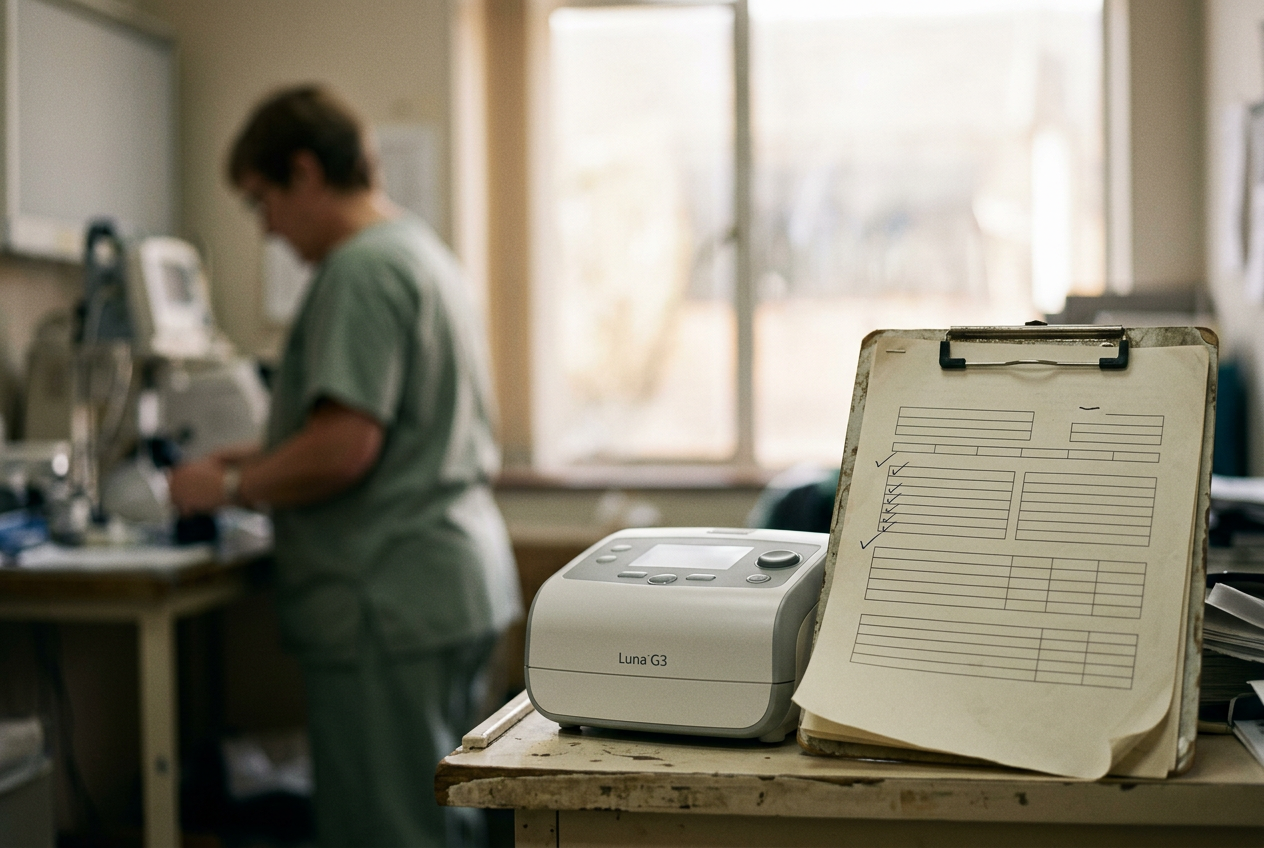
The recall applies to US-distributed Luna G3 automatic positive airway pressure devices, model LG3600, running firmware version G3-2.00.76. The FDA notice identifies BMC Medical Co., Ltd. as the recalling manufacturer and cites a firmware defect as the reason.
This is a firmware-specific action, not a blanket finding that every Luna G3 APAP is affected. Product name or appearance alone is therefore insufficient for determining recall status. Teams need to match the model and firmware version against the FDA notice and the manufacturer’s recall communication, while using serial numbers or other device identifiers to manage individual cases.
The FDA’s Class I designation is its most serious recall category. It indicates a reasonable probability that use of, or exposure to, the affected product will cause serious adverse health consequences or death. That classification describes the potential hazard; it does not mean every affected device has malfunctioned or every user has been harmed.
Nor does the word “recall” necessarily mean every device must be removed from a patient’s home immediately. FDA device recalls can involve correction, inspection, software remediation, replacement, relabeling or physical removal. The action specified in the recall notice and manufacturer communication should determine the response.
Build a reliable device list before contacting patients
Sleep clinics may not hold the firmware data needed to identify affected units. DME suppliers, manufacturers and remote-monitoring platforms may each hold different parts of the record. A practical first step is to establish one shared line list rather than launch broad outreach based only on the Luna G3 name.
| Field | Why it matters | Preferred verification source |
|---|---|---|
| Manufacturer and model | Separates model LG3600 from other PAP devices | Device label or DME asset record |
| Firmware version | Identifies the recalled configuration | Device information screen, service record or validated manufacturer data |
| Serial number | Supports case-level tracking and manufacturer confirmation | Device label and supplier record |
| Current user and status | Distinguishes active, returned, unused and reassigned units | DME dispensing and pickup records |
| Prescribing clinic | Enables clinical review when therapy continuity is a concern | Prescription or referral record |
| Corrective action status | Prevents duplicate outreach and unresolved cases | Shared recall log |
Firmware should be recorded exactly as displayed. Similar-looking version strings should not be treated as equivalent without confirmation. If teams can't obtain firmware information remotely, they can ask the manufacturer or authorized supplier how to retrieve it safely; they should not direct users into service menus or attempt an unofficial software installation.
The working list should also include devices in inventory, loaner pools, repair channels and returned-stock areas. A unit that is not assigned today can still re-enter circulation later unless it is quarantined or its correction status is documented. Conversely, historical billing or dispensing data may include devices that have already been returned and should not trigger unnecessary patient alarm.
Coordinate the response without creating a therapy gap
Once an affected device is confirmed, the manufacturer’s recall instructions should anchor the operational plan. Clinics and DME teams should agree on who will explain the issue, who will arrange the specified correction or replacement, and who will document completion. Patients should not receive conflicting messages from a prescriber, supplier and automated portal.
The clinical question is separate from the technical one. The recall establishes that a device configuration requires action, but decisions about temporary continuation, alternative equipment or interruption depend on the manufacturer’s directions and the patient’s clinical context. Factors relevant to clinician review can include sleep apnea severity, symptoms, cardiovascular or respiratory comorbidity, safety-sensitive work, prior difficulty tolerating alternatives and the expected time to correction.
A Class I label alone should not prompt an improvised instruction to stop positive airway pressure. Abruptly interrupting effective therapy may carry its own risks, while continuing an affected device may expose the user to the defect that prompted the recall. The evidence supports individualized risk management and rapid access to the authorized remedy, not a universal keep-using or stop-using rule beyond the regulator’s and manufacturer’s instructions.
Patient communication should be specific and calm: identify the device and firmware under review, state whether the individual unit has been confirmed as affected, describe the next operational step, and provide a route for reporting malfunction or worsening symptoms. Teams should avoid implying that the recall proves an injury occurred.
A closed-loop record should capture the date of identification, outreach attempts, patient acknowledgment, interim plan, correction or replacement, and final disposition. It should also distinguish technical completion from clinical follow-up. Installing an authorized correction or exchanging hardware closes the device task, but a patient who experienced treatment interruption or symptoms may still need clinical assessment.
What the regulatory record cannot answer
This evidence is a regulatory recall decision, not a randomized trial, cohort study or comparative device evaluation. There is no treatment comparator, effect estimate, confidence interval, p-value or standardized follow-up period to interpret. The number of distributed or recalled devices also should not be read as the number of malfunctions, injuries or exposed patients.
The FDA classification establishes the seriousness of the potential consequence and defines the affected product described in the notice. It does not, by itself, quantify an individual user’s probability of harm. Public recall information may also lag local correction activity, so clinics should reconcile FDA information with dated manufacturer confirmations rather than assume that every listed unit remains uncorrected.
Important operational details can change as a recall proceeds, including affected serial-number ranges, correction availability and return logistics. Teams should preserve the version of each notice used for decision-making and check the FDA record for updates. Document any suspected device-related adverse event through established organizational and regulatory reporting pathways.
Questions clinicians ask
Should every Luna G3 APAP user stop therapy immediately?
No universal stop instruction follows from the Class I designation alone. The appropriate response depends on the FDA and manufacturer instructions for the affected firmware, whether the individual device is confirmed within scope, the availability of a correction or alternative, and the clinical risks of interrupting positive airway pressure.
How can a clinic confirm whether a device is affected?
Confirm the manufacturer, LG3600 model designation and exact firmware version G3-2.00.76, then reconcile the serial number with supplier or manufacturer records. If the firmware cannot be verified through an approved method, the DME supplier or manufacturer should guide identification rather than having the patient attempt a service-level procedure.
Who should own patient follow-up?
The clinic and DME supplier should explicitly assign responsibility. The supplier is often positioned to verify inventory, firmware and correction status, while the clinical team can assess therapy-continuity concerns; one shared tracker should record outreach, interim planning, technical remediation and closure.
Does more than 20,000 recalled devices mean 20,000 injuries?
No. Device count describes the scope of the recall, not the number of malfunctions, injuries or deaths. The FDA’s Class I classification reflects the potential seriousness of the defect, but the public notice does not convert distribution volume into an individual risk estimate.
References
1. BMC Medical Co., Ltd. Recalls Luna G3 APAP Model LG3600 with Firmware G3-2.00.76 Due to Firmware Defect — US Food and Drug Administration, 2026 2. Medical Device Recalls — US Food and Drug Administration, 2026 3. Recalls, Corrections and Removals (Devices) — US Food and Drug Administration, 2026
One story a day
The story of the day, in your inbox
One health journey each morning — no advice, no alarm, just company for the road.