TAVR Reduces Events in At-Risk Moderate Aortic Stenosis
In a randomized trial, TAVR lowered the two-year risk of death or heart-failure hospitalization in patients with moderate aortic stenosis and at-risk features.
 Written and medically reviewed byDr. Abu BakarContributing writer · PharmD, PhD (Pharmacology)
November 8, 2026 · 6 min read
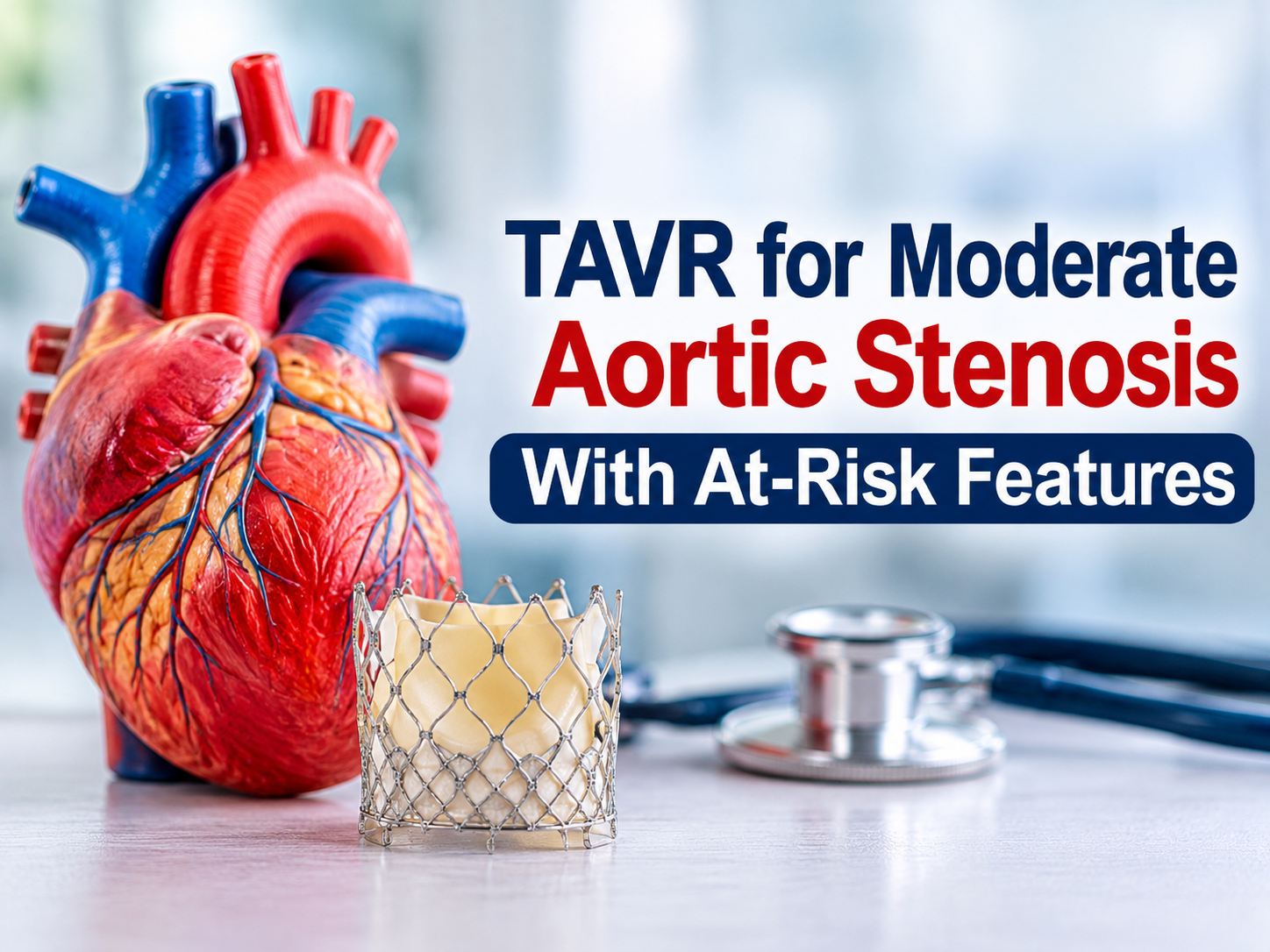
A clinically meaningful reduction in major events
The randomized finding moves the discussion about moderate aortic stenosis beyond observation alone. At two years, the composite of death or hospitalization for heart failure occurred in 16.7% of patients assigned to transcatheter aortic valve replacement, or TAVR, and 23.9% of those assigned to surveillance.
That is a 7.2-percentage-point absolute difference and an approximately 30% crude relative reduction. Expressed as a simple reciprocal of the absolute difference, about 14 patients would need to undergo TAVR rather than surveillance to prevent one composite event over two years. That number is descriptive, not a substitute for the trial’s prespecified time-to-event analysis, confidence interval or assessment of competing risks.
| Two-year outcome | TAVR | Surveillance | Crude difference |
|---|---|---|---|
| Death or heart-failure hospitalization | 16.7% | 23.9% | 7.2 percentage points lower |
The composite matters because both components are consequential, but it does not show by itself whether TAVR reduced mortality, heart-failure admissions or both. Component results, repeat-event analyses and confidence intervals are needed to judge the mechanism and precision of benefit. A composite driven mainly by hospitalization may still be clinically important, although its interpretation differs from a demonstrated survival advantage.
What the randomized comparison establishes
The study compared TAVR with surveillance in patients who had moderate, rather than severe, aortic stenosis and additional at-risk features. Random allocation supports a causal interpretation of the between-group difference, assuming treatment groups were well balanced, follow-up was sufficiently complete and outcomes were analyzed as prespecified.
The supplied primary-source record reports a two-year comparison but does not expose the article-level methods needed to verify the sample size, confidence interval, P value, endpoint adjudication, crossover rate or exact definition of the at-risk population. Those details should be checked in the complete peer-reviewed report before the magnitude and certainty of benefit are incorporated into protocols or coverage decisions.
Surveillance should not be interpreted as therapeutic neglect. In contemporary practice, it generally entails serial clinical and echocardiographic assessment, management of heart failure and other cardiovascular conditions, and valve intervention if a patient progresses to an established indication. The exact surveillance protocol used in this trial, including visit frequency and criteria for later TAVR, is important because crossover can narrow treatment differences while delayed intervention may influence hospitalization risk.
The result also needs to be distinguished from evidence in severe aortic stenosis. US guidelines have traditionally reserved aortic valve replacement for severe disease associated with symptoms, left ventricular systolic dysfunction or other defined indications. Moderate stenosis has generally been followed unless valve surgery is being performed for another reason. This trial directly challenges that watchful-waiting framework only for the narrower population with trial-defined at-risk features.
Who may merit valve-team review
“At risk” is not interchangeable with every patient who has moderate aortic stenosis. The trial’s precise entry criteria are essential for identifying patients to whom the result applies. Until those criteria can be reviewed, the 16.7% versus 23.9% result should not be generalized to asymptomatic patients with stable ventricular function, low near-term event risk or uncertain stenosis severity.
The evidence most reasonably prompts valve-team discussion when moderate aortic stenosis has been confirmed with an integrated echocardiographic assessment and the patient also has objective evidence of vulnerability. In practice, reasons for referral may include heart-failure hospitalization, persistent symptoms despite appropriate treatment, left ventricular systolic dysfunction or adverse remodeling, evidence of cardiac damage, or clinical concern that valve obstruction is materially adding to ventricular load. These are considerations for specialist evaluation, not a reconstruction of the trial’s unreported eligibility list.
Confirmation of severity is particularly important. Discordant valve area, gradient and flow measurements can reflect low-flow physiology, measurement error or severe stenosis that has been misclassified as moderate. A valve team can integrate imaging, hemodynamics, symptoms, ventricular function, frailty, comorbidity and procedural anatomy before deciding whether the randomized population resembles the individual being assessed.
The comparison also changes the balance of the conversation rather than eliminating trade-offs. TAVR can relieve valvular obstruction without open surgery, but it carries risks that may include vascular complications, bleeding, stroke, conduction disturbance requiring permanent pacing, acute kidney injury, paravalvular regurgitation and the need for future valve procedures. The relevant question is whether the expected reduction in death or heart-failure hospitalization exceeds those immediate and longer-term harms for a patient whose stenosis is not yet severe.
For policymakers, the finding is not yet a mandate for broad expansion of TAVR eligibility. Implementation would require a reproducible definition of at-risk moderate disease, evidence that benefit is consistent across prespecified subgroups, procedural safety data, longer follow-up and an assessment of resource use. Expanding intervention without those guardrails could expose lower-risk patients to procedural harm while substantially increasing demand on valve programs.
Important uncertainties before practice broadens
The most immediate limitation is incomplete article-level detail in the supplied source record. The trial’s sample size, statistical precision, individual endpoint components, safety outcomes, missing-data handling, crossover, funding and investigator conflicts cannot be responsibly supplied from the available information. The publication date provided is November 2, 2026, which is prospective relative to the information available for independent verification here.
Generalizability may also be limited by the trial’s definition of at-risk features and selection by participating valve centers. Patients with substantial frailty, advanced noncardiac illness, unfavorable anatomy or limited life expectancy may have been underrepresented. Conversely, patients labeled as having moderate stenosis in routine care may not have undergone the centralized imaging confirmation often used in randomized valve trials.
Two years is enough to detect an early clinical difference but not to resolve valve durability, lifetime management or the consequences of implanting a transcatheter prosthesis earlier in the disease course. These questions are especially relevant for younger patients, who may face coronary-access issues and one or more subsequent valve procedures.
The result is therefore practice-informing rather than universally practice-changing. It supports examining whether selected patients with moderate aortic stenosis and meaningful heart-failure or cardiac-risk features should be assessed earlier by a multidisciplinary valve team. It does not establish TAVR as standard treatment for all moderate aortic stenosis.
Questions clinicians ask
Does this result support TAVR for every symptomatic patient with moderate stenosis?
No. Symptoms may arise from coronary disease, lung disease, arrhythmia, deconditioning or myocardial dysfunction rather than the valve. The result applies to the trial’s at-risk population, so clinicians need the complete eligibility criteria and careful confirmation that moderate aortic stenosis is contributing materially to the patient’s risk.
How large was the benefit at two years?
The composite occurred in 16.7% with TAVR and 23.9% with surveillance, an absolute difference of 7.2 percentage points. The corresponding crude number needed to treat is approximately 14, but confidence intervals and the prespecified time-to-event estimate are required to determine precision.
Should a recent heart-failure admission trigger referral?
A heart-failure admission in a patient with confirmed moderate aortic stenosis is a reasonable prompt for multidisciplinary review, particularly when ventricular dysfunction or ongoing symptoms are present. Referral does not presume intervention; it allows reassessment of stenosis severity, competing causes of decompensation, procedural risk and similarity to the trial population.
What information is still needed before changing pathways?
Clinicians need the trial’s sample size, exact risk-feature definition, component endpoints, safety results, subgroup analyses, crossover and longer follow-up. Programs should also determine whether imaging definitions and patient selection can be reproduced before extending TAVR to a broader moderate-stenosis population.
References
1. TAVR for Moderate Aortic Stenosis With At-Risk Features — The New England Journal of Medicine, 2026 2. 2020 ACC/AHA Guideline for the Management of Patients With Valvular Heart Disease — Circulation, 2021 3. 2021 ESC/EACTS Guidelines for the Management of Valvular Heart Disease — European Heart Journal, 2022
One story a day
The story of the day, in your inbox
One health journey each morning — no advice, no alarm, just company for the road.