AVID Medical Kits Require Class I Saline Quarantine
The Class I correction applies to affected AVID Medical convenience kits containing Huons sodium chloride ampules. Facilities should quarantine stock, trace prior use and assess possible exposures.
 Written and medically reviewed byDr. Abu BakarContributing writer · PharmD, PhD (Pharmacology)
October 21, 2026 · 6 min read
What changed
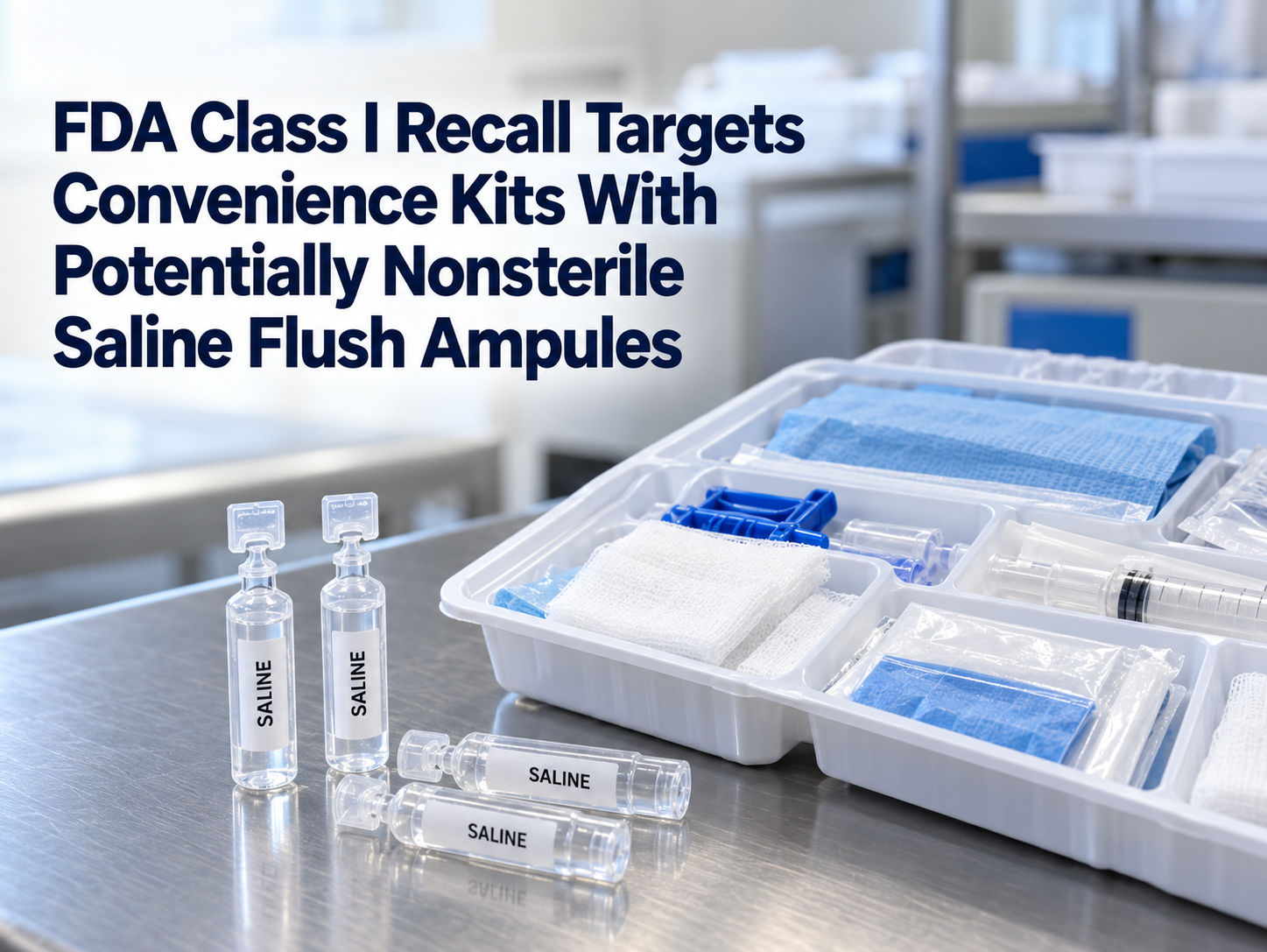
The FDA classified the AVID Medical convenience-kit correction as Class I on September 21, 2026. The affected kits contain sodium chloride ampules made by Huons, and the concern is that their contents may expose patients to microorganisms, endotoxins or foreign matter.
A Class I classification is the FDA’s most serious recall category. It indicates a reasonable probability that use of, or exposure to, the affected product will cause serious adverse health consequences or death. The classification describes the potential severity of harm; it does not establish that every affected ampule is contaminated or that every exposure will cause an adverse event.
The action concerns convenience kits assembled by AVID Medical rather than every sodium chloride product or every AVID kit. Facilities should therefore use the identifiers in the FDA notice and the company’s correction communication—including product descriptions, catalog or kit numbers, lot information and distribution details—to establish the exact scope locally. Similar-looking kits or ampules should not be included or cleared solely by visual comparison.
The term “correction” also matters operationally. In FDA recall terminology, a company may address a problem at the location where a device is used rather than removing every unit from the market. That does not make continued clinical use acceptable. Affected kits should remain segregated until the manufacturer’s authorized instructions establish whether they must be returned, replaced or otherwise handled.
Why the included ampules matter at the bedside
Sodium chloride ampules can enter workflows in which sterility, freedom from pyrogens and absence of visible or microscopic foreign material are essential. The clinical consequences of a compromised ampule depend on how its contents were used, the amount administered, the route and site of exposure, and the patient’s underlying vulnerability.
Microbial contamination can lead to localized or systemic infection. Endotoxins can provoke a pyrogenic or inflammatory response, potentially including fever, chills, hypotension or other acute symptoms even when viable bacteria are not recovered. Foreign material may cause local irritation, inflammation or other injury; the risk varies with the material and route of exposure.
These are potential hazards, not reported incidence estimates. The FDA correction does not function like a clinical study and does not provide a comparison group, effect size, confidence interval or follow-up period. It should prompt risk-based inventory control and exposure review rather than assumptions that harm has occurred in every patient associated with an affected kit.
Immediate inventory and supply-chain response
Facilities should begin with a documented search across central supply, operating rooms, procedure areas, emergency departments, inpatient units, ambulatory sites and off-site storage. The search should include unopened inventory, kits already placed on carts or trays, and partially used kits retained in clinical areas. Electronic inventory records may not capture products transferred manually between departments.
Potentially affected kits should be physically segregated and labeled to prevent use while product identifiers are checked against the FDA and AVID Medical information. Quarantine controls should be strong enough to block restocking, picking and automatic replenishment. Where relevant, barcode, enterprise resource planning and materials-management systems should also be updated so quarantined stock cannot be released inadvertently.
Facilities should not independently open kits, remove the Huons ampule and return the remaining components to service unless written manufacturer instructions explicitly authorize that approach. Local rework could create sterility, labeling, traceability or configuration problems and may not satisfy the correction.
The response should involve supply chain, pharmacy, nursing, procedural leadership, infection prevention, risk management and biomedical or device-safety personnel as appropriate. One accountable team should reconcile quantities received, still on hand, quarantined, previously used, transferred and returned. Any mismatch deserves follow-up because an unlocated kit may have moved to a point of care outside routine inventory channels.
Substitute supplies should be sourced through normal procurement and clinical-governance processes. Staff should verify that replacements meet the intended use and applicable requirements rather than substituting a different concentration, container or presentation based only on availability.
Tracing use and responding to possible exposure
If an affected kit was opened or used, the facility should determine whether the included sodium chloride ampule was actually used. Kit use alone does not prove ampule exposure. Records that may help include procedure documentation, medication administration records, implant or supply logs, operating-room records, charge capture, barcode data and lot-tracking systems.
For a confirmed or plausible exposure, clinicians and infection-prevention teams should assess the route and timing of use, the clinical site, the patient’s current condition and whether symptoms compatible with infection, a pyrogenic reaction or injury from foreign material occurred. Evaluation should follow the patient’s presentation and established clinical protocols. The FDA action alone does not support automatic antimicrobial treatment, laboratory testing or recall of every patient associated with an affected kit.
Facilities should preserve the kit, ampule or packaging when available and permitted by local policy, because product identifiers and remaining material may be important for investigation. Suspected adverse events and product-quality problems can be reported through FDA MedWatch, alongside any reporting requested by AVID Medical. Internal safety-event and infection-surveillance channels may also be appropriate.
Patient notification decisions should be individualized through infection prevention, clinical leadership, risk management and applicable public-health or regulatory processes. Relevant considerations include confirmation that the ampule was used, route of exposure, evidence of compromised product, time since use, symptoms and whether meaningful monitoring or intervention is available.
What the notice cannot establish
This evidence base is a regulatory correction, not a controlled investigation. It does not estimate the frequency of contaminated ampules, quantify absolute patient risk or establish that a particular infection or inflammatory event was caused by the product. No comparator, confidence interval, statistical test or standardized follow-up period is available.
The available information also may not answer whether risk is uniform across all listed lots, whether contamination can be detected visually, or how many exposed patients experienced harm. Facilities should avoid using the absence of visible particles, package damage or immediate symptoms to clear an affected ampule. Conversely, temporal proximity between use and illness is not by itself proof of causation.
Questions clinicians ask
Does every AVID Medical convenience kit need to be quarantined?
No. The correction applies to affected kit configurations containing the implicated Huons sodium chloride ampules. Match local stock against the identifiers and distribution information in the FDA notice and manufacturer communication; quarantine uncertain inventory until its status is confirmed rather than clearing it by appearance.
Should every patient linked to an affected kit be tested?
The FDA action does not support automatic testing solely because a kit appears in a procedure or supply record. First determine whether the ampule was used, then assess the route, timing, symptoms and patient risk factors with infection-prevention and clinical teams. Testing should be driven by the exposure assessment and clinical presentation.
Can staff remove the saline ampule and use the rest of the kit?
Not unless AVID Medical’s written correction instructions specifically authorize that action. Opening or reconfiguring a convenience kit can affect sterility, labeling and traceability. Keep the entire affected kit quarantined until the manufacturer’s directions establish how it should be corrected, returned or replaced.
What should be reported to the FDA?
Clinicians and facilities can submit suspected adverse events and product-quality problems through MedWatch. Reports should include available product identifiers, the way the ampule was used, timing, clinical findings and patient outcome, while following privacy requirements. Reporting a suspected event does not establish that the product caused it.
References
- Convenience Kit Correction: AVID Medical Issues Correction for Kits Containing Huons Sodium Chloride — US Food and Drug Administration, 2026
- Medical Device Recalls — US Food and Drug Administration, 2026
- Medical Device Reporting: How to Report Medical Device Problems — US Food and Drug Administration, 2026
One story a day
The story of the day, in your inbox
One health journey each morning — no advice, no alarm, just company for the road.