FDA Class I Recall: CooperSurgical Removes INCA Infant Nasal CPAP Sets
An FDA Class I recall covers specified CooperSurgical INCA infant nasal CPAP set lots because tubing-to-cannula connections may loosen and interrupt respiratory support.
 Written and medically reviewed byDr. Abu BakarContributing writer · PharmD, PhD (Pharmacology)
October 21, 2026 · 6 min read
What the FDA action covers
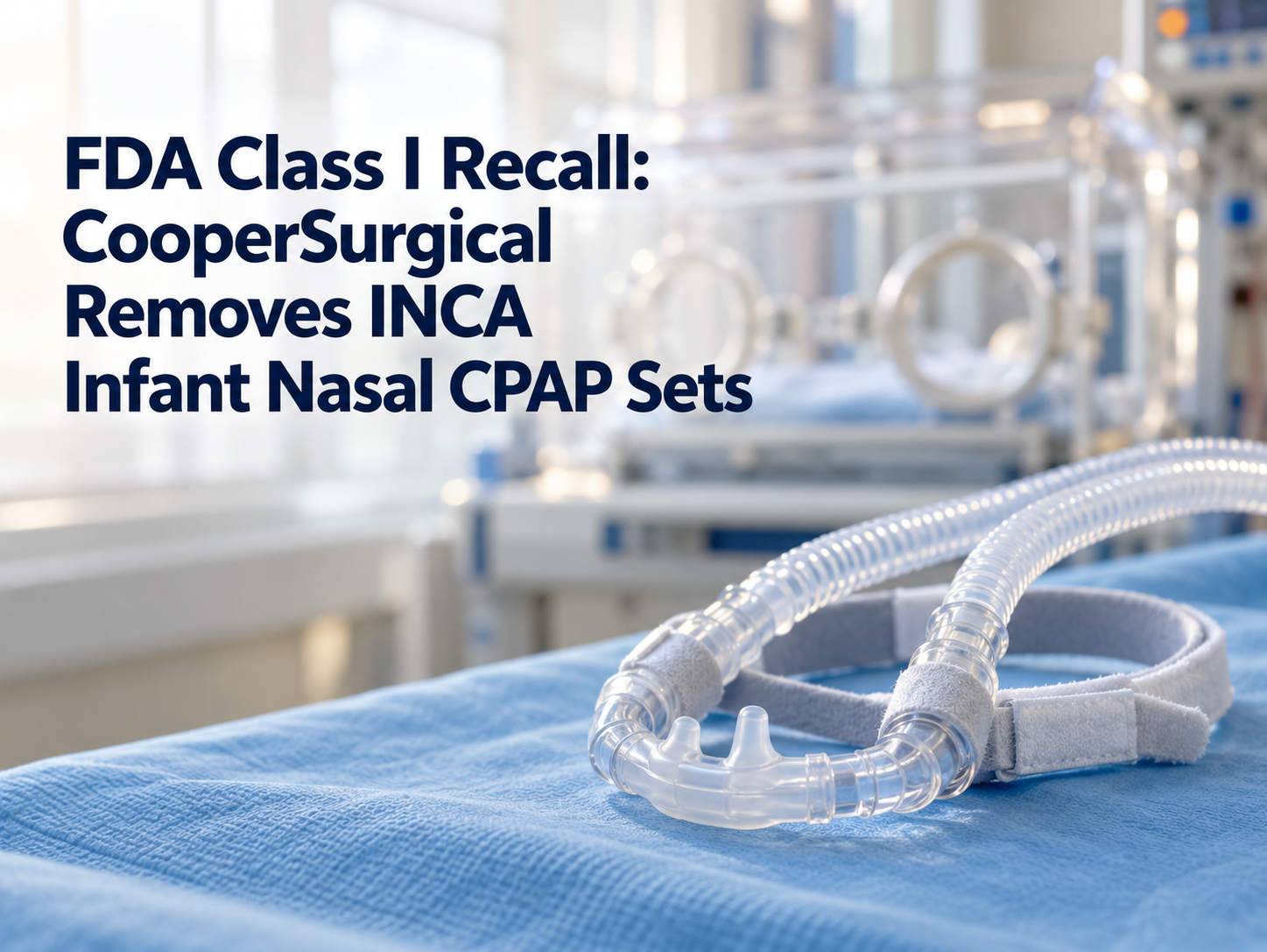
The FDA classified CooperSurgical’s removal of specified INCA infant nasal continuous positive airway pressure sets as a Class I recall in its September 18, 2026 notice. The concern is that the connection between the breathing tubing and nasal cannula may loosen, potentially reducing or interrupting the pressure and gas flow intended to support an infant’s breathing.
This is not a recall of every CPAP interface or every INCA product by name alone. Services need to compare the catalog, lot and other identifying information on their packaging with the affected products listed in the FDA notice and CooperSurgical’s communication. A visual check of the device type is not an adequate substitute for lot-level verification.
The FDA uses Class I for recalls in which exposure to the affected product presents a reasonable probability of serious adverse health consequences or death. That classification describes the potential severity of the hazard; it does not, by itself, establish how often the connection loosens or show that every affected set will fail.
Why a loose connection matters at the bedside
Infant nasal CPAP depends on a functioning circuit and interface to deliver distending pressure. If the tubing-to-cannula junction becomes loose or separates, delivered support may fall even if the flow source remains active. The clinical effect will depend on the degree and duration of the leak, the infant’s underlying respiratory reserve, alarm performance and how quickly staff recognize the problem.
Possible bedside signals include a loss of measured or expected pressure, an unexpected increase in leak, changes in circuit sound, visible movement at the junction, falling oxygen saturation, increased oxygen requirement, apnea, bradycardia or greater work of breathing. These signs are not specific to this recall. Cannula displacement, mouth leak, circuit obstruction, pneumothorax and progression of lung disease may produce overlapping findings and require clinical assessment.
The risk extends beyond the NICU. INCA sets may be held in labor and delivery areas, operating rooms used for cesarean births, newborn stabilization spaces, special care nurseries, emergency departments, transport equipment or respiratory therapy stores. Maternity services should therefore be included in the recall response rather than assuming the inventory is confined to neonatal intensive care.
A service-level response to affected lots
Recall management should start with a centralized, documented inventory search. Materials management, respiratory therapy, biomedical or clinical engineering, neonatal leadership, maternity leadership and risk or quality teams may each hold part of the relevant information. Electronic purchasing records can narrow the search, but physical checks remain important because sets may have moved into procedure carts, transport bags, satellite stores or bedside supplies.
Unused packages that match the FDA-listed identifiers should be segregated from available stock and clearly labeled to prevent inadvertent issue. Services should retain the packaging and product identifiers needed for traceability and follow CooperSurgical’s instructions for return, replacement or other disposition. They should not rely solely on shelf location, packaging color or staff familiarity with the product.
For an affected set already in use, the immediate priority is continuity of respiratory support. A trained team should plan the transition to an unaffected, compatible interface or respiratory support system under the manufacturer’s instructions and local neonatal protocol. Removing a set without a ready alternative could itself expose a dependent infant to loss of support.
During any change, the team should be prepared to maintain oxygenation and ventilation using the unit’s established backup pathway. Monitoring should continue through the transition, with confirmation that the replacement circuit is assembled correctly, the interface is secure and the intended pressure or support is being delivered. Compatibility should not be assumed merely because components appear to fit.
Units should also consider whether local alarms and observation practices are sufficient to detect loss of delivered support promptly. This does not mean creating unvalidated alarm limits or modifying the recalled connector. Tape, adhesives, improvised clamps or nonstandard component combinations could obscure a problem, damage the device or introduce a different hazard unless explicitly authorized by the manufacturer.
Documentation, communication and reporting
The response should produce a traceable record of where affected lots were found, whether any were used, how remaining stock was quarantined and how replacement devices were supplied. Shift-to-shift communication matters while the search is underway, particularly when respiratory equipment is assembled away from the bedside or moved between maternity, nursery and transport settings.
If loosening or separation is suspected during use, staff should preserve the device and packaging when feasible, document the product and lot identifiers, and record the clinical circumstances without delaying care. The event should enter the organization’s device-safety and incident-review processes. Reports to the manufacturer and FDA MedWatch can help regulators identify patterns that may not be visible from an individual institution.
Hospitals should distinguish recall completion from clinical review. Removing unused inventory addresses future exposure, but it does not determine whether an earlier episode of unexpected support loss involved the recalled connection. A focused review may be reasonable when records show an affected lot was used and there was an unexplained circuit disconnection or abrupt deterioration.
What the notice cannot establish
This evidence is a regulatory recall notice, not a controlled clinical study or prospective surveillance cohort. It does not provide a comparator group, an effect estimate with a confidence interval, or follow-up data from a defined infant population. It therefore cannot quantify an individual infant’s probability of harm or establish that a recalled connection caused a particular clinical event.
Public recall information may also be updated as distribution, lot or corrective-action details are refined. Services should use the current FDA notice and manufacturer communication when reconciling inventory rather than relying on a printed summary or an internal email that may become outdated. Local findings should not be generalized to unaffected lots without supporting evidence.
Questions clinicians ask
Does the recall mean all INCA infant nasal CPAP sets must be removed?
No. The FDA action applies to the product identifiers and lots specified in the recall notice. Staff should match package information against the current FDA and manufacturer lists; the INCA name or a visual resemblance alone does not establish that a set is affected.
What should happen if an affected set is already supporting an infant?
The infant should not be left without respiratory support simply to remove the recalled device. A trained team should arrange an orderly transition to an unaffected, compatible system, maintain monitoring and backup support, and verify effective pressure delivery after the change under local protocols and manufacturer instructions.
Can staff secure the connection with tape or another improvised method?
An improvised fix should not replace the manufacturer’s recall action. Tape, clamps or unapproved component combinations may conceal separation, damage the circuit or alter performance. Services should use unaffected compatible equipment and follow the FDA and CooperSurgical instructions rather than create a local connector modification.
When should a suspected failure be reported?
Suspected loosening, separation or loss of support involving an affected device should enter the hospital’s safety process and be reported to the manufacturer and FDA as appropriate. Preserve the set and identifying packaging when feasible, but do not delay stabilization or replacement of respiratory support to collect device information.
References
1. Ventilator Recall: CooperSurgical Removes INCA Infant Nasal CPAP Sets — U.S. Food and Drug Administration, 2026 2. Medical Device Recalls — U.S. Food and Drug Administration, n.d. 3. MedWatch: The FDA Safety Information and Adverse Event Reporting Program — U.S. Food and Drug Administration, n.d.
One story a day
The story of the day, in your inbox
One health journey each morning — no advice, no alarm, just company for the road.