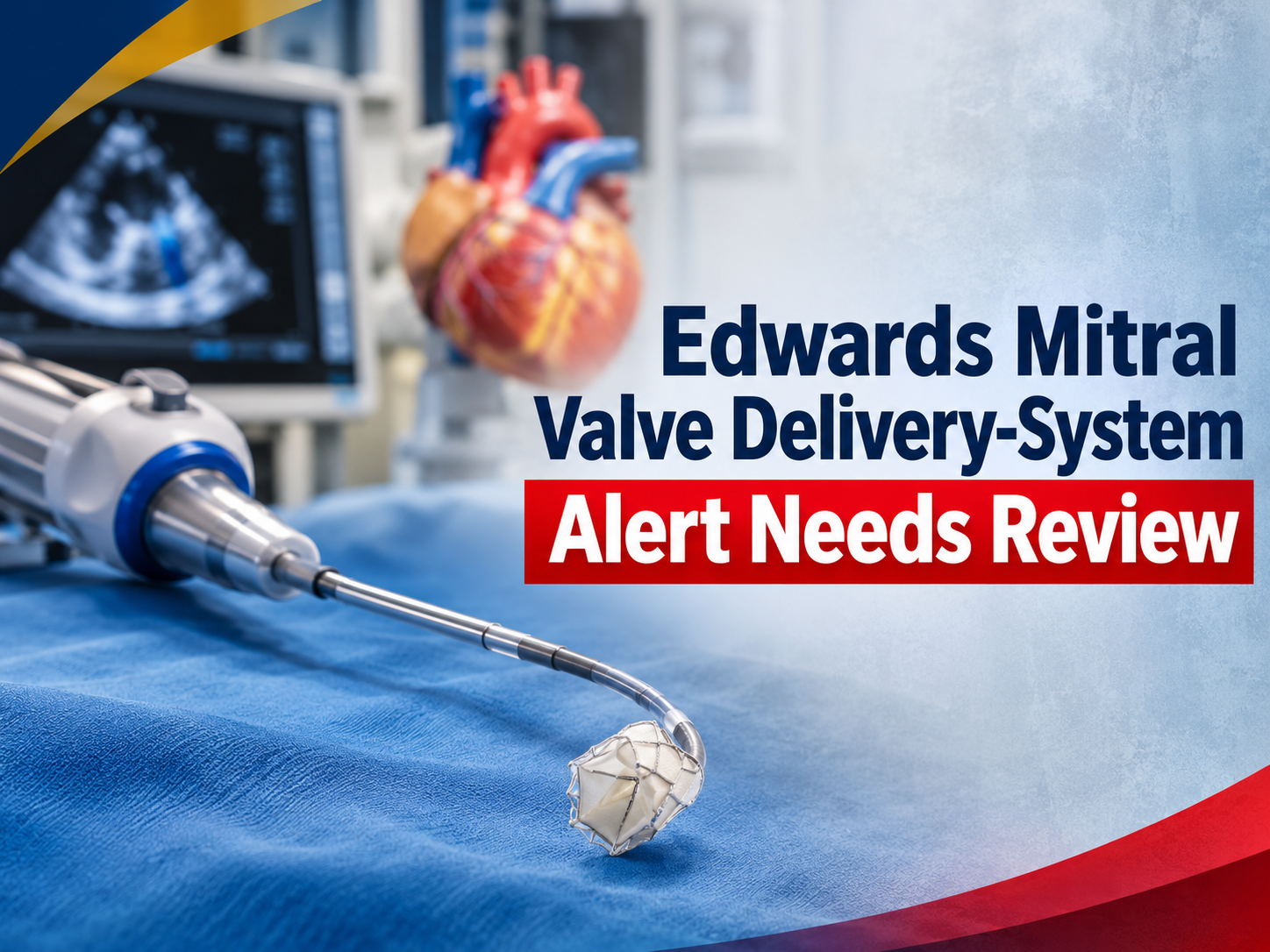
FDA Flags Edwards Mitral Delivery-System Safety Issue
An FDA early alert concerns an Edwards transcatheter mitral-valve delivery system, but key scope and response details remain unavailable to structural-heart teams.
 Written and medically reviewed byRayan SalihContributing writer · PharmD, RPh
November 5, 2026 · 6 min read
What the early alert establishes
The FDA medical-device safety listing dated October 15, 2026, flags an issue involving an Edwards transcatheter mitral-valve delivery system. That establishes a regulatory safety signal requiring attention from structural-heart programs, catheterization laboratories, operating rooms, supply-chain teams and risk-management staff that may handle the system.
The available record does not identify a specific model, catalog number or other affected-device scope. It also does not provide an event count or describe a corrective action. Those omissions matter: without a device identifier, teams cannot reliably determine which inventory or prior cases fall within scope; without event and denominator data, they cannot estimate frequency; and without instructions, they cannot know whether the expected response is inspection, updated handling, software or labeling changes, return, quarantine or another measure.
The wording also points to the delivery system rather than necessarily to the implanted mitral valve itself. Preserve that distinction in clinical communication. The alert alone does not establish a defect in every system, a problem with every implanted valve or a need for patient intervention.
| Information field | Status in the available record |
|---|---|
| Manufacturer | Edwards |
| Device category | Transcatheter mitral-valve delivery system |
| Specific model or catalog number | Not identified |
| Number of events | Not reported |
| Event rate or denominator | Not reported |
| Corrective action | Not identified |
Why the missing identifiers matter
Transcatheter valve procedures depend on multiple components that may have separate model numbers, lot numbers, expiration dates and instructions for use. A broad product description is therefore insufficient for matching an alert to local stock. A delivery-system issue could also arise at different stages—preparation, advancement, deployment or withdrawal—but the available record does not support a conclusion about mechanism or procedural timing.
This is a regulatory early alert, not a comparative clinical study. There is no defined patient population or sample size, no comparator, no reported effect estimate or confidence interval, and no follow-up period. It cannot quantify excess risk or establish causation. Even if a later communication reports a case count, that number would not provide an incidence rate without a credible denominator and information about exposure, reporting completeness and case adjudication.
An early alert also should not automatically be treated as a recall. FDA recall communications generally identify affected products and describe the firm’s or regulator’s recommended response. The available listing does not allow teams to infer whether a recall classification, field correction or other formal action will follow.
A measured response for structural-heart programs
The immediate operational priority is traceability. Programs can confirm which Edwards transcatheter mitral-valve delivery systems they stock or have recently used, while recording exact model, catalog, lot and serial information from packaging, inventory systems and procedure documentation. This is preparatory reconciliation, not a conclusion that those products are affected.
Teams should designate responsibility for reviewing subsequent FDA notices and direct manufacturer communications. Updates may reach purchasing, biomedical engineering, the catheterization laboratory, the operating room or a health system’s recall coordinator through different channels. A centralized review reduces the risk that clinically important instructions remain isolated in one department.
Procedure changes should be tied to authoritative, product-specific information. The present record does not support a universal decision to cancel cases, quarantine all Edwards mitral products, alter implantation technique or initiate surveillance of every previously treated patient. Conversely, the absence of detail should not be interpreted as reassurance that no action will be needed. Local policies for unresolved device-safety signals remain relevant while clarification is pending.
If clinicians encounter a suspected malfunction or adverse event, they should preserve the device and packaging when feasible under institutional policy, document relevant identifiers and procedural details, and route the event through established safety-reporting channels. FDA’s MedWatch program accepts reports involving serious problems with medical products. Reporting should describe what occurred without assuming a causal relationship that has not been established.
Communication with patients should remain factual and individualized. The alert by itself does not define a clinical risk for recipients of an implanted valve, and it does not supply criteria for imaging, reintervention or explantation. If later instructions identify a patient-facing concern, programs will need to translate the affected-device scope into case-level records before outreach.
What remains unresolved
The central unknowns are the exact delivery-system model, the nature and severity of the reported issue, the number of events, the number of systems used, affected manufacturing dates or lots, and the action expected from health care facilities. It is also unclear from the available record whether the concern applies to unused inventory, systems used during prior procedures or both.
These gaps are the principal limitation of this assessment. The source is an FDA safety listing rather than a detailed safety communication, recall notice, investigation report or peer-reviewed analysis. It supports awareness and verification, but not estimates of incidence, comparative risk or patient outcomes. Conclusions should be revised when the FDA or Edwards publishes product-specific instructions.
Questions clinicians ask
Should our program postpone transcatheter mitral procedures?
The available alert does not provide enough information to support a blanket postponement. Programs should promptly identify the exact delivery systems planned for use and check for product-specific FDA or manufacturer instructions, while applying their usual device-safety and escalation policies if uncertainty remains before a scheduled case.
Should all Edwards mitral delivery systems be quarantined?
The record does not identify an affected model, lot or corrective action, so it cannot define the inventory that would require quarantine. Supply-chain and procedural teams can reconcile identifiers now, but any hold, return or inspection process should follow a verified notice or the health system’s policy for unresolved safety concerns.
Do previously treated patients need additional surveillance?
The alert alone does not establish a problem with implanted valves or provide criteria for additional imaging, visits or intervention. Patient-level action would require clarification of the failure mode, affected systems, dates of use and potential clinical consequences, followed by matching those details to procedure records.
What should we document if a malfunction is suspected?
Record the device and delivery-system identifiers, procedural stage, observed behavior, patient consequences and actions taken. Preserve packaging or equipment when feasible under local policy, notify the appropriate institutional safety teams, and use established FDA and manufacturer reporting pathways without presenting temporal association as proof of causation.
References
1. Edwards Transcatheter Mitral-Valve Delivery-System Early Alert — U.S. Food and Drug Administration, 2026 2. Medical Device Recalls — U.S. Food and Drug Administration, n.d. 3. MedWatch: The FDA Safety Information and Adverse Event Reporting Program — U.S. Food and Drug Administration, n.d.
One story a day
The story of the day, in your inbox
One health journey each morning — no advice, no alarm, just company for the road.