Impella Controller Recall: Immediate Cath Lab Checks
Cardiac procedural teams should reconcile every automated Impella controller against the FDA-listed removal, including units in use, storage, transport kits and biomedical engineering custody.
 Written and medically reviewed byRayan SalihContributing writer · PharmD, RPh
November 11, 2026 · 7 min read
What the FDA listing changes
The FDA device safety record supplied for this brief, dated August 26, 2026, identifies an Abiomed removal involving automated Impella controllers. For cardiac procedural teams, the immediate issue is not simply whether the institution owns an Impella system. It is whether each individual controller matches the identifiers and scope in the current recall communication.
A recall or removal does not by itself establish that every controller bearing the product name is affected. Scope may depend on model, catalog or part number, serial-number range, manufacturing or distribution dates, software version, configuration, or another identifier specified by the manufacturer and FDA. Teams should therefore avoid relying on appearance, acquisition date, informal staff recollection, or the fact that a controller has recently functioned normally.
The controlling documents are the FDA notice and Abiomed’s customer communication. Those materials should determine whether affected devices must be removed, corrected, inspected, updated, relabeled, returned, or managed through another specified action. The supplied FDA page does not support adding assumptions about the failure mechanism, recall classification, event count, or patient risk beyond the information stated in the applicable notice.
Build a complete controller inventory
The first operational question is whether the inventory is complete enough to determine affected versus unaffected. A list limited to the catheterization laboratory’s equipment room can miss controllers assigned to cardiac intensive care, operating rooms, emergency departments, perfusion services, transport teams, training areas, loaner pools, off-site campuses, or biomedical engineering.
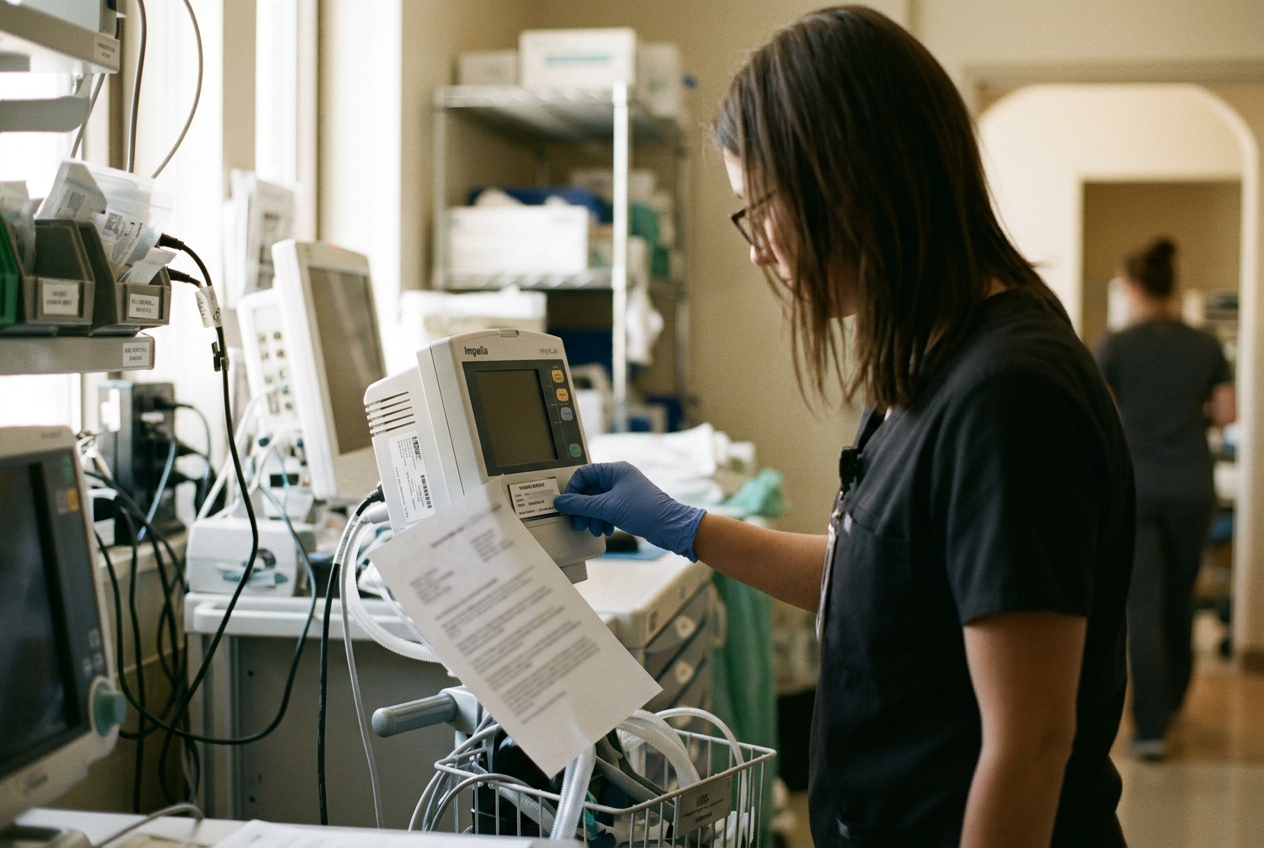
Each physical controller should match a unique record. At minimum, teams need the product name, model or part number, serial number, software version (if relevant), current location, service status, ownership status, and the person or department responsible. Photographs of identification labels can help resolve transcription errors, but enter the verified identifier into the recall record rather than leaving it only in an email or image.
Ownership also requires clarification. A controller may be hospital-owned, leased, consigned, temporarily loaned, supplied as a replacement, or awaiting return. The institution should establish who received the manufacturer’s notice and whether distributors, service contractors, or affiliated facilities maintain separate records. A device can be physically present without appearing in the local capital-equipment database.
The reconciliation should produce a clear disposition for every controller:
| Inventory finding | Operational question to resolve | Documentation needed |
|---|---|---|
| Identifier matches the notice | What action and timeframe does the manufacturer require? | Match record, location, status and completed action |
| Identifier does not match | Was exclusion confirmed using the current notice? | Verified identifiers and reviewer |
| Identifier is missing or unreadable | Can biomedical engineering or Abiomed confirm status? | Escalation record and temporary controls |
| Controller cannot be located | Where was it last used, serviced, transferred or shipped? | Search trail and final disposition |
| Loaner or replacement unit | Is it independently within the affected scope? | Supplier, identifiers and acceptance check |
Protect active support and procedural readiness
An affected controller already supporting a patient presents a different problem from one sitting unused in storage. The team must first identify whether the manufacturer’s communication distinguishes between active use and devices available for future use. Abruptly disconnecting or exchanging circulatory support equipment without a patient-specific plan can introduce risk; continued use may also carry risk if the recall identifies a performance problem. Consider the notice, device instructions, institutional escalation pathway, and clinical judgment together.
For occupied units, the bedside record should identify the controller, the supported pump configuration, the patient’s location, the responsible clinical service, and the backup plan. Appropriate escalation may involve interventional cardiology, advanced heart failure, cardiac surgery, critical care, perfusion, nursing, biomedical engineering, risk management, and the manufacturer’s clinical support channel. The exact participants will depend on local organization and the action described in the recall.
For unoccupied affected units, teams should prevent unintended selection while preserving the device and its identifiers for the required action. Any quarantine process should be conspicuous, controlled and documented. A label alone may be insufficient if the controller remains visible in a ready-equipment area or can be moved during an emergency.
Procedural readiness requires a separate capacity review. Removing controllers from circulation can reduce the number available for scheduled high-risk percutaneous coronary intervention, cardiogenic shock response, transfers, or backup. The cath lab should determine how many verified unaffected or corrected controllers remain, where they are, whether required accessories are available, and whether staff know how to obtain them after hours. Scheduling and emergency pathways may need reassessment if capacity falls below the institution’s usual contingency level.
Replacement equipment should not be presumed unaffected. Every loaner, exchanged, repaired, or newly delivered controller needs an acceptance check against the recall criteria before deployment. Verify software version and correction status when those elements are part of the manufacturer’s action.
Close the communication and reporting gaps
Recall management is incomplete until the institution can show the notice reached everyone who selects, maintains, transports, or oversees the equipment. That may include physicians, advanced practice clinicians, nurses, technologists, perfusionists, biomedical engineers, materials management, transfer centers and administrators responsible for procedural capacity.
Communication should state which controllers are affected, which remain available, where verified units are located, and whom to contact when an identifier is uncertain. It should not paraphrase technical criteria in a way that changes their meaning. Teams should retain the original manufacturer communication and record the version or date used for reconciliation because safety instructions may be updated.
The FDA explains that medical-device recalls may involve a correction or removal and that firms generally initiate the action, with FDA oversight. Institutions should document receipt of the notice, inventory reconciliation, acknowledgment to the manufacturer when requested, device disposition, correction or return, and final closure. A closed purchase order or shipping receipt alone does not establish that every unit was addressed.
Suspected malfunctions, injuries, or deaths should move through the institution’s device-event process. FDA’s MedWatch program provides a route for voluntary reporting by health professionals and consumers, while federal requirements may impose mandatory reporting obligations on device user facilities and manufacturers. The manufacturer’s recall response and adverse-event reporting are related but distinct workflows; completing one does not necessarily complete the other.
What remains uncertain
This is a regulatory safety action, not a comparative clinical study. There is no study population, comparator, effect estimate, confidence interval, or follow-up period to interpret. The FDA listing supplied here does not, by itself, establish the frequency of controller failure or quantify the balance between continued use and exchange during active support.
The exact affected identifiers, technical problem, recall classification, required action, and completion deadlines must come from current FDA and manufacturer materials. Local teams should also account for inventory changes after the first review. A one-time count can become obsolete as controllers are transferred, serviced, replaced, or returned.
Questions clinicians ask
Does the recall mean every automated Impella controller must be removed?
Not necessarily. FDA recalls can apply to defined models, lots, serial numbers, software versions, or distribution periods, and they may require correction rather than physical removal. Each controller should be checked against the precise identifiers and instructions in the current FDA notice and Abiomed communication.
What should happen if an affected controller is supporting a patient?
Confirm the device identifier and escalate through the clinical and technical teams specified by local policy and the manufacturer’s notice. The FDA listing alone does not justify an improvised exchange or disconnection; the risks of the identified issue and of changing active circulatory support require a patient-specific plan.
How should a controller with an unreadable serial number be handled?
Do not classify it as unaffected based on appearance or apparent age. Prevent unintended deployment when clinically feasible, preserve all available identifying information, and ask biomedical engineering or Abiomed to establish its status under the recall criteria and document the determination.
When is the institutional recall response complete?
Closure requires more than notifying the cath lab. Every controller must have a documented match decision and disposition; required corrections or returns must be verified; affected services must receive updated availability information; and any reportable device events must follow the appropriate institutional, manufacturer, and FDA pathways.
References
1. Abiomed Removes Automated Impella Controllers — U.S. Food and Drug Administration, 2026 2. MedWatch: The FDA Safety Information and Adverse Event Reporting Program — U.S. Food and Drug Administration, 2026
One story a day
The story of the day, in your inbox
One health journey each morning — no advice, no alarm, just company for the road.